 Ferndale Siding
 Siding Built for Lynden's Corner of Whatcom County
Lynden sits inland from the coast, but that doesn't spare it from the weather patterns that define this part of Washington. Whatcom County's climate is shaped by marine air moving in off the water, funneling moist, salt-tinged air across the lowlands even miles from the shoreline. Combine that with the long, wet stretch from October through April and the shade cover common on Lynden's tree-lined lots, and you get a recipe that's tough on exterior building materials. Siding here doesn't just get rained on — it stays damp for days at a time, gets colonized by moss and algae, and cycles through freeze-thaw swings that most siding products were never engineered to handle long-term.
We're based out of Ferndale and work throughout Whatcom County, and Lynden is a regular part of our service area. That matters more than it sounds like it should. A crew that only shows up for one job learns nothing about how a house performs here over five or ten years. A crew that works this area consistently starts to recognize patterns — which exposures fail first, which details always get skipped by production-builder trim work, which products hold up and which ones quietly don't.
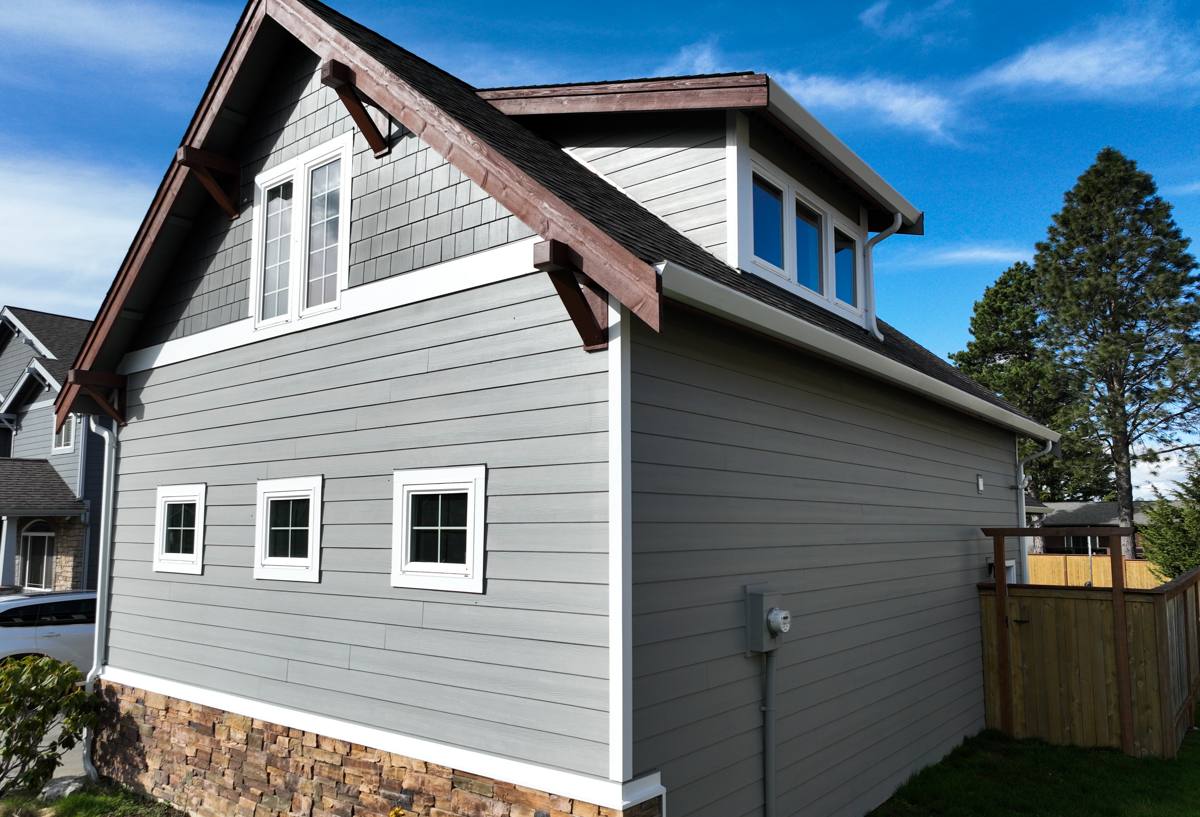
What Whatcom County Weather Actually Does to a House
Moisture That Doesn't Let Up
The Pacific Northwest doesn't get the heaviest annual rainfall in the country, but it gets some of the most persistent. Long stretches of drizzle and overcast days mean siding, trim, and roofing surfaces stay wet far longer per rain event than they would in a drier climate with the same rainfall total. Materials that absorb moisture — or that let water behind them without a way to dry out — are working against the clock here in a way they aren't in Arizona or Texas.
Moss, Algae, and the Shade Problem
Lynden's mix of mature trees and long wet season creates ideal conditions for moss and algae growth on north-facing walls, under eaves, and anywhere airflow is limited. This isn't just cosmetic. Moss holds moisture against a surface, and on materials that aren't dimensionally stable or that swell when wet, that sustained dampness accelerates rot, delamination, and paint failure.
Temperature Swings and Material Movement
Whatcom County isn't extreme, but it does see real freeze-thaw cycling in winter and warm, dry stretches in summer. Siding materials that expand and contract significantly with temperature and moisture — wood-based composites in particular — are more prone to joint gaps, buckling, and finish cracking over time than materials engineered for dimensional stability.
Why We Install Only James Hardie Fiber Cement
We made a deliberate decision as a company: we install James Hardie fiber cement siding, and nothing else. Not vinyl, not LP SmartSide, not Cemplank or Allura, not primed spruce or cedar. That's not a marketing gimmick — it's a standard we hold because of what we've seen this climate do to alternatives, and what fiber cement gets right that they don't.
Vinyl siding is inexpensive and low-maintenance in the sense that it doesn't need painting, but it's a thin plastic product that becomes brittle with age and UV exposure, doesn't stand up well to impact, and can't be repaired invisibly — a cracked panel means a new panel, and color-matching an older run is often impossible. Engineered wood products like LP SmartSide use real wood strand technology with a resin binder, which is a genuine improvement over old-school hardboard siding, but it's still a wood-based product at its core: it can swell, delaminate, or take on moisture damage at cut edges and butt joints if installation and caulking aren't maintained exactly to spec, in exactly the kind of wet, shaded conditions common around Lynden. Primed wood siding — spruce, cedar, and similar species — requires the most diligent maintenance of all: regular repainting, caulk inspection, and vigilance against rot, especially in a climate that doesn't give wood much chance to dry out between storms.
James Hardie fiber cement is cement, sand, and cellulose fiber, cured into a rigid board that doesn't burn, doesn't rot, and doesn't attract insects. It's dimensionally stable across temperature and humidity swings, which means tighter joints and fewer finish problems over the years. Hardie's ColorPlus finish is baked on at the factory under controlled conditions, rather than site-applied paint that depends on weather and technique on installation day. And Hardie backs its products with a strong transferable warranty — one that assumes the product is going to be on that house for decades, not repainted and patched along the way.
The Hardie Product Lines We Work With
James Hardie makes several siding profiles and product lines, and part of doing this job right is matching the right one to the house and its exposure.
| Product | Profile | Best Fit |
|---|---|---|
| HardiePlank | Lap siding, several reveal widths | Most common choice for full re-sides; traditional or modern look |
| HardiePanel | Vertical panel | Board-and-batten look, accent walls, modern facades |
| HardieShingle | Staggered or straight-edge shingle | Craftsman and cottage-style homes, gable accents |
| HardieTrim | Fascia, corner boards, window trim | Rot-proof trim to match the siding system |
For our region, we typically spec Hardie's HZ5 climate zone engineering, which is formulated for the freeze-thaw and moisture conditions found in the Pacific Northwest, as opposed to the HZ10 formulation built for hot, humid southern climates. That distinction matters — it's part of why "fiber cement" as a category isn't a single product with one performance profile, and why installer knowledge of climate zone matching is worth asking about.
Beyond Siding: Roofing, Windows, and Decks
Siding doesn't work in isolation. Water management on a house is a system — roof, flashing, windows, siding, and decks all have to work together to keep water out and let the structure dry when it does get wet. We handle all four on Lynden homes:
- Roofing: Roof condition and flashing details directly affect how water moves down a wall and behind trim — a siding job on a failing roof is fixing the wrong problem first.
- Windows: Window flashing and integration with the siding plane is one of the most common failure points we find on older homes; replacing siding is a natural time to correct it.
- Decks: Decks take even more direct weather exposure than walls do, and rot at ledger boards and posts is a frequent, serious issue in this climate.
Being able to look at a house's full exterior envelope — not just the wall cladding — lets us flag problems a siding-only crew might miss or work around instead of fixing.
What a Local Crew Brings to a Lynden Project
There's a practical case for hiring a contractor based nearby, and it's not sentimental. A crew working regularly in Whatcom County knows the local permitting process, has an established relationship with area building departments, and isn't guessing at how a product will hold up here — they've already seen it on other houses in similar conditions. Response time matters too: if a weather event causes damage or a warranty question comes up years later, a company still operating in the area is a very different proposition than a traveling crew that moved on after the job.
Planning a Siding Project: What Drives Cost
Every house is different, but a few factors consistently move the price on a siding project more than anything else:
| Factor | Why It Matters |
|---|---|
| House size and wall complexity | More corners, dormers, and cutouts mean more labor and material waste |
| Existing siding removal | Tear-off of old material, especially if it conceals rot, adds time |
| Substrate repair | Rotted sheathing or framing found underneath must be fixed before new siding goes on |
| Trim and detail work | Custom trim, window casing, and accent profiles add labor |
| Product line and color | ColorPlus factory finishes and certain profiles cost more than base options |
We won't quote a number without seeing the house, but we can walk through these factors on-site and explain what's driving the estimate before any work starts.
Signs Your Siding Needs Attention
A few warning signs are worth acting on before they turn into structural repairs:
- Soft or spongy spots when you press on the siding, especially near the bottom courses
- Persistent moss or dark staining that keeps returning after cleaning
- Visible gaps, warping, or buckling at panel joints
- Peeling or bubbling paint, particularly on wood-based siding
- Rising energy bills that might point to compromised insulation behind failing siding
- Cracked or missing caulk at trim, window, and corner joints
Any one of these is worth a look. Several at once usually means it's time for a real evaluation rather than another round of patching.
What to Expect When You Work With Us
We start with an on-site walkthrough to assess the current siding, look for underlying damage, and talk through what you're trying to accomplish — whether that's a full re-side, storm repair, or tackling siding alongside roofing, windows, or a deck. From there we put together a clear, itemized estimate before any work begins, using James Hardie products matched to your home's exposure and the Whatcom County climate. We handle removal, any substrate repair we uncover, and installation to Hardie's specifications, because correct installation is what makes the warranty and the performance real — fiber cement installed wrong loses most of its advantage.
If you're in Lynden and thinking about siding, roofing, windows, or a deck project, we're happy to come take a look and put together a free, no-pressure estimate. There's no obligation, and it's the fastest way to get real numbers instead of guesswork.