 Ferndale Siding
 The Problem Almost Always Starts With Water, Not the Siding Itself
When a homeowner in Ferndale calls us about "siding that's failing," they usually mean paint peeling, panels warping, dark streaks near the trim, or soft spots you can push a finger into. In almost every case, the siding material is just the messenger. The real story is what's happening behind it — a wall assembly that's been holding moisture longer than it should, slowly breaking down sheathing, framing, and insulation while the outside still looks mostly fine.
This matters more here than in a lot of the country. Whatcom County sits right on the water, and Ferndale gets the full package: salt-laden air off Bellingham Bay and the Strait of Georgia, driving rain that comes in sideways off Pacific storms, and a moss season that stretches from October well into spring. None of that is exotic weather — it's just relentless. Siding here doesn't fail because of one dramatic event. It fails because it's asked to manage water intrusion, week after week, for twenty or thirty years straight.
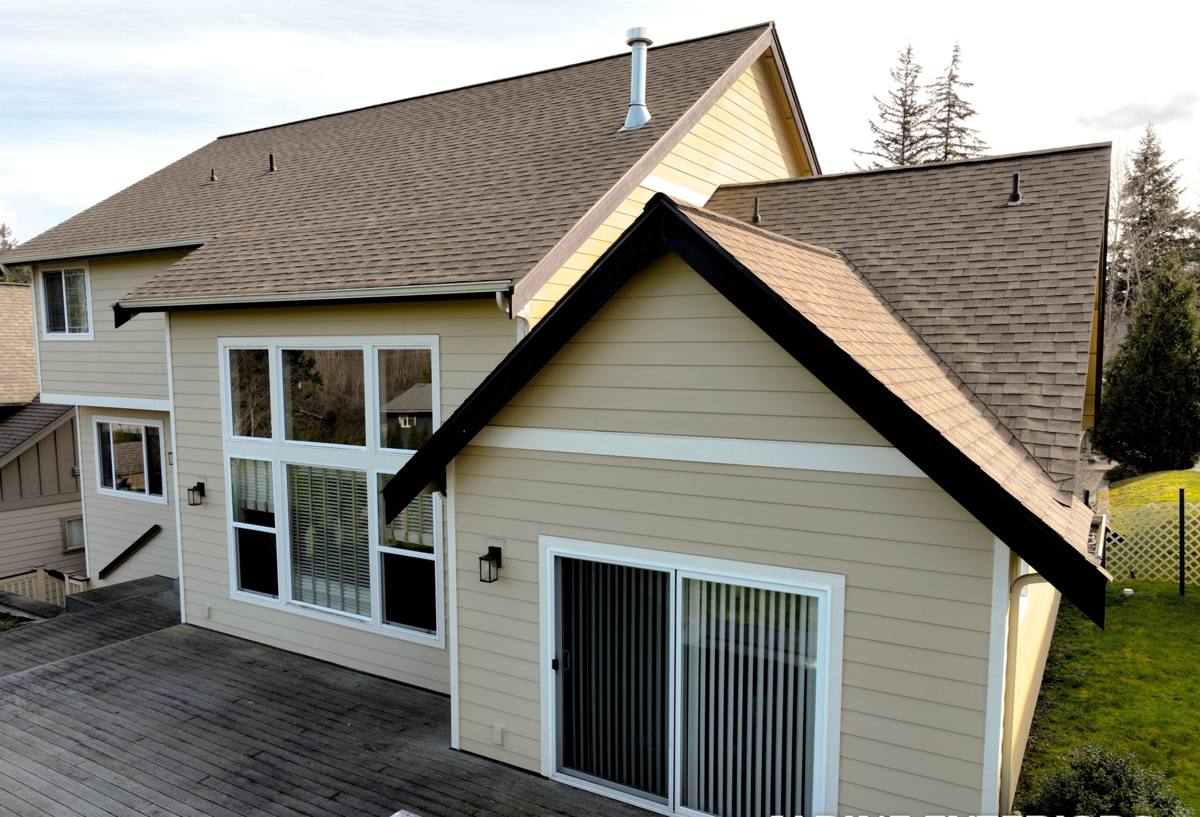
How Water Actually Gets In
It's Rarely the Face of the Panel
Most homeowners assume rain soaks straight through the siding material. In reality, the failure points are almost always at the seams and penetrations: butt joints between panels, corner boards, window and door trim, hose bib penetrations, and anywhere flashing was skipped or installed backwards. Water finds the path of least resistance, and on an older or poorly installed wall, that path leads behind the cladding.
Capillary Action and Wind-Driven Rain
Driving rain off the water isn't just falling straight down — wind pushes it sideways and even upward under laps and at butt joints. Once moisture gets past the face of the siding, capillary action can pull it further along seams and fasteners than gravity alone would suggest. This is why a house facing the prevailing weather off the Strait often shows damage on one elevation years before the others.
What Happens Once Moisture Gets Behind the Cladding
Behind the siding is a water-resistive barrier (housewrap or building paper), sheathing, and framing. If the WRB is intact, lapped correctly, and the assembly can dry out between rain events, minor moisture intrusion is manageable — it's designed to happen occasionally. The trouble starts when water gets in faster than the wall can dry, which happens when:
- Flashing at windows, doors, and deck ledgers is missing, reversed, or improperly lapped
- The WRB has tears, gaps, or wasn't lapped shingle-style (upper layer over lower)
- Caulk was used as the primary water seal instead of proper flashing and shedding details
- The siding material itself absorbs and holds moisture rather than shedding it
- There's no drainage plane or rainscreen gap, so water sits against the sheathing
Why Some Siding Materials Make This Worse
Not all siding responds to trapped moisture the same way. This is one of the biggest factors we weigh with homeowners before recommending a product, and it's a big part of why we standardized on one material rather than offering a menu of options.
| Material | How It Responds to Moisture | Long-Term Risk in This Climate |
|---|---|---|
| Untreated or primed wood (cedar, spruce) | Absorbs water directly into the fiber; swells, cups, and holds moisture against the back side | High — rot, delamination, and repaint cycles every few years in a wet climate |
| Vinyl siding | Doesn't absorb water itself, but expands/contracts significantly and can warp or buckle, opening gaps at seams | Moderate — moisture gets behind through gaps rather than through the panel |
| OSB-based composite siding (e.g., LP SmartSide) | Engineered wood strand product; performs well when detailed correctly, but end-cuts and damaged edges are vulnerable if moisture reaches the substrate | Moderate — installation precision matters more than with other materials |
| Fiber cement (James Hardie) | Cement-based core doesn't swell, rot, or support moss growth; factory-cured for dimensional stability | Low, when installed to manufacturer spec with proper flashing and clearances |
We don't install every product on that list, and we're upfront about why. Cedar and primed spruce look great on day one, but wood is wood — it wants to absorb moisture, and in a climate with this much sustained dampness, that means more frequent repainting, caulking, and eventually board replacement. Vinyl is affordable and low-maintenance in dry climates, but its expansion and contraction cycles are more pronounced with our temperature swings between summer and our damp winters, and once a seam opens, there's little protecting the wall behind it. We made the call years ago to install only James Hardie fiber cement, because its moisture behavior is the most predictable of anything on the market, and predictable is what you want on a coastal wall.
Moss, Algae, and the "It's Just Cosmetic" Trap
Ferndale's moss season isn't just an eyesore issue. Moss and algae hold moisture against whatever surface they're growing on, extending the time siding stays wet after every rain. On wood or wood-composite products, that prolonged dampness accelerates rot at the exact spots — low horizontal laps, north-facing walls, areas shaded by trees — where moss tends to establish itself first. By the time you notice green-black streaking or a fuzzy texture on the siding face, the material underneath has often been staying wet for considerably longer than it should.
James Hardie's fiber cement doesn't feed moss the way organic wood fiber does, and its factory-applied ColorPlus finish resists the kind of surface degradation that gives algae something to grip. It's not immune to surface growth in a wet enough spot, but it doesn't compound the problem by absorbing water into the material itself.
The Warning Signs Worth Taking Seriously
Most siding failures give warning signs long before there's a hole in the wall. Catching these early is the difference between a repair and a full re-side.
- Paint that's bubbling, peeling, or alligatoring in one specific area rather than uniformly
- Soft or spongy spots when you press on the siding, especially near the bottom courses or under windows
- Visible gaps, warping, or buckling at panel seams
- Dark staining or streaking that keeps returning after cleaning
- Interior drywall staining, bubbling, or a musty smell on an exterior wall
- Siding that's noticeably swollen or thicker at the edges than the field of the panel
If you're seeing two or more of these on the same wall, it's worth having someone look behind the siding, not just at it. A quick visual check from the street rarely tells the whole story.
Why Installation Detail Matters as Much as the Material
We want to be honest about something: even the best siding material fails if it's installed wrong. Fiber cement that's face-nailed too tight, installed without the manufacturer's required clearance above rooflines and decks, or flashed incorrectly at penetrations will trap moisture just like any other product. The material buys you margin for error — it won't rot or swell if it does get wet occasionally — but it's not a substitute for correct flashing, proper lap sequencing, and the right gap at grade and hard surfaces.
This is why we treat installation spec as seriously as the product choice itself. A correctly detailed wall assembly manages the water that inevitably gets past the cladding surface. A poorly detailed one fights a losing battle no matter what material is on the outside.
What This Means If You're Planning a Re-Side
If your current siding is showing early signs of trouble, the smartest move is usually a full assessment before you're forced into an emergency repair. That means checking the WRB and sheathing condition once the old siding is off, not just replacing what's visible. It's also the point where you get to make a real decision about material — one that accounts for how this specific climate, on this specific lot, is going to treat whatever goes back up.
For most homes in Ferndale and the surrounding county, that decision comes down to how much ongoing maintenance you're willing to take on versus how much you want the wall assembly working in the background without much attention. That's the trade-off we walk homeowners through, and it's why James Hardie is what we recommend and install.
A Straightforward Way to Think About It
Siding has one job: shed water and let the wall breathe when a little gets past. Materials that absorb moisture into their own structure are working against that job from day one. Materials that don't absorb it, paired with correct flashing and installation, are working with it. In a place with as much sustained rain and salt air as Whatcom County sees, that distinction shows up in the wall's condition ten and twenty years down the road — long after the choice of material has been forgotten.
If you're noticing early warning signs, or you just want an honest read on how your current siding and wall assembly are holding up, we're happy to take a look. There's no pressure and no sales pitch — just a straight answer about what we see and what your options are, using the form below to request a free estimate.