 Ferndale Siding
 Point Roberts: A Peninsula With Its Own Weather Rules
Point Roberts sits in a strange spot on the map — physically separated from the rest of Washington, surrounded on three sides by water, and exposed to marine weather that hits harder and more often than it does just a few miles inland in Ferndale or Bellingham. If you own a home out there, you already know your siding works overtime compared to a house tucked into a valley or a subdivision with more tree cover and less direct exposure to the Strait of Georgia.
That exposure is the whole story for exterior materials in Point Roberts. Salt-laden air, wind-driven rain that hits siding sideways instead of falling straight down, and a moss and algae season that can run most of the year all combine to shorten the life of materials that aren't built to handle it. We've built our approach around that reality rather than around what's easiest to install or cheapest to sell.
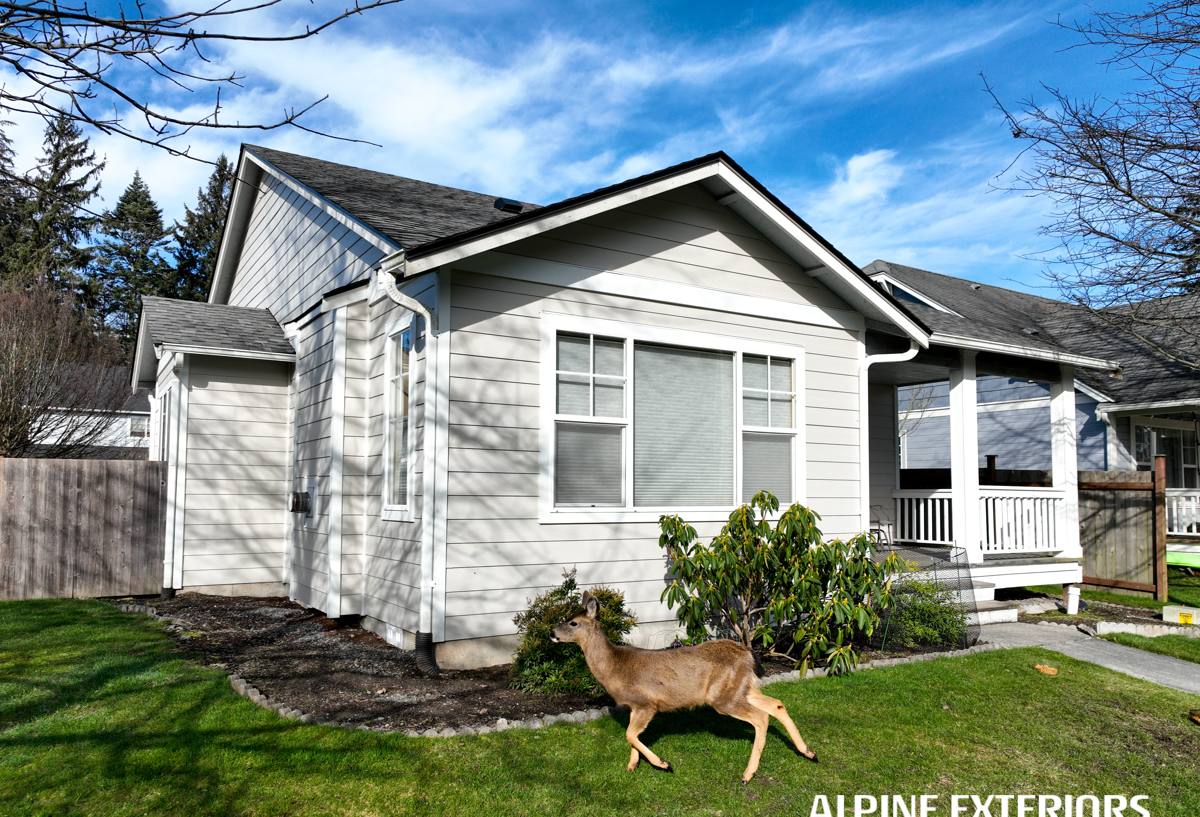
What the Climate Actually Does to a House Out Here
Salt Air and Metal, Fasteners, and Finishes
Proximity to saltwater doesn't just mean corroded hinges and rusty patio furniture. Salt-bearing air accelerates corrosion on exposed fasteners, degrades lower-quality paint films faster than inland weathering would, and can contribute to premature failure at seams and joints where moisture and salt residue collect. Materials and finishes that aren't rated for coastal exposure tend to show their age early — chalking, fading, and fastener bleed show up years ahead of schedule.
Driving Rain and Wind-Driven Moisture
Point Roberts catches wind off open water with little to break it up before it reaches a house. That means rain doesn't just fall on a wall — it's pushed into it, working its way toward seams, laps, corners, and any gap in flashing or caulking. Siding systems that depend heavily on perfect field caulking to stay watertight are more exposed here than in a sheltered inland lot, because the wind is doing extra work to find every weak point.
A Long Moss and Algae Season
Cool, damp, and often shaded conditions across much of Whatcom County give moss and algae a long growing window, and homes close to the water tend to stay damp longer after a storm than homes further inland. On siding, that shows up as green-black streaking, a fuzzy texture in shaded corners, and — over years — a surface that's constantly holding moisture against the substrate underneath. Some siding materials shrug this off. Others give algae and moss something to grip onto and feed from.
Why We Install Only James Hardie Fiber Cement
We made a deliberate decision as a company to install James Hardie fiber cement siding exclusively — not vinyl, not LP SmartSide, not Cemplank, not Allura, not primed spruce or cedar. That's not a marketing angle; it's a standard we hold because of what we've seen these products do (and not do) in exactly the kind of climate Point Roberts has.
- Non-combustible core. Fiber cement doesn't burn, which matters on a peninsula where emergency response can take longer than it would in a denser area.
- Engineered for moisture, not just painted over it. Hardie's HZ5 product line is formulated specifically for cold, wet, freeze-prone climates like ours — it's not a one-size-fits-all product stamped out for every region in the country.
- Factory-applied ColorPlus finish. The color and protective coating are baked on under controlled conditions, which holds up to salt air and UV exposure far more consistently than field-applied paint.
- Dense, hard surface. Moss and algae have a harder time establishing on fiber cement than on some wood-based or textured composite surfaces, which matters given how long the damp season runs here.
- A transferable warranty structure that's meaningful — it's backed by a large, established manufacturer rather than a smaller composite producer with a thinner track record in coastal climates.
We're not going to tell you every other product on the market is worthless — vinyl, LP SmartSide, and engineered wood products all have their place, and homeowners install them successfully across the country. But we've chosen to build our business around one material we can stand behind fully, install to spec every time, and warranty with confidence, rather than spreading ourselves across several products with different weaknesses. In a marine environment like Point Roberts, that focus matters more, not less.
What Correct Installation Looks Like Out Here
Fiber cement siding is only as good as the installation behind it, and coastal conditions raise the stakes on details that might be forgiving in a drier, calmer inland climate.
Weather-Resistive Barrier and Flashing
Every wall gets a proper weather-resistive barrier, correctly lapped and sealed, with flashing detailed at every penetration, window, door, and horizontal transition. In a spot where wind pushes rain sideways, the drainage plane behind the siding is doing as much work as the siding itself.
Fastener Placement and Spacing
Hardie's installation specs call for specific fastener types, spacing, and placement relative to panel edges — get this wrong and you create weak points where moisture and salt exposure can do damage over time, plus you risk voiding the manufacturer warranty. We follow Hardie's published specs, not shortcuts.
Caulking and Sealant Strategy
Because we can't control how hard the wind drives rain into a wall, we don't rely on caulking alone to keep water out — it's a backup to good flashing and drainage, not the primary defense. Caulking still matters, and we use products rated for the exposure, but the design behind it is what actually keeps a house dry for decades.
Installation Checklist We Follow On Every Job
- Weather-resistive barrier installed and lapped per manufacturer direction
- Flashing at every window, door, deck ledger, and roof-to-wall transition
- Correct starter strip and clearance from grade, decks, and roof lines
- Manufacturer-specified fastener type, length, and spacing
- Proper joint treatment at butt seams and corners
- Rated caulking and sealants at penetrations, not as a substitute for flashing
- Final inspection walk-through with the homeowner before we call it done
Siding Materials Compared for a Marine Climate
| Factor | Vinyl | LP SmartSide / Engineered Wood | James Hardie Fiber Cement |
|---|---|---|---|
| Salt air resistance | Can become brittle over time with UV/salt exposure | Moisture-sensitive at cut edges and seams | Engineered coastal-climate product line (HZ5) |
| Moss/algae resistance | Moderate; smooth surface but seams collect debris | Can be more susceptible where coating is compromised | Dense surface resists organic growth better |
| Fire rating | Combustible | Combustible (wood-based) | Non-combustible core |
| Finish durability | Color molded in but can chalk/fade | Factory or field-applied, varies by product | Factory-baked ColorPlus finish |
| Typical lifespan (installed to spec) | 20-40 years, variable | 20-30 years, moisture-sensitive | 30-50 years, manufacturer warranted |
These are general characteristics based on product design, not guarantees — real-world performance always depends heavily on installation quality, maintenance, and site-specific exposure.
Beyond Siding: Roofing, Windows, and Decks in a Coastal Setting
Siding doesn't work in isolation. On a home exposed the way Point Roberts homes are, roofing, windows, and decks all interact with the same moisture and wind loads siding does, and we handle all four as one exterior envelope rather than treating each as a separate project.
- Roofing: Roof-to-wall flashing details directly affect whether water gets pushed behind your siding at the transition — get one wrong and the other suffers.
- Windows: Window flashing integration is one of the most common failure points on any home; it has to tie into the weather-resistive barrier correctly, not just get caulked around the trim.
- Decks: Deck ledger attachment against a wall needs proper flashing to keep water from tracking behind siding at that connection point — a detail that's easy to get wrong and expensive to fix later.
Having one crew familiar with how these systems interact reduces the finger-pointing that happens when separate contractors handle each piece and something leaks at a boundary between their work.
Why a Local Crew Matters on a Peninsula Like This
Point Roberts' geography means logistics are different than a typical job in Ferndale proper — materials, scheduling, and site access all take a bit more planning. A crew that's done work in Whatcom County's coastal pockets knows to plan for that instead of being surprised by it mid-project. We also know what "normal" wear looks like out here versus what's actually a sign of a failing exterior, which matters when you're deciding whether a home needs a repair, a partial re-side, or a full replacement.
What to Expect From an Estimate
When we come out to look at a home in Point Roberts, we're checking more than square footage. We look at current siding condition, moisture staining or soft spots at trim and penetrations, existing flashing details, and how exposed the home is to prevailing wind and salt spray based on its position and orientation. That assessment shapes the recommendation — sometimes it's a full re-side, sometimes targeted repair and refinishing makes more sense, and we'll tell you honestly which one fits your situation.
If your Point Roberts home is showing signs of wear from salt air, moss buildup, or water intrusion — or you're just planning ahead for a re-side — we're happy to come take a look. Reach out for a free, no-pressure estimate using the form below.