 Ferndale Siding
 Siding Built for Nooksack's Climate, Not Just Its Curb Appeal
Nooksack sits inland from the salt water that shapes so much of Whatcom County's weather, but the exterior challenges homeowners face here aren't all that different from what we see closer to the coast. Long stretches of damp, overcast weather roll through the Nooksack River valley for much of the year, and homes tucked against tree lines or shaded by fir and cedar cover deal with slow-drying siding, persistent moss growth, and wood trim that never quite gets a chance to dry out before the next system moves through. Add in the driving rain that comes with Pacific frontal systems and the humidity that lingers in low-lying areas near the river, and you've got an environment that is genuinely hard on exterior building materials.
We're a Ferndale-based crew that works throughout Whatcom County, and Nooksack is part of our regular service area. That matters more than it might sound like it should — a contractor who only shows up once for an install and then disappears leaves you without anyone who understands how a specific product performed on a specific street through a specific winter. A local crew sees the same houses, the same weather patterns, and the same failure points year after year, and that experience shapes what we're willing to put our name behind.
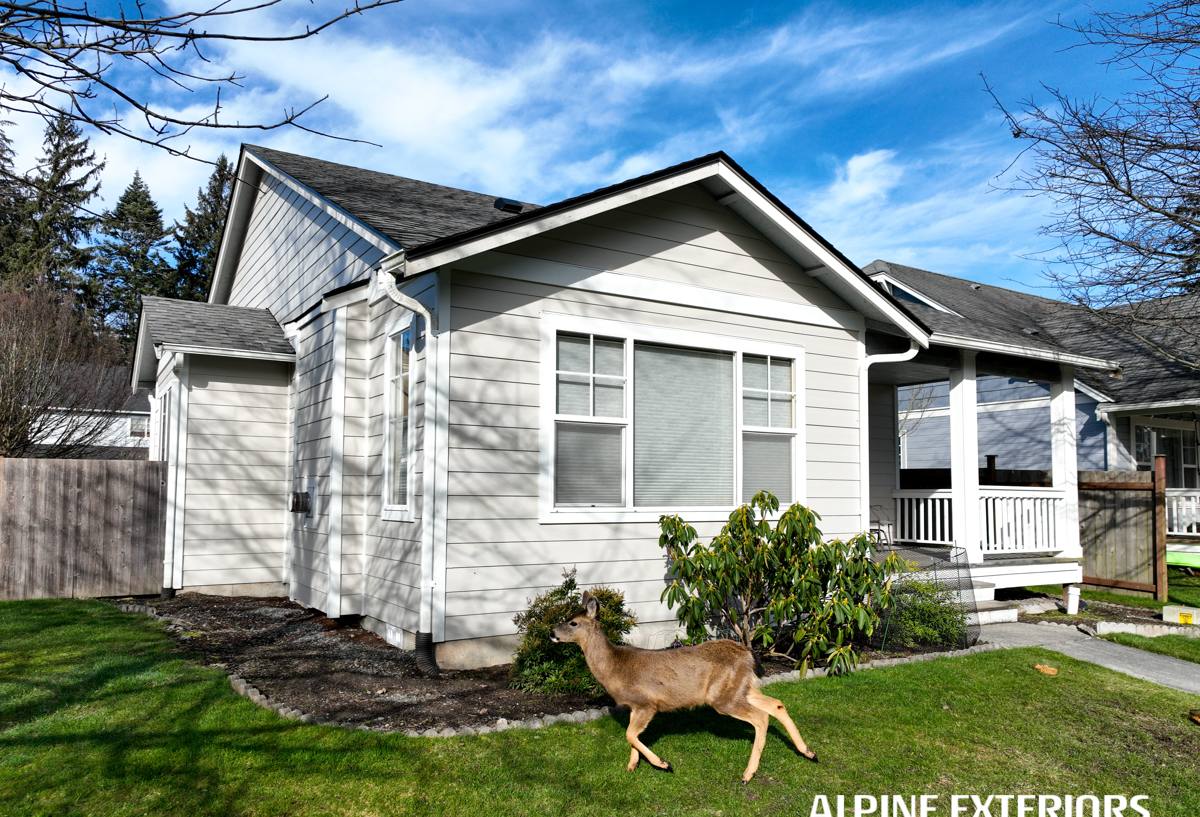
What Nooksack Homes Are Up Against
Moisture That Doesn't Let Up
Whatcom County doesn't get the heaviest rainfall totals in the state, but it gets a lot of low-intensity, long-duration wet weather — the kind that keeps siding damp for days at a stretch rather than a quick downpour that clears out fast. That slow-soak pattern is harder on wood-based products than a single hard storm, because moisture has time to work into seams, fastener holes, and butt joints before anything gets a chance to dry.
Moss and Organic Growth
Shaded lots, tree-lined properties, and north-facing walls around Nooksack are prone to moss, algae, and mildew staining on siding that stays damp too long. This is partly an appearance issue, but it's also a durability issue — organic growth holds moisture against the surface of the siding and, on products that aren't dimensionally stable, can accelerate swelling, delamination, or paint failure underneath.
Temperature Swings and UV Exposure
Summers in this part of Whatcom County bring stretches of direct sun that can bake siding on south- and west-facing walls, while the rest of the year stays cool and wet. That swing between UV exposure and constant moisture is exactly the kind of cycling that causes cheaper coatings to chalk, fade, or crack over time.
Why We Only Install James Hardie Fiber Cement
We made a decision as a company to install one siding system: James Hardie fiber cement. We don't install vinyl, LP SmartSide, Cemplank, Allura, or primed wood species like cedar or spruce. That's not a marketing angle — it's a standard we hold because of what we've seen these products do (and not do) in exactly the kind of climate Nooksack sits in.
- Non-combustible material. Fiber cement doesn't contribute fuel to a fire the way wood-based sidings can, which matters to insurers and to homeowners near wildland-urban interface areas.
- Dimensionally stable in wet-dry cycling. Hardie board doesn't swell and shrink with moisture the way wood-based composites can, which reduces the joint gaps and paint cracking that let water in over time.
- Factory-applied ColorPlus finish. The color and topcoat are baked on under controlled conditions, not brushed on in the field where humidity and temperature affect cure quality.
- Climate-engineered product lines. Hardie makes different formulations (HZ5 for the Pacific Northwest, for example) specifically tuned for moisture exposure rather than a single generic board sold everywhere.
- A warranty that's actually transferable. Coverage that survives a home sale is worth more to a homeowner than a longer number on paper that doesn't transfer or comes loaded with exclusions.
None of this means other products are worthless — vinyl is inexpensive and low-maintenance in the right application, and wood has a look some homeowners genuinely prefer. But we've chosen not to install the alternatives because we don't think they hold up to this climate the way we'd want to stand behind, and we'd rather install fewer products well than a wider range with reservations.
How Fiber Cement Compares to What We Won't Install
| Material | Moisture Behavior | Maintenance | Fire Rating | Typical Lifespan |
|---|---|---|---|---|
| James Hardie Fiber Cement | Dimensionally stable, resists moisture-driven warping | Low — factory finish holds color for years | Non-combustible | 30+ years with proper install |
| Vinyl Siding | Doesn't absorb water but can warp/buckle with heat and cold | Low, but fades and becomes brittle over time | Combustible, can melt/deform in heat | 15-25 years typical |
| LP SmartSide / Wood Composite | Engineered to resist moisture but still wood-based at the core | Moderate — edge sealing and caulking upkeep matter | Combustible | 20-30 years with diligent upkeep |
| Cedar / Primed Spruce | Absorbs and releases moisture readily; prone to swelling | High — repainting, sealing, moss treatment | Combustible | Variable, heavily maintenance-dependent |
The lifespan figures above assume reasonable maintenance and installation to spec — every one of these products fails faster when installed poorly, which is a big part of why the crew matters as much as the material.
Why Installation Quality Decides the Outcome
Fiber cement is only as good as the install behind it. Hardie publishes specific fastening patterns, clearance requirements above grade and roofing, caulking specifications, and gapping instructions — and skipping any of these doesn't show up as a problem on day one. It shows up two or three winters later as a water stain, a soft spot, or a section that needs to come off and be redone.
- Correct clearance between siding and grade, decks, and roof lines so water doesn't wick up into the board
- Proper fastener spacing and depth — over-driven or under-driven nails both cause problems
- Manufacturer-specified caulking and flashing at every penetration, corner, and butt joint
- Rain-screen or drainage plane detailing appropriate to a wet Pacific Northwest climate
- Field-cut edges sealed per manufacturer spec before installation, not left raw
This is where a crew that installs one product exclusively has an advantage over one that installs six different systems a few times a year each. Repetition builds the muscle memory that keeps these details from getting missed.
Beyond Siding: The Rest of the Exterior Envelope
Siding doesn't work in isolation. We also handle roofing, windows, and decks, because a home's exterior performs as one system — a roof that's shedding water onto a wall, a window that's not flashed correctly, or a deck ledger that's trapping moisture against the siding will undercut even a perfect siding install. When we're on a property in Nooksack for a siding project, we're looking at the whole envelope, not just the walls, because that's usually where the real leak sources turn up.
Signs It Might Be Time to Look at Your Siding
- Visible moss or algae staining that keeps coming back after cleaning
- Paint that's peeling, bubbling, or chalking heavily on south- or west-facing walls
- Soft spots or visible swelling, especially near the bottom courses or around windows
- Gaps opening up at butt joints or corner boards
- Rising energy bills that suggest the wall assembly isn't performing the way it should
What a Nooksack Siding Project Typically Involves
Every home is different, but most projects in this area follow a similar sequence: an on-site evaluation of the existing siding and any moisture damage behind it, removal of the old material, inspection and repair of sheathing and framing where needed, installation of a proper drainage plane, and then the Hardie install itself with attention to every clearance and flashing detail. Where we find rot or water damage during tear-off, we address it before new siding ever goes up — covering a problem with new material doesn't solve it.
Why a Local Crew Matters Here
Ferndale and the surrounding Whatcom County communities, Nooksack included, have their own microclimate quirks — tree cover, river valley humidity, and weather patterns that don't match what a crew based in Seattle or coming up from out of state deals with day to day. Being local means we're back for warranty work without a service call turning into a multi-hour drive, and it means we've already seen how our own installs hold up through a Whatcom County winter, not just how they look on install day.
If your Nooksack home's siding is showing its age, or you're planning ahead for a project, we're happy to take a look and walk you through honest options — no pressure, no obligation. The form below gets you a free estimate from a crew that actually works in this area.