 Ferndale Siding
 Siding Built for Sudden Valley's Setting
Sudden Valley sits in a part of Whatcom County where the climate doesn't do a home's exterior any favors. Between the wooded, hillside lots common to the area, the long stretch of wet months typical of Northwest Washington, and the salt-laced air that moves inland off the Puget Sound and Strait of Georgia, siding here works harder than it does in drier, more exposed parts of the state. We install and service exterior systems throughout this part of Ferndale and greater Whatcom County, and Sudden Valley's tree-shaded, moisture-heavy conditions are exactly the kind of environment we build our recommendations around.
This page covers what homes in Sudden Valley tend to run into over time, how we approach siding, roofing, window, and deck work for properties in this setting, and why we've standardized on one siding product instead of offering the usual menu of options.
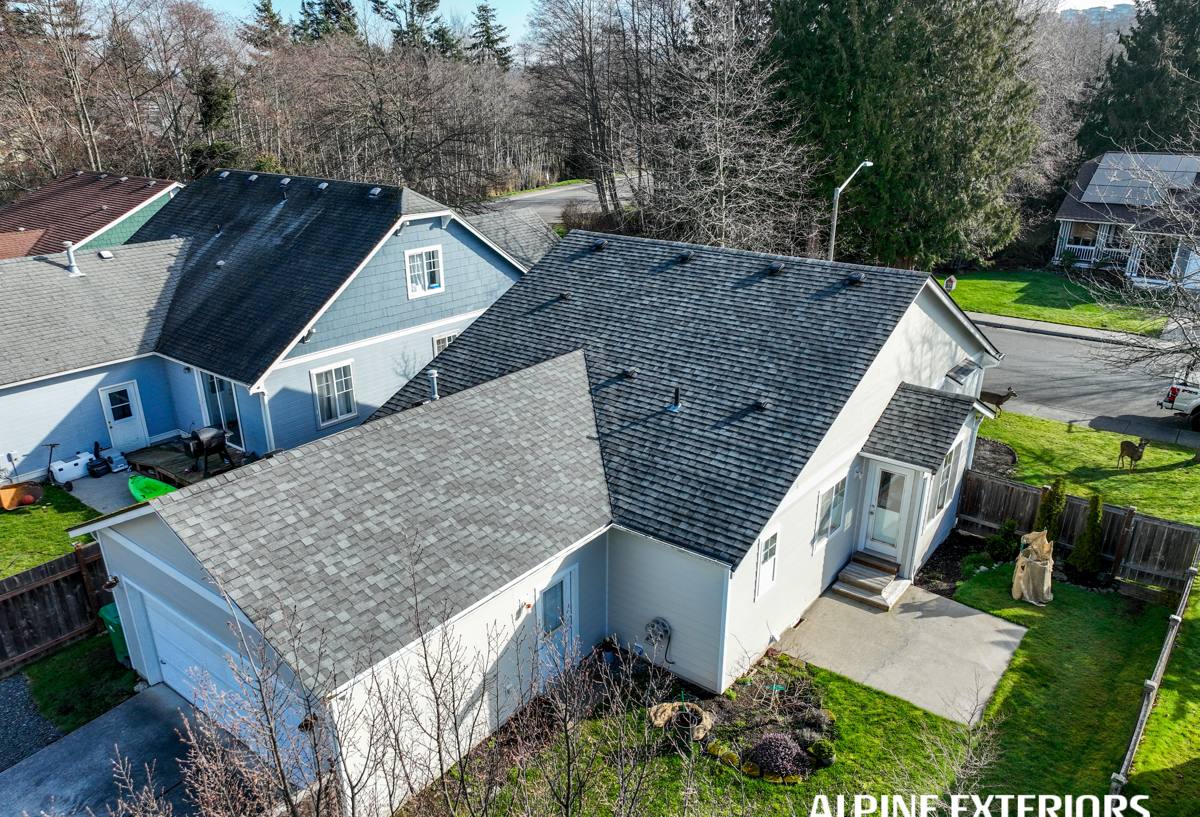
What This Environment Does to a Home's Exterior
Shade, Moisture, and a Long Moss Season
Wooded and hillside properties hold moisture longer than open lots. Tree canopy blocks sun and wind that would otherwise dry siding out after a storm, and needle and leaf debris collects in corners, behind trim, and along lower courses of siding where it holds water against the surface. Combined with Whatcom County's extended wet season, that adds up to months at a time where siding stays damp — ideal conditions for moss, algae, and mildew to take hold, especially on north-facing and shaded walls.
Driving Rain and Wind-Driven Moisture
Storms off the water don't just rain straight down — wind pushes moisture sideways into siding, trim, window flashing, and butt joints. Over years, that repeated wind-driven exposure is what finds the weak points in a siding system: caulked seams that were never meant to be a primary water barrier, laps that weren't installed with enough clearance, or trim details that trap rather than shed water.
Salt Air
Proximity to Puget Sound and Bellingham Bay means a measure of salt content in the air across this whole region, Sudden Valley included. Salt exposure accelerates corrosion on fasteners and metal flashing and can be harder on certain paint finishes and coatings than inland conditions. It's a slower, quieter factor than moss or rain, but it shows up over a couple of decades in the form of rust streaking, failing caulk, and fading finishes that weren't engineered with coastal exposure in mind.
Why We Only Install James Hardie Fiber Cement
We get asked fairly often why we don't offer vinyl, LP SmartSide, cedar, primed spruce, or other fiber cement brands like Cemplank or Allura. The honest answer is that we looked at what actually holds up in this climate over 20-30 years — not just what looks good going in — and standardized on one product line because it's the one we're comfortable putting our name behind.
Non-Combustible, Moisture-Resistant Core
James Hardie siding is fiber cement — sand, cement, and cellulose fiber — which doesn't absorb and swell with moisture the way wood-based products can, and doesn't soften or become brittle the way vinyl can in temperature extremes. It's also non-combustible, which matters more each year as wildfire smoke and fire risk become a bigger part of Pacific Northwest summers.
Engineered for This Region
Hardie manufactures regional product lines (HZ5 and HZ10) specifically formulated for different climate zones, and the Pacific Northwest falls into a wetter, moisture-focused category. That's not marketing language — the composition and installation specs are genuinely different from what's shipped to arid states.
Factory-Applied ColorPlus Finish
Rather than field-painted siding, Hardie's ColorPlus finish is baked on at the factory in multiple coats, which gives more consistent coverage and better fade resistance than most job-site paint jobs achieve — a real advantage against the UV and salt exposure this area sees.
Warranty Backing
Hardie backs its siding with a long, transferable limited warranty, which matters both for the current owner and for resale — a documented warranty on file is something buyers and their inspectors notice.
We're not saying every other product is a bad product in a vacuum. Vinyl, LP SmartSide, and cedar all have legitimate use cases and loyal customers. What we're saying is that for the specific combination of shade, moisture, and salt air common around Sudden Valley and the rest of Whatcom County, fiber cement — and specifically Hardie's engineered lines — is the product we trust to still look right and perform at year 20.
How Siding Materials Compare in This Climate
| Material | Moisture/Moss Behavior | Maintenance | Typical Lifespan Here |
|---|---|---|---|
| James Hardie fiber cement | Doesn't absorb/swell; factory finish resists mildew staining | Occasional wash; repaint only if ever needed, decades out | 30+ years with correct install |
| Vinyl | Won't rot, but seams and J-channels trap moisture; can warp in heat | Low, but panels can crack/fade and aren't repairable, only replaceable | 15-25 years |
| Cedar / wood | Absorbs moisture readily; prone to moss, rot, and insect damage in shade | High — regular refinishing, caulking, and spot repair | 15-20 years without heavy upkeep |
| LP SmartSide (engineered wood) | Treated to resist moisture but still wood-based; edge/cut-end sealing is critical | Moderate — repainting on a cycle, careful joint maintenance | 20-25 years with diligent maintenance |
These are general tendencies, not guarantees for any specific installation — installation quality affects every one of these materials more than the brand name does. But the underlying material behavior is why we made the call we made.
Our Siding Process for Sudden Valley Homes
- On-site assessment. We walk the exterior, check for existing moisture damage, moss buildup, and rot behind current siding, and look at tree cover and drainage patterns specific to the lot.
- Tear-off and inspection. Removing old siding lets us actually see the sheathing underneath — this is where hidden water damage from years of trapped moisture usually turns up, and it needs to be addressed before new siding goes on, not covered over.
- Weather-resistive barrier and flashing. Proper house wrap, window and door flashing, and kick-out flashing at roof-wall intersections are what actually keep wind-driven rain out — the siding itself is the second line of defense, not the first.
- Hardie installation to manufacturer spec. Correct fastening, clearances, and caulking (only where Hardie specifies it, not as a substitute for proper flashing) are what determine whether the warranty is even valid.
- Trim and finish work. Corner boards, fascia, and trim details get the same attention, since these are common failure points for moisture intrusion.
Beyond Siding: The Full Exterior
Siding doesn't work in isolation — a roof that's shedding water poorly or windows with failed seals will undermine even a perfect siding job. We handle roofing, windows, and decks as well, which matters in a setting like Sudden Valley where tree debris affects roofs and gutters as much as it affects siding, and where shaded decks face the same moss and moisture pressure as wall surfaces.
- Roofing: moss and debris management, flashing integrity, and material choices suited to shaded, wet conditions
- Windows: proper flashing integration with new siding, addressing condensation and seal failure common in humid, tree-shaded homes
- Decks: materials and fastener choices that hold up to standing moisture and moss in shaded outdoor spaces
Coordinating these as one project, rather than four separate contractors, means flashing and water management get handled consistently across the whole exterior instead of at the seams between trades.
What Drives Cost on a Sudden Valley Project
| Factor | Why It Matters |
|---|---|
| Home size and story count | More surface area and access difficulty on multi-story or steep-lot homes increases labor |
| Condition of existing sheathing | Hidden moisture damage found at tear-off requires repair before new siding goes on |
| Trim and architectural detail | Homes with more corners, gables, and trim lines take more time to finish correctly |
| Access and site conditions | Tree cover, slope, and driveway access affect staging, scaffolding, and disposal logistics |
| Hardie product line and profile | Lap width, texture, and color options carry different material costs |
We give honest, itemized estimates rather than a flat per-square-foot number pulled out of thin air, because the variables above genuinely change the price from one Sudden Valley property to the next.
Why a Local Crew Matters Here
A crew that works Whatcom County regularly knows what wooded, lake-proximity, and coastal-adjacent properties tend to look like underneath the siding before they even open the wall up. That's not a small thing — it means fewer surprises, more accurate estimates up front, and installation decisions (flashing details, ventilation, moisture barrier choices) made with this specific climate in mind rather than a generic national spec sheet. It also means someone is local if a warranty question or a follow-up concern comes up years down the road, rather than a crew that was passing through for one job.
A Simple Checklist Before You Hire
- Ask what siding material they install and why — and be wary of a contractor who installs "whatever you want" with no professional opinion
- Confirm they'll inspect and address sheathing condition during tear-off, not just install over existing damage
- Ask specifically how they handle flashing at windows, doors, and roof-wall intersections
- Get a written, itemized estimate rather than a single lump number
- Confirm licensing, insurance, and whether they're a manufacturer-certified installer if that matters for warranty coverage
- Ask about their experience with shaded, moisture-prone, or moss-heavy properties specifically
Get an Estimate
If moss, moisture staining, or aging siding is showing up on a Sudden Valley home, we're happy to take a look and give a straightforward, no-pressure assessment of what's going on and what it would take to fix it right. The estimate is free, and there's no obligation attached to it.