 Ferndale Siding
 Metal Roofing in Marietta: Built for What This Climate Actually Does
Marietta sits close to the water on the edge of Ferndale, and that proximity shapes what a roof needs here more than most homeowners realize. Salt-tinged marine air, wind-driven rain that gets pushed sideways and up under roofing edges rather than falling straight down, and a moss season that runs long on shaded, north-facing slopes — all of it works against a roof year-round, not just during the occasional storm. Metal roofing, installed correctly, holds up well against that combination. Installed poorly, it can develop problems faster than a comparable asphalt roof, because the failure points are different and less forgiving.
This page is specifically about metal roofing for Marietta homes — what the climate demands, what a correct installation actually involves, and how our process works when we take on a metal roofing project in this neighborhood.
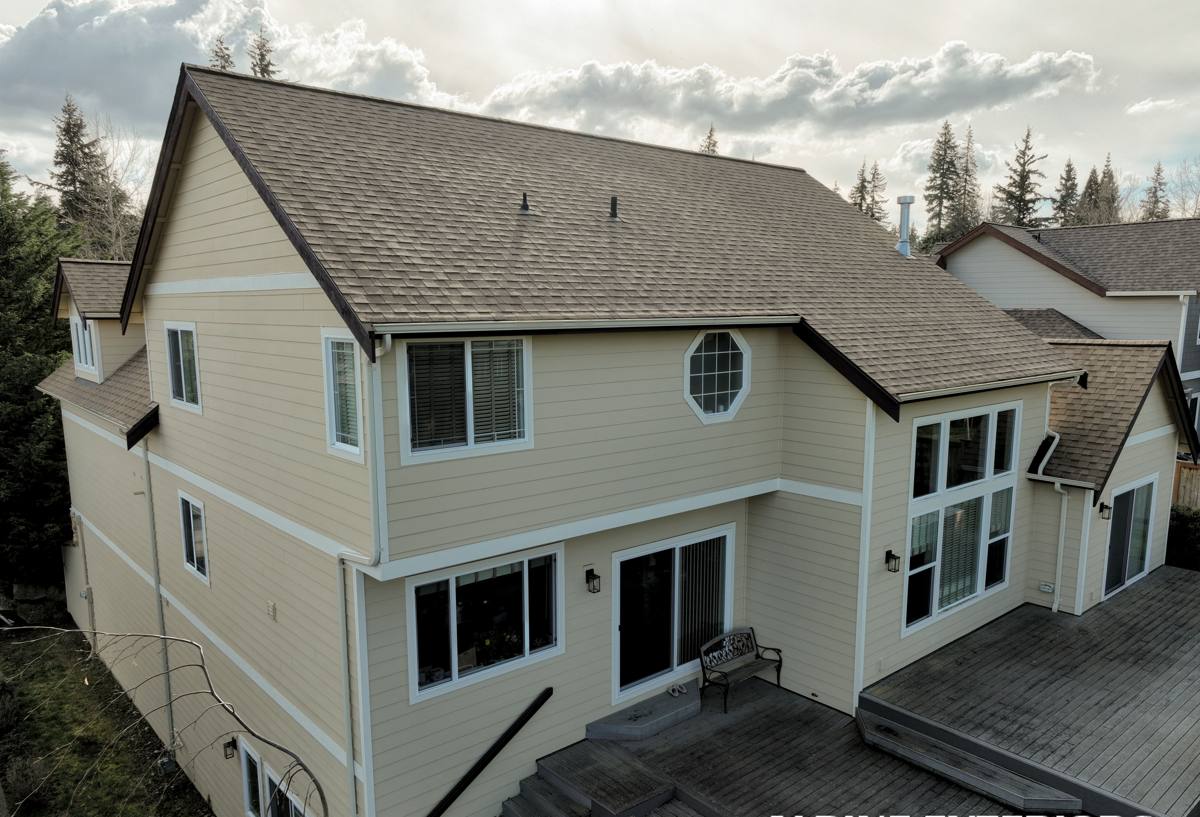
Why Marietta's Location Changes the Calculus
Marietta's closeness to the water means homes here catch more of the salt air that drifts inland off Bellingham Bay than properties further into Whatcom County. Salt air accelerates corrosion on any exposed metal — fasteners, flashing, panel edges — if that metal isn't rated for it or isn't installed with corrosion in mind. It's not a dramatic effect you'd notice in year one, but it's a cumulative one that shows up as premature fastener failure or edge corrosion five or ten years down the road on a roof that wasn't specified correctly from the start.
The same wind-driven rain that challenges asphalt shingle roofs challenges metal roofing too, just differently. Rain pushed sideways by wind off the water can work its way under panel laps and around penetrations if seam spacing, panel overlap, and flashing details aren't done to spec. And the long moss season common to shaded Whatcom County roofs still applies to metal — moss and organic debris can accumulate in panel valleys and around fasteners even though metal itself doesn't feed the growth the way wood or algae-prone asphalt granules can.
What This Means for a Marietta Roof, Specifically
- Fasteners and exposed flashing need corrosion-resistant coatings and finishes appropriate for near-water exposure, not just standard-grade hardware
- Panel seams and laps need to be sized and sealed for wind-driven rain, not just straight-down rainfall
- Underlayment beneath the metal matters as much as the metal itself, since it's the backup layer if wind ever pushes water past a seam
- Valleys, ridges, and any shaded slope need attention to moss and debris buildup over time, even on a low-maintenance material
What a Correct Metal Roofing Job Actually Involves
Metal roofing has a reputation as a low-maintenance, long-lifespan option, and that reputation is generally earned — but only when the installation is done right. The material itself rarely fails on its own. Almost every metal roof problem we're called to look at traces back to an installation shortcut: wrong fastener spacing, missed flashing detail, or underlayment that wasn't matched to the panel system.
The Components That Matter Most
| Component | What It Does | Why It Matters in Marietta |
|---|---|---|
| Panel material and coating | Determines corrosion resistance and expected lifespan | Near-water salt exposure means coating quality is not optional here |
| Fastener type and spacing | Holds panels secure through wind loading | Wind off the water puts real uplift stress on panel edges and fastener points |
| Underlayment | Backup water barrier beneath the panels | Catches wind-driven rain that gets past a seam before it ever reaches the deck |
| Flashing at valleys, walls, and penetrations | Seals transitions and roof breaks | The majority of metal roof leaks start at flashing details, not the panel field |
| Panel profile and seam type | Standing seam vs. exposed-fastener systems | Standing seam sheds wind-driven rain and resists moss buildup better on shaded slopes |
| Ventilation | Attic and roof deck moisture control | Poor ventilation traps moisture that accelerates deck rot regardless of the roof surface above it |
Standing Seam vs. Exposed-Fastener Panels
Homeowners researching metal roofing usually run into two broad categories: standing seam systems, where panels interlock with concealed fasteners, and exposed-fastener panel systems, where screws penetrate the panel face directly. Both are legitimate roofing products, but they behave differently in this climate.
Exposed-fastener systems cost less upfront but rely on gaskets under every screw head to stay watertight. Those gaskets degrade over time, and in a climate with sustained wind-driven rain and salt air, that degradation happens faster than in a drier inland location — meaning a homeowner needs to plan for periodic fastener inspection and eventual gasket replacement to keep the roof watertight over its full lifespan. Standing seam systems cost more to install but have no exposed fasteners on the field of the roof, which removes that maintenance burden and generally performs better against wind-driven rain intrusion over the long run. We'll walk through both honestly for your specific roof and budget rather than defaulting to the higher-margin option.
Our Process for a Marietta Metal Roofing Project
Every metal roofing job we take on in Marietta starts with an in-person inspection, not a phone estimate. Metal roofing decisions depend on details you can't assess remotely — existing deck condition, roof pitch, current ventilation, and how exposed specific slopes are to wind and shade.
What to Expect, Step by Step
- In-person roof and attic inspection: We walk the roof and check the attic or roof deck from below to assess existing condition, ventilation, and any moisture damage before recommending anything.
- Panel system and material discussion: We go over standing seam versus exposed-fastener options, coating and gauge choices, and how each performs given your roof's specific exposure to sun, shade, and wind direction.
- Written, itemized estimate: Scope, material specification, underlayment type, flashing detail, and timeline in writing, not a one-line total.
- Tear-off and deck inspection: Where a full tear-off is warranted, we inspect the deck for hidden moisture damage before any new material goes down, since covering a compromised deck defeats the purpose of a new roof.
- Installation with climate-appropriate detailing: Correct fastener spacing, proper underlayment matched to the panel system, and flashing work sized for wind-driven rain rather than a generic installation approach.
- Final walkthrough: We review the completed roof with you, cover maintenance expectations, and make sure any warranty documentation is in your hands.
Why Local Experience Matters More Than It Sounds
A crew that regularly works roofs in Marietta and the rest of Ferndale has already seen how salt air treats different fastener grades over time, how wind off the water finds weak seams, and which roof orientations in this specific area hold moss longest through a wet winter. That's knowledge that only comes from doing the work here repeatedly, not from a single job or from experience in a drier inland climate where none of these pressures apply the same way.
It also matters for something more practical: warranty follow-through. A roof installed by a crew that isn't based locally, or that was only in the area temporarily, is harder to get back out for a warranty inspection or repair years later. A local, established crew has a reason to stand behind the work, because the reputation and the physical presence are both still here.
Questions Worth Asking Any Metal Roofing Contractor
- What panel system and fastener grade do you recommend for a home this close to the water, and why?
- How do you handle flashing at valleys, walls, and roof penetrations on a metal roof specifically?
- What underlayment do you install beneath the metal, and is it rated for wind-driven rain intrusion?
- Do you have current or recent metal roofing jobs in Ferndale or Marietta you can point to?
- What does your workmanship warranty cover, separate from the manufacturer's material warranty?
- Are you a WA-licensed contractor, and can you provide proof of liability and workers' comp coverage?
Maintenance: What Metal Roofing Actually Needs Here
Metal roofing is genuinely lower-maintenance than most alternatives, but "low-maintenance" isn't the same as "no-maintenance," especially in Marietta's specific conditions. A short list of realistic upkeep goes a long way toward getting the full expected lifespan out of the roof.
- Periodic visual inspection of fasteners and flashing, particularly after major windstorms
- Clearing moss, needles, and organic debris from valleys and shaded slopes before buildup traps moisture
- Keeping gutters clear so water isn't backing up against roof edges and flashing
- Watching for any coating wear or corrosion spots at cut edges or fastener heads, and addressing them early rather than waiting
- Confirming attic ventilation is still functioning as intended, since blocked or damaged vents undermine the whole system over time
Cost Factors to Understand Before You Compare Bids
Metal roofing bids can vary significantly between contractors, and the gap usually comes down to real differences in material, scope, and labor rather than one company simply padding the price. Panel gauge and coating quality, standing seam versus exposed-fastener systems, the extent of tear-off and deck repair, and the amount of flashing detail work all move the number. A bid that's dramatically lower than others, with no clear explanation for the difference, is worth asking hard questions about before you sign anything — particularly around what underlayment and flashing approach is actually included.
If you're weighing a metal roof for a Marietta home and want a straightforward, no-pressure look at what your specific roof needs, we're happy to come take a look and put together a written estimate you can compare against anything else you've received.