 Ferndale Siding
 Why Kendall Decks Wear Out Faster Than You'd Expect
Kendall sits back from the water, up in the forested country toward the Mount Baker foothills, but that inland location doesn't spare a deck from Whatcom County's climate. If anything, the tree cover that makes the area attractive works against exposed wood and composite decking. Overhanging trees keep decks shaded and damp long after a storm has passed, which is exactly the combination moss, algae, and wood rot need to take hold. Add the region's long, wet stretch from fall through spring, and a deck that isn't detailed correctly will show problems years before a similarly built deck in a drier climate would.
We also see decks in Kendall dealing with the driving rain that blows through Whatcom County during winter systems, plus the general moisture load that comes with being surrounded by evergreens and damp ground cover. None of that is unique to any one yard, but it adds up differently depending on sun exposure, how close the trees sit to the structure, and how the deck was built in the first place. A deck repair here has to account for all of it, not just patch the board that's visibly failing.
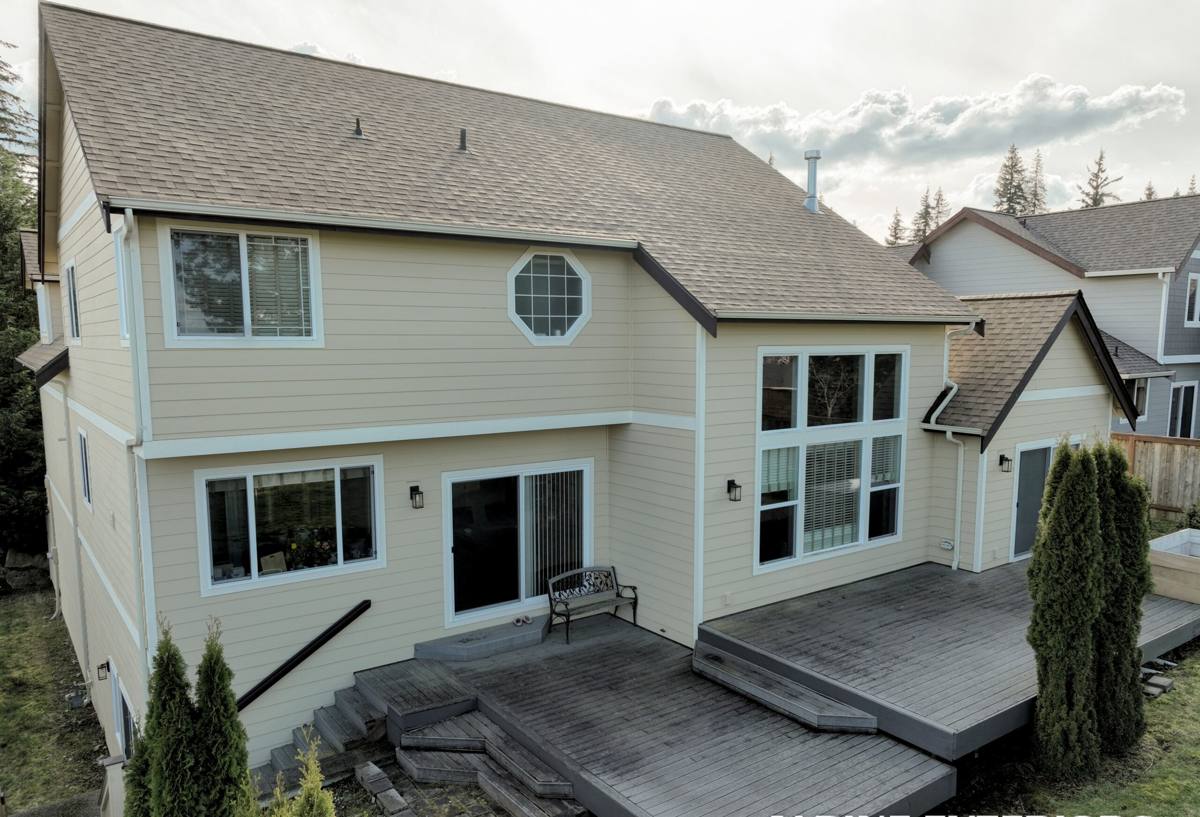
How the Climate Actually Damages a Deck
Moss and Algae Growth
Moss doesn't just look bad — it holds moisture directly against the wood or decking surface, which accelerates rot underneath even when the top of the board still looks intact. Shaded, north-facing decks and any deck under a tree canopy are the most common places we find this in Kendall. Once moss gets established between deck boards or in ledger connections, it's doing damage you can't see from a normal walk-through.
Driving Rain and Standing Water
Whatcom County's rain doesn't fall straight down most of the year — wind-driven rain gets pushed under railings, into board gaps, and against ledger boards where the deck meets the house. Poor drainage and boards that were installed too tight (with no gap for water to shed) are the biggest culprits we find in older or DIY-built decks.
Freeze-Thaw and Long-Term Swelling
Kendall's inland location means slightly colder winter nights than the coast. Wood that stays saturated through the wet season and then freezes will crack and split at a faster rate than wood that gets a chance to dry out. Repeated wet-dry-freeze cycles are one of the main reasons fasteners back out and boards cup over time.
Signs Your Deck Needs Repair Now
Most deck failures don't happen all at once — they show warning signs for a season or two first. If you're seeing any of the following, it's worth having it looked at before the next wet season:
- Soft or spongy spots when you walk across the deck, especially near the house or stair landing
- Boards that have visibly cupped, split, or separated from the joists
- Rust streaks around fasteners, or screws/nails that have backed out or spun freely
- A ledger board (where the deck attaches to the house) that shows staining, gaps, or soft wood
- Railings or posts that wobble or flex under normal pressure
- Persistent moss or dark staining that keeps coming back after cleaning
- Stairs that feel uneven, bouncy, or have visible gaps at the stringers
Any of these on their own might be a simple fix. Several at once, especially near the ledger or support posts, usually points to a structural issue that needs to be opened up and inspected properly.
What a Correct Deck Repair Actually Involves
Checking the Structure First
Before we touch a single deck board, we check the framework underneath: ledger board attachment, joist condition, post bases, and how water has been draining (or not draining) around the foundation of the deck. A deck that looks fine on top can still have a ledger connection that's been slowly rotting from moisture trapped between the house and the deck — this is one of the most serious issues we find, because it affects how safely the deck is attached to the structure at all.
Repairing or Replacing Decking
Once the framework is sound, we address the surface: replacing individual boards that have failed, correcting board spacing so water can actually shed instead of pooling, and re-securing anything that's come loose. We don't just swap out the obviously bad boards and leave neighboring ones that are already showing early rot — that leads to another repair call within a year or two.
Railings, Stairs, and Fasteners
Railings and stairs take a different kind of abuse — repeated flexing, foot traffic, and hand contact — and they're also a safety issue, not just a cosmetic one. We check post attachment, guard height and spacing where it's a factor, and replace any fasteners that have corroded rather than just tightening what's there.
Drainage and Ventilation
A repair that doesn't fix the underlying moisture problem is a repair that fails again. That can mean adjusting how water is directed away from the ledger, improving airflow underneath a low deck, or correcting grading that's pushing water back toward the structure.
Repair vs. Replacement: How We Make the Call
Not every damaged deck needs to be torn out. We look at how much of the structure is still sound versus how much has been compromised, and we're honest with you either way — there's no benefit to us talking you into a full rebuild if a targeted repair will hold up.
| Factor | Usually Repairable | Usually Needs Replacement |
|---|---|---|
| Framework (joists, posts) | Solid, no soft spots when probed | Widespread soft or crumbling wood |
| Ledger board | Attached tight, no rot at connection | Rot, gaps, or improper flashing at the house |
| Decking boards | A handful of boards failed, rest sound | Most boards cupped, split, or rotted |
| Age of structure | Under 15-20 years, built to code | Older, undersized framing, or unpermitted additions |
| Railings/stairs | Loose but structurally attached | Posts rotted at the base or disconnected from framing |
In practice, most of the calls we get in Kendall fall into the repair category — a rotted ledger connection, a handful of failed boards, or a railing that's become unsafe. Full replacement usually comes up when the original deck was undersized, poorly flashed, or well past its practical lifespan.
Materials We Use and Why
What we repair with depends on what's already there and what the homeowner wants going forward. For wood decks, we match species and treatment level so the repaired section weathers consistently with the rest of the structure. For composite or PVC decking, we use manufacturer-approved fasteners and hardware, because mixing incompatible materials is one of the fastest ways to void a warranty or cause galvanic corrosion at the connection points.
We're选择性 about fasteners specifically because of this climate: standard steel screws and nails corrode faster in a consistently damp environment, and a rusted fastener is often the first failure point on an otherwise sound deck. We use corrosion-resistant, exterior-rated hardware sized correctly for the framing it's going into, not whatever's fastest to install.
For any structural framing repairs, we use pressure-treated lumber rated for ground contact where it's called for, and we make sure cut ends are sealed — an untreated cut end is an open door for moisture, even on treated stock.
Our Process, Start to Finish
1. On-Site Inspection
We walk the whole deck, probe suspect areas, and check the ledger, posts, and framing — not just the parts that are visibly failing.
2. Honest Scope and Estimate
You get a clear explanation of what's actually wrong, what needs to be repaired now versus what can wait, and a written estimate before any work starts.
3. The Repair Itself
We work from the structure out — framing and ledger first, then decking, then railings and stairs — so nothing gets covered up before it's confirmed sound.
4. Final Check
Before we consider the job done, we walk it with you, check for level, secure fasteners, and confirm drainage is actually directing water away from the structure.
Why Hire a Crew That Already Works in Kendall
Deck problems here follow patterns — where moss builds up, which ledger details fail first, how shaded lots behave differently from open ones. A contractor who's already worked on decks in this specific area isn't guessing at how Whatcom County's wet season will affect a repair a year or two down the line; they've already seen it play out on other decks nearby. That local experience shows up in small decisions — board spacing, fastener choice, where extra flashing is worth the effort — that matter more here than they would in a drier climate.
It also matters for straightforward logistics: knowing the area means fewer surprises on scheduling, material delivery, and working around Ferndale-area permitting when a repair crosses into structural or code-related territory.
Get a Straight Answer on Your Deck
If your deck in Kendall has soft spots, a stubborn moss problem, or a railing that doesn't feel as solid as it used to, it's worth getting an honest look before another wet season adds to the damage. We offer free, no-pressure estimates — fill out the form below and we'll take a look and tell you plainly what it needs.