 Ferndale Siding
 Siding Replacement Built for Everson's Weather, Not Just Its Homes
Everson sits in the part of Whatcom County where the weather doesn't ease up for long. Homes here go through months of steady rain, damp air that never quite dries out, and shaded stretches where moss and algae get a foothold on anything that stays wet long enough. Siding that isn't built for that cycle starts showing it early — softening at the bottom edges, staining under eaves, or just looking tired years before it should. A siding replacement in Everson isn't a cosmetic project. It's a decision about what's going to stand between your house and this climate for the next few decades.
We work throughout Whatcom County, and Everson gets the same regional pattern as the rest of it: long stretches of driving rain, a moss season that can run most of the year in shaded spots, and enough humidity that anything porous or poorly sealed eventually pays for it. That's the lens we bring to every replacement job here, not a generic checklist.
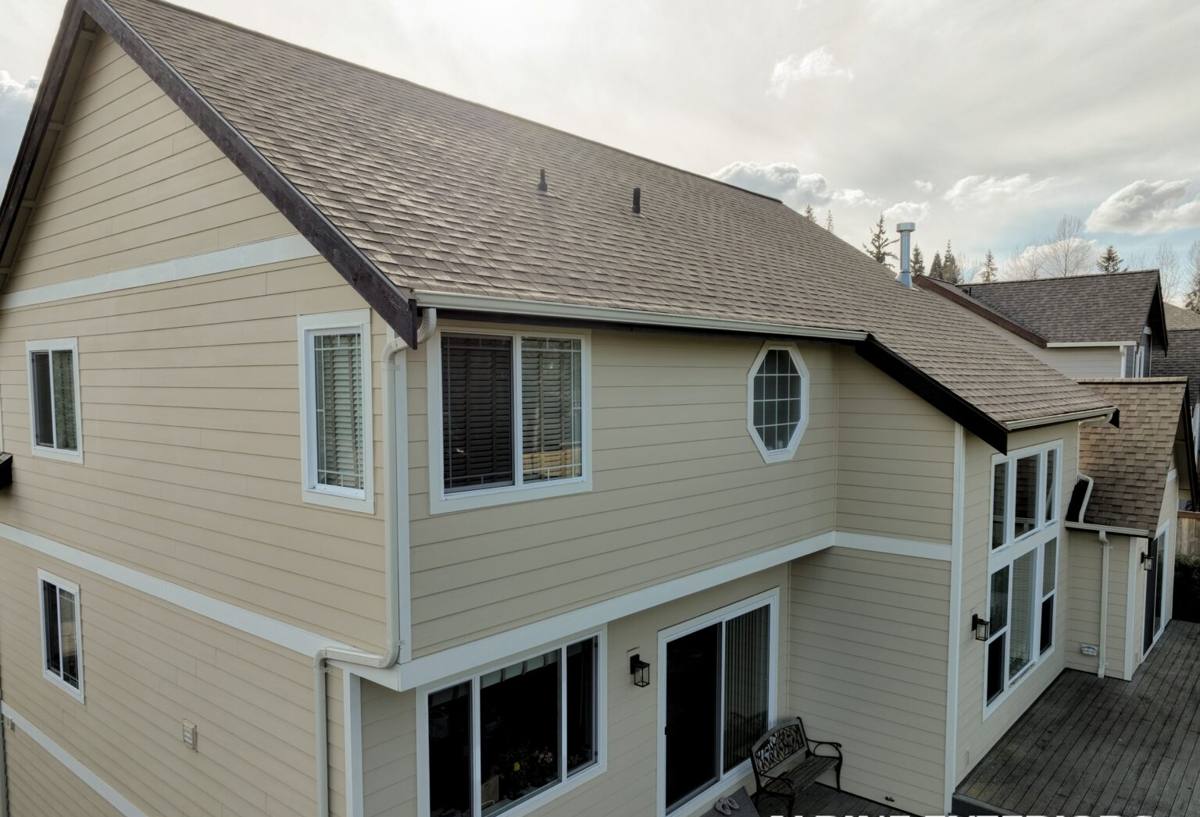
Signs an Everson Home Is Overdue for New Siding
Most homeowners don't wake up one day and decide they need new siding — it's usually a slow accumulation of small warning signs that finally add up. Watch for:
- Soft or spongy spots when you press on the siding, especially near the bottom courses or below windows
- Paint that won't hold anymore, even after a fresh coat — a sign moisture is working from underneath
- Visible moss, algae, or dark streaking that comes back within a season of cleaning it off
- Gaps, warping, or boards that have pulled away from the wall line
- Rising energy bills that don't match your usage — a clue the wall assembly behind the siding has lost its seal
- Visible rot at corners, seams, or anywhere trim meets siding
Any one of these can be a minor fix. Several at once, especially on a home that's been through fifteen-plus Whatcom County winters, usually means the siding system as a whole has reached the end of what it can do.
What Whatcom County's Climate Actually Does to Siding
Rain That Doesn't Come and Go — It Sits
The Pacific Northwest doesn't just get rain; it gets rain that lingers. Siding here spends long stretches at high moisture levels rather than getting a quick soak and a chance to dry. Products that absorb water or swell at cut edges and seams take a beating under that pattern, even if they look fine the first few years.
A Moss Season That's Nearly Year-Round
Shaded north walls, tree cover, and consistent dampness give moss and algae exactly what they need. Once organic growth gets a grip on a porous or textured surface, it holds moisture against the wall longer, which accelerates whatever damage is already starting underneath.
Salt-Influenced Air Moving Inland
Whatcom County's proximity to Puget Sound and the Strait of Georgia means the broader region deals with salt-influenced air, particularly on wind-driven days. Combined with constant humidity, that's a tougher environment for coatings, fasteners, and any material with cardboard-adjacent wood fiber facing than a dry inland climate would be.
Freeze-Thaw at the Margins
Everson winters aren't brutal, but they're not nothing either. Occasional hard freezes after a wet stretch put stress on any siding that's already saturated or has moisture trapped behind it — that's when cracking and delamination show up.
Why We Install Only James Hardie Fiber Cement
We made a deliberate call years ago to install one siding system and stand behind it fully: James Hardie fiber cement. We don't install vinyl, LP SmartSide, Cemplank, Allura, primed spruce, or cedar. That's not about brand loyalty — it's about what actually holds up through the pattern of weather described above.
Fiber cement is non-combustible and dimensionally stable, meaning it doesn't swell, warp, or absorb water the way wood-based products can. James Hardie's ColorPlus finish is baked on at the factory under controlled conditions, which gives it better fade and moisture resistance than field-applied paint — a real advantage in a climate where a paint job is fighting rain most of the year. Hardie also engineers specific product lines (their HZ5 line, for example) for climates with heavier moisture exposure, which fits Whatcom County better than a one-size-fits-all product.
None of this means other products are junk — vinyl and engineered wood siding both have legitimate uses and loyal installers. But we've chosen to specialize in one system we can install to spec every time and back with a strong transferable warranty, rather than spread our crews thin across several products with different installation rules, different failure points, and different long-term track records in this specific climate.
What a Correct Siding Replacement Actually Involves
Replacing siding is not just pulling old boards off and nailing new ones on. On a home in Everson's climate, the parts you don't see matter as much as the parts you do:
- Full tear-off and inspection. Removing the old siding exposes the sheathing, framing, and any hidden rot or moisture damage that's been building for years.
- Repair before covering anything up. Damaged sheathing or framing gets replaced — covering rot with new siding just hides the problem.
- Weather-resistive barrier and flashing. A properly lapped house wrap and correctly installed window, door, and penetration flashing are what actually keep water out — the siding is the second line of defense, not the first.
- Rainscreen or drainage gap where called for. Giving the wall assembly a way to drain and dry is one of the biggest differences between siding that lasts and siding that traps moisture.
- Correct fastening and clearances. James Hardie has specific nailing patterns, gaps, and ground clearance requirements — skip them and you undercut the product's own warranty.
- Caulking and trim details done to spec. This is where a lot of failures start on rushed jobs — improperly sealed joints let water behind the siding regardless of how good the panels themselves are.
Skip or rush any one of these steps and you can end up with premium siding failing at the same rate as a cheap product, just for different reasons.
Our Process, Start to Finish
1. Free On-Site Estimate
We walk the exterior with you, look at what's actually happening under the surface where we can, and talk through what your home needs — not a generic package.
2. Written Scope and Pricing
You get a clear, itemized proposal: what's being removed, what's being repaired, the Hardie product and color, and the timeline. No vague allowances.
3. Prep and Protection
Landscaping, windows, and walkways get protected before tear-off starts.
4. Tear-Off, Repair, and Weather Barrier Install
This is the stage that determines whether the job lasts — sheathing repairs, house wrap, and flashing all happen before a single piece of new siding goes up.
5. Hardie Installation to Manufacturer Spec
Correct fastening, clearances, and caulking, installed by a crew that installs this one product consistently rather than switching between systems.
6. Final Walkthrough
We go over the finished work with you directly and make sure everything matches what was scoped.
What Affects the Cost of a Siding Replacement
| Factor | Why It Matters |
|---|---|
| Extent of hidden damage | Rotted sheathing or framing found during tear-off adds repair scope before new siding can go on |
| Home size and wall complexity | More corners, gables, and trim details mean more labor and material |
| Siding profile and color | Lap width, texture, and ColorPlus color selections affect material cost |
| Access and site conditions | Steep grades, tight lot lines, or limited equipment access add labor time |
| Trim and detail work | Window and door trim, fascia, and soffit work scoped alongside siding changes the total |
| Removal and disposal | Full tear-off of old material adds disposal cost versus a simple recover, which we don't recommend over damaged substrate |
We don't quote a number without seeing the home — anyone who does is guessing, and on a job where hidden damage is common in this climate, a guess isn't useful to you.
Why Hiring a Crew That Already Works in Everson Matters
Siding installed to the letter of a manufacturer's spec sheet in a dry climate can still fail here if the crew doesn't understand what Whatcom County weather actually does to a wall assembly over time. A contractor who works this area regularly already accounts for the drainage details, flashing choices, and moss-prone shaded elevations that matter locally — it's not something you have to explain or hope they figure out. That familiarity shows up in fewer callbacks and a job that's still performing well a decade in, not just on move-in day.
It also matters for warranty follow-through. A crew based in the region is still around and reachable if a question comes up years later, rather than having moved on to a different market entirely.
A Quick Checklist Before You Sign a Siding Contract
- Get a written scope that names the exact product, line, and color — not just "fiber cement" or "siding"
- Ask what happens if rot or damaged sheathing is found during tear-off, and how that's priced
- Confirm whether a weather-resistive barrier and proper flashing are included, not assumed
- Ask about the nailing pattern and clearances the crew follows and whether it matches manufacturer spec
- Check that the warranty is transferable if you sell the home
- Get references or examples of similar work in this climate, not just photos from a dry-climate install
If you're weighing a siding replacement for a home in Everson, we're glad to come take a look and give you a straightforward, no-pressure estimate — what we'd actually recommend for your home, not a one-size-fits-all pitch. Use the form below to get started.