 Ferndale Siding
 Cordata's Climate Puts Real Stress on Siding
Homes in the Cordata area face a specific combination of weather that most siding products were never designed to handle well long-term. This isn't generic "Pacific Northwest rain" marketing talk — it's a real set of conditions that shows up on siding inspections year after year: salt-laden air moving inland off the Sound, wind-driven rain that hits walls sideways instead of falling straight down, and long stretches of shaded, damp weather that keep exterior surfaces wet far longer than siding manufacturers assume in their standard testing.
Salt Air and Coastal Moisture
Even a few miles inland, salt air carries moisture and fine mineral content that accelerates corrosion on fasteners, trim, and any siding material with metal components or a finish that isn't fully sealed. Over years, this shows up as rust streaking, finish breakdown, and premature fastener failure — problems that are hard to see coming and expensive to fix once they start.
Driving Rain and Wind-Driven Exposure
Whatcom County storms don't always drop rain straight down. Wind pushes water sideways and upward under laps, around window trim, and into any gap that wasn't flashed or caulked correctly. Siding that relies on face-sealing alone — rather than a properly built drainage plane behind it — eventually lets water in, and once moisture gets behind siding it doesn't dry out quickly in this climate.
Moss, Shade, and Slow-Drying Facades
Mature tree cover and long overcast stretches mean north- and west-facing walls in particular can stay damp for days at a time. That's exactly the environment moss, algae, and mildew need to take hold. Siding that absorbs moisture, or that has seams and joints where organic growth can get a foothold, ages faster and needs more upkeep here than it would in a drier climate.
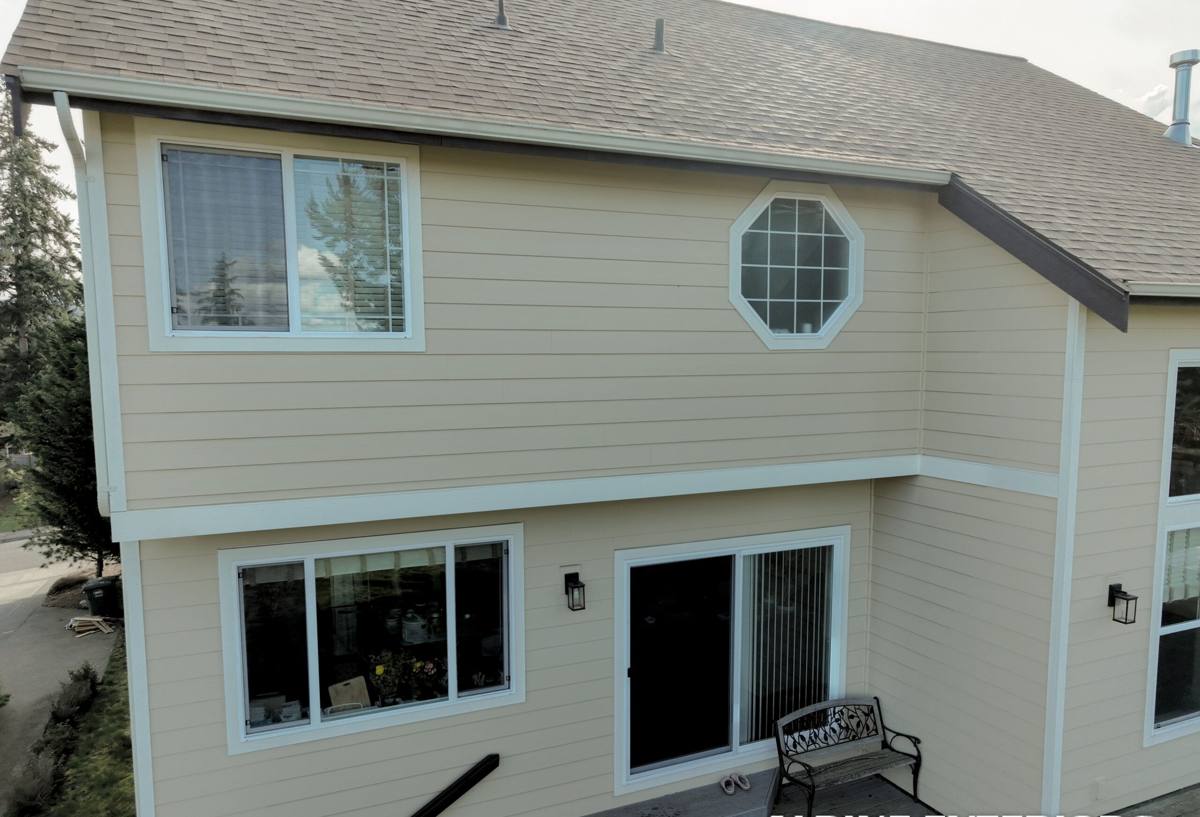
Why We Only Install James Hardie Fiber Cement Here
We standardized on James Hardie fiber cement siding for every job we take on, including in Cordata, and we don't install vinyl, engineered wood, or bare wood siding. That's not a marketing position — it's a decision based on what actually holds up in this specific climate. Fiber cement is non-combustible, dimensionally stable in wet-dry cycling, and doesn't feed mold or moss the way wood-based products can. Hardie's ColorPlus factory finish is baked on and warranted separately from the substrate, which matters in an area where UV exposure is lower but moisture exposure is high nearly year-round.
We're not going to tell you every other siding product is worthless — vinyl and engineered wood both have legitimate uses and loyal installers. But we've made a professional call: on homes we put our name behind in Whatcom County, we want a material that's proven against salt air, sustained moisture, and moss pressure without relying on the homeowner to stay on top of aggressive maintenance. That's Hardie.
What a Correct Fiber Cement Installation Involves
Fiber cement siding is only as good as the installation behind it. A huge share of the siding failures we get called out to inspect in this region aren't a materials problem — they're a workmanship problem. A correct install includes:
- A continuous weather-resistant barrier installed behind the siding, lapped correctly so water sheds outward at every seam
- Proper flashing at every window, door, deck ledger, and roof-to-wall transition — the spots where nearly all water intrusion actually starts
- Correct fastener type, spacing, and depth per Hardie's published installation specs, not generic siding nailing patterns
- Manufacturer-specified clearances from grade, roofing, and decks so the bottom edge of the siding never sits in standing moisture
- Caulked and painted cut edges, since an unsealed factory cut is the one spot on a Hardie board that isn't factory-protected
- Proper joint treatment at butt seams so water doesn't wick into the panel end grain
Skip any one of these steps and you can end up with a siding job that looks fine for a year or two, then starts showing staining, swelling at seams, or paint failure right where the water was actually getting in. This is the part of the job that separates a crew that occasionally installs Hardie from one that installs it correctly every time.
Matching the Right Hardie Product to a Cordata Home
James Hardie builds its siding in climate-specific HZ formulations, and homes in this region should be specified with the HZ5 line, engineered for wetter, colder climates rather than the hot-dry HZ10 formulation used in the Southwest. Beyond that, the right product choice comes down to the home itself:
HardiePlank Lap Siding
The most common choice for Cordata homes — available in several exposure widths and textures, it gives a traditional horizontal look with strong, tested water-shedding performance when the laps are installed to spec.
HardiePanel and Board-and-Batten
Popular on contemporary and craftsman-style homes for accent walls, gables, or full facades where a cleaner vertical line is the goal.
HardieShingle
Used for a shingle-style look on gables or full elevations without the moisture absorption and moss vulnerability that comes with actual wood shingles.
ColorPlus factory-finished color is worth strong consideration here specifically because it removes one variable: the paint job. In a climate this wet, a quality factory finish holds up longer than most field-applied paint, and it's backed by its own separate finish warranty.
How Fiber Cement Compares for This Climate
This is a general, honest comparison based on how these materials typically perform under sustained coastal moisture, moss pressure, and wind-driven rain — not a claim about any specific product line being defective.
| Factor | Fiber Cement (Hardie) | Vinyl Siding | Untreated Wood/Cedar | Engineered Wood |
|---|---|---|---|---|
| Moisture & rot resistance | Strong — cement-based, doesn't rot | Doesn't rot, but can trap moisture behind it | Vulnerable without diligent upkeep | Moderate — depends on resin/coating integrity |
| Moss & mildew resistance | Strong — inorganic surface | Moderate — moss grows on surface grime | Weak — organic material moss favors | Moderate — vulnerable if edges swell |
| Salt air durability | Strong when correctly finished | Can become brittle over time | Weathers and grays quickly | Moderate — coating-dependent |
| Maintenance | Low — periodic wash and caulk check | Low, but limited repair options if damaged | High — regular sealing/painting needed | Moderate — coating upkeep matters |
| Fire resistance | Non-combustible | Combustible | Combustible | Combustible |
Our Process, Start to Finish
Every Cordata-area project follows the same disciplined sequence, whether it's a single wall replacement or a full re-side:
- On-site assessment — we inspect the existing siding, sheathing, and any water damage or rot before quoting anything, since problems hidden behind old siding change the scope
- Written estimate — a clear breakdown of product, labor, and any sheathing or flashing repair the walls need
- Tear-off and inspection — old siding comes off and we check the sheathing underneath for soft spots or existing moisture damage before anything new goes up
- Weather barrier and flashing — a correctly lapped moisture barrier and flashing at every penetration, done before a single piece of siding is hung
- Hardie installation to manufacturer spec — proper fastening, clearances, and joint treatment throughout
- Caulking, touch-up, and final inspection — every cut edge sealed, every joint checked
- Site cleanup — full cleanup of old material and job debris before we consider the project done
What Affects Your Project's Cost
We don't publish blanket per-square-foot pricing because it genuinely depends on the home, but these are the real cost drivers we walk every Cordata homeowner through:
- Home size and wall complexity — more corners, gables, and trim detail mean more labor
- Condition of the existing sheathing — hidden rot or water damage found during tear-off adds repair cost, but it's cost you want to know about rather than cover up
- Product choice — lap siding, panel, and shingle profiles carry different material and labor costs
- Finish choice — ColorPlus factory finish versus field painting after install
- Trim and accessory work — window trim, corner boards, and fascia often get replaced alongside siding
- Access and site conditions — multi-story walls, tight lots, or landscaping that limits equipment access
Keeping Your Siding Looking Right in This Climate
Fiber cement is low-maintenance compared to wood, but "low-maintenance" isn't "no-maintenance," especially with the moss and moisture exposure common around Cordata. A short annual routine keeps a Hardie exterior looking and performing the way it should:
- Rinse the siding annually, focusing on shaded, north-facing walls where moss and algae take hold first
- Keep landscaping and tree branches trimmed back from siding so walls can actually dry between rain events
- Check and refresh caulking at trim, window, and door joints every couple of years
- Clear debris out of gutters and off any horizontal trim ledges where standing water can sit against the siding
- Watch for paint or finish changes near ground level, decks, and downspouts — early staining is easier and cheaper to address than a repair after moisture gets behind the board
Why Local Experience in Cordata Matters
A siding crew that already works this part of Whatcom County knows things a traveling or out-of-area installer doesn't: which wall orientations in this area take the worst of the wind-driven rain, how aggressive the moss season really gets on shaded lots, and what flashing and clearance details actually matter versus what's just code minimum. That local pattern recognition shows up in fewer callbacks and fewer surprises — not because the material is different, but because the installation decisions are informed by what actually happens to homes here, year after year.
If you're weighing a siding project for a Cordata-area home, we're happy to walk the exterior with you, point out anything we see, and put together a clear, no-pressure estimate — no obligation, just a straight assessment of what your home needs.