 Ferndale Siding
 Why Sandy Point Asks More of a Siding Job
Sandy Point sits right up against the water on a low, sandy stretch of Whatcom County shoreline, and that location changes what a house needs from its exterior. Homes here take on a combination that inland Ferndale properties don't deal with nearly as much: near-constant salt-laden air off the water, wind-driven rain that hits siding sideways instead of straight down, and a wet season that runs long enough for moss and algae to get a real foothold on anything that stays damp. Any one of those on its own is manageable. Together, over years, they expose weak points in a siding system fast — at seams, at fastener heads, at the bottom edge near grade, and anywhere caulk or paint is doing more of the waterproofing work than the material itself.
This page is specifically about James Hardie fiber cement siding on Sandy Point homes — not a general siding overview. We only install James Hardie, and this is why it holds up in this particular setting, what a correctly done job looks like out here, and what to expect from a crew that already knows this stretch of coastline.
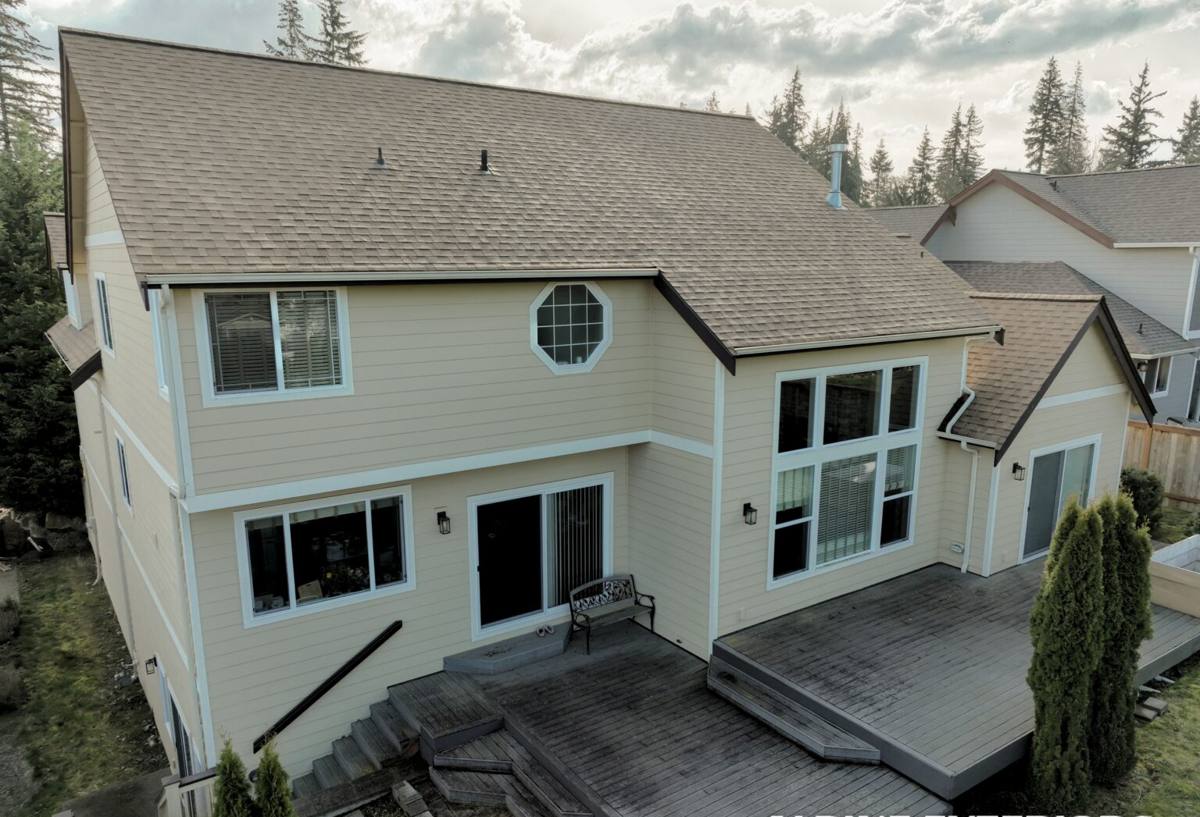
What Salt Air and Driving Rain Actually Do to a House
Salt Air
Airborne salt is corrosive and it's persistent — it settles on every exterior surface, works into hairline cracks, and accelerates the breakdown of anything that relies on paint film or a thin coating for protection. Fasteners, trim edges, and any exposed wood grain are the first places it shows up as premature wear.
Driving Rain
Wind off the water doesn't let rain run straight down a wall the way it does on a calm inland lot. It drives water sideways and upward into laps, seams, and any gap in the water-resistive barrier behind the siding. A siding system that depends on face-sealing (caulk and paint alone, with no drainage path behind it) will eventually let moisture in during a Sandy Point storm, even if it looks fine from the street.
Moss and Algae
Whatcom County's wet season is long, and a shaded, moisture-holding surface near the water grows moss and algae faster than the same surface would inland. Beyond the cosmetic issue, moss holds water against the siding face, which extends how long the wall stays wet after every storm — and that matters more for some materials than others.
Why We Install James Hardie Here — Not Something Else
We standardized on James Hardie fiber cement for every site we work, but the reasoning matters most in a place like Sandy Point:
- It's fiber cement, not wood-based. There's no wood fiber in the board to swell, rot, or feed fungal growth if water does find its way to an edge.
- It's engineered for wet climates. James Hardie's HZ5 product line is formulated for regions with more moisture exposure, which fits Whatcom County generally and a waterfront community like Sandy Point specifically.
- The factory finish carries the color, not a field-applied coat. ColorPlus finish is baked on at the factory and holds up to UV and moisture cycling better than most site-applied paint, which matters when salt air is working against the finish every day.
- It's non-combustible. Not a coastal-specific benefit, but a real one anywhere in the region during dry-season fire risk.
We're not going to tell you every other siding product is unusable — that's not honest, and it's not our call to make about your neighbor's house. What we will say is that after years of installing and standing behind our own work, we don't think vinyl, wood-based panel products, or unfinished cedar hold up to this specific combination of salt air, driving rain, and moss as reliably as correctly installed James Hardie does, and we'd rather install one product very well than several products adequately.
Material Comparison for Salt-Air, High-Moisture Exposure
| Factor | James Hardie Fiber Cement | Vinyl | Wood-Based Panel / Cedar |
|---|---|---|---|
| Moisture absorption | Very low; won't swell or rot | Doesn't absorb, but seams/panels can flex and gap over time | Absorbs moisture; prone to swelling and rot at edges |
| Salt air resistance | Factory finish resists fading and chalking | Can chalk and become brittle over time near salt air | Coatings break down faster; bare wood weathers quickly |
| Moss/algae susceptibility | Low; hard, non-porous surface | Low, but traps moisture behind panels if installed poorly | Higher; porous surface holds moisture longer |
| Fire rating | Non-combustible | Combustible | Combustible |
| Finish longevity | Factory-baked ColorPlus, long repaint interval | Color molded in, but fades/chalks with age | Requires regular repainting or restaining |
What a Correct Installation Involves on This Coastline
James Hardie siding performs the way it's supposed to only if it's installed to spec. In a driving-rain, salt-air environment, the details that get skipped on a rushed job are exactly the ones that fail first here.
Drainage Behind the Siding
A correct install includes a drainage plane and weather-resistive barrier behind the siding, not just caulked seams. Water that does get past the face needs somewhere to go — down and out, not trapped against the sheathing.
Fasteners and Hardware
In a salt-air setting, fastener choice matters more than usual. We use fasteners rated for the exposure so they don't become the first point of corrosion and staining on the wall.
Flashing and Laps
Every horizontal lap, window head, and penetration needs proper flashing and the correct overlap — installed so wind-driven rain can't find a way in from the side or from below.
Clearance at Grade and Hardscape
Siding needs proper clearance from grade, decking, and hardscape so it isn't sitting in standing moisture or splash-back, which is a bigger risk on low-lying, sandy lots close to the water.
Caulking and Sealant
Caulk is a backup layer, not the primary water management system. We use it where James Hardie's install specs call for it — not as a substitute for flashing and drainage done right.
ColorPlus Finish, Moss Resistance, and Long-Term Maintenance
One of the practical advantages of James Hardie's ColorPlus finish in a place like Sandy Point is how it ages. The factory finish is more UV- and moisture-stable than field-applied paint, so homeowners aren't repainting every few years just to keep ahead of salt air and sun. That said, no siding is maintenance-free in this climate — moss and algae will still grow on any exterior surface that stays shaded and damp long enough, James Hardie included. The difference is that a hard, factory-finished fiber cement surface is easier to clean without damaging the finish, and it doesn't feed the growth the way a porous wood surface can.
Homeowner Maintenance Checklist
- Rinse siding gently once or twice a year to clear salt residue and organic buildup, especially on north- and shade-facing walls
- Check caulking at trim, windows, and penetrations annually and re-caulk where it's cracked or pulled away
- Keep gutters clear so overflow isn't running down the siding face during storms
- Trim back vegetation and landscaping that keeps a wall section shaded and damp
- Watch for moss buildup at the lowest courses near grade and address it before it spreads
- Inspect fastener heads and trim edges every couple of years for any early signs of corrosion or staining
Our Process for a Sandy Point Job
Every project starts with a site visit, not a phone estimate — we want to see the actual exposure on your specific lot, which direction the prevailing wind and rain hit the house, where moss is already established, and where the existing siding or trim shows the most wear. From there:
- Assessment and measurement — we document exposure, existing water damage if any, and the sections that need the most attention to detail during install.
- Product and color selection — HZ5 panel and plank options and ColorPlus color selection suited to coastal exposure.
- Tear-off and inspection of sheathing — this is where hidden moisture damage from a previous siding system often shows up, and it gets addressed before anything new goes on.
- Weather barrier and flashing installation — the drainage and flashing details described above, done to manufacturer spec.
- James Hardie installation — proper fastening, clearances, and lap details for a marine exposure.
- Final walkthrough — we go over the finished work with you before calling the job done.
Because we work Sandy Point and the surrounding Ferndale area regularly, we plan around the weather windows that actually work here rather than treating it like an inland job with the same schedule assumptions.
Why Local Experience on This Stretch of Coast Matters
A crew that's only worked drier, inland sites can install James Hardie correctly on paper and still miss the details that matter specifically for salt air and driving rain — because those failure points don't show up until a few winters in. Working Sandy Point and the rest of the Ferndale coastline regularly means we've already seen how flashing, fastener choice, and drainage details hold up in this exact exposure, and we build every job around what actually survives it, not just what passes a general install checklist.
If you're planning a siding project on Sandy Point or anywhere along the Ferndale coast, we're happy to walk your property, look at your specific exposure, and put together a straightforward, no-pressure estimate — just fill out the form below.