 Ferndale Siding
 Why Siding Wears Differently Around Lummi Nation
Homes in and around Lummi Nation sit close enough to Bellingham Bay and the Strait of Georgia that salt-laden air is a constant, not an occasional visitor. Add Whatcom County's long wet season, driving rain off the water, and the kind of shaded, tree-lined lots common in this part of the county, and you get a climate that's genuinely tougher on exterior walls than what siding is rated for on a spec sheet written for a national market. We work this area regularly, and the failure patterns we see on older siding here are consistent: swelling at butt joints facing the water, moss and algae staking a claim on north- and west-facing walls, and paint that gives out years before it should because the substrate underneath was never built to shed this much moisture.
A siding replacement in this neighborhood isn't just a cosmetic upgrade. Done right, it's a chance to correct decades of moisture problems baked into the original construction and put a material and installation system on the house that's actually engineered for a marine, high-rainfall climate.
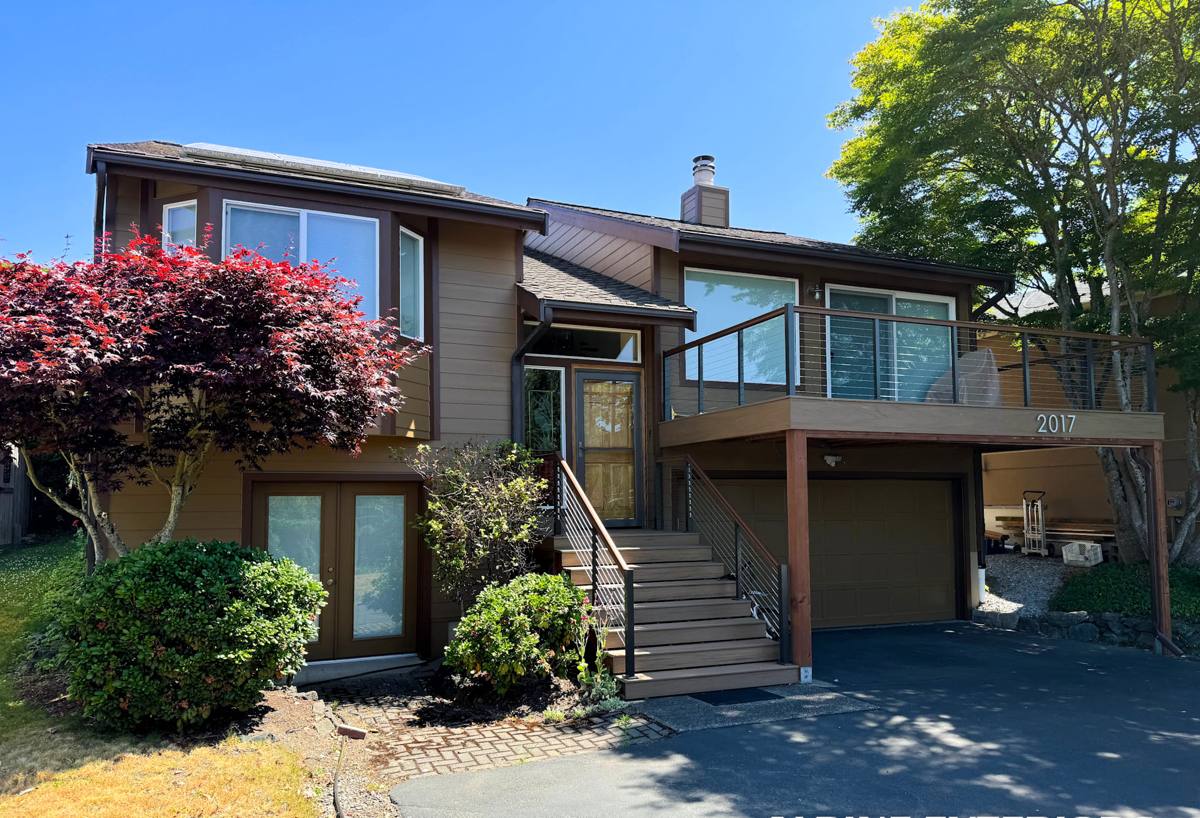
What Salt Air, Rain, and Moss Actually Do to a Wall
Salt-Laden Air
Airborne salt is corrosive to fasteners and metal flashing, and it's abrasive to paint films over time. On wood-based siding products, salt exposure accelerates the breakdown of surface coatings, which lets moisture into the substrate faster than it would inland. Once that starts, swelling, cracking, and edge delamination follow.
Wind-Driven Rain
Rain that comes in sideways off the water doesn't behave like rain falling straight down. It gets pushed up under laps, into seams, and behind trim if the flashing details and caulking weren't done correctly the first time. Whatcom County's rainfall totals aren't unusual for the Pacific Northwest, but the wind component near the water pushes more of that water directly onto and into the wall assembly than you'd see a few miles inland.
Moss and Shade
Wooded lots and cloud cover for much of the year keep siding damp longer between rain events. Moss and algae take hold on any surface that stays wet, and once established they hold moisture against the siding surface around the clock. On wood-based products this accelerates rot at the exact spots the moss colonizes — usually low on the wall, under eaves with poor overhang, and on the shaded side of the house.
What a Correct Siding Replacement Involves Here
Replacing siding correctly is not a matter of pulling off the old boards and nailing up new ones. In a climate like this, the layers you don't see matter as much as the finished product. A proper job includes:
- Full tear-off and inspection of the sheathing underneath for rot, soft spots, or prior water damage
- Repair or replacement of any compromised sheathing before new material goes up
- A correctly lapped water-resistive barrier (house wrap) installed shingle-style so water sheds outward, not inward
- New flashing at every window, door, and roof-to-wall intersection — not reused old flashing
- Rain screen or proper gapping where called for, so water that does get behind the cladding can drain and dry
- Correct fastener type, spacing, and depth for the specific siding product and wall assembly
- Sealant only where the manufacturer specifies it — over-caulking traps moisture instead of stopping it
Skip any one of these steps and the new siding will fail on the same timeline as the old siding did, just with a fresh coat of paint hiding the problem for a few more years.
Why We Only Install James Hardie Fiber Cement
We stopped installing vinyl, LP SmartSide, primed spruce, cedar, and other fiber cement brands on homes in this part of the county because we kept seeing the same coastal-climate failures repeat themselves regardless of how carefully the crew installed the product. James Hardie's fiber cement is cement, sand, and cellulose fiber — it doesn't absorb water the way wood-based products do, it won't swell at the seams the way engineered wood can in a wet climate, and it's non-combustible, which matters given how dry late-summer conditions can still get here even with the wet season on either side of it.
Hardie also makes a climate-specific product line — the HZ5 formulation — engineered for regions with freeze-thaw cycles and heavy moisture exposure, which fits western Whatcom County better than a generic national product. The factory-applied ColorPlus finish is baked on under controlled conditions rather than field-painted, which means better adhesion and a longer color life in an environment where UV and salt both work against paint. It's backed by a strong transferable warranty on both the material and the finish, which matters if the home changes hands.
None of this means other products are unusable everywhere — vinyl and engineered wood have real markets and real advantages in the right climate. It means that for the specific combination of salt air, driving rain, and moss pressure we see on Lummi Nation and Ferndale-area homes, we no longer think they hold up well enough to put our name behind the installation.
Our Process for a Lummi Nation Siding Replacement
1. On-Site Assessment
We walk the exterior, check for moisture intrusion at trim, corners, and penetrations, and look at how the house is currently oriented to prevailing wind and rain. This tells us where the wall assembly needs extra attention, not just where the old siding looks worn.
2. Scope and Estimate
You get a written scope covering tear-off, sheathing repair allowances, water-resistive barrier, flashing, the specific Hardie product and profile, and finish color — no vague line items.
3. Tear-Off and Sheathing Repair
Old siding comes off, sheathing gets inspected board by board, and anything soft or rotted is replaced before anything new goes up.
4. Weather Barrier and Flashing
New house wrap and all-new flashing go in with attention to how water needs to move on this specific site — near the water, we don't take shortcuts here.
5. Hardie Installation
Panels or lap siding go up to manufacturer fastening and clearance specs, with trim and joint treatment matched to the coastal exposure of each wall face.
6. Final Walkthrough
We review the finished work with you, including basic care guidance for keeping moss and algae from getting a foothold on the new surface.
What It Costs and What Drives the Price
Every siding replacement is priced off the actual scope of your home, but the factors below are what typically move a Lummi Nation-area project up or down in cost.
| Cost Factor | Why It Matters Here |
|---|---|
| Sheathing condition | Coastal moisture exposure means a higher chance of hidden rot that has to be repaired before new siding goes on |
| Wall complexity | Homes with more corners, dormers, and roof-to-wall intersections need more flashing and labor |
| Siding profile and finish | Lap width, panel style, and ColorPlus color selection affect material cost |
| Trim and detail work | Window and door trim, fascia, and soffit work are often bundled with a full replacement |
| Site access | Tree cover and lot layout common in this area can affect staging and scaffolding needs |
| Tear-off and disposal | Multiple layers of old siding or hidden damage add to demo and haul-away time |
We'd rather walk your specific home and give you real numbers than quote a range that doesn't mean much either way.
Signs Your Siding Needs Replacing, Not Just Patching
Not every siding problem near the water calls for a full tear-off. But a few signs usually mean patching won't hold:
- Soft or spongy spots when you press on the siding, especially near the bottom courses
- Persistent moss or algae growth that comes back within weeks of cleaning
- Visible swelling, bubbling, or separation at panel seams and butt joints
- Paint that's failing in patches rather than evenly across the wall
- Interior signs of moisture — stained drywall or trim near exterior walls
- Siding that's original to a home built more than 20-25 years ago in an untreated wood or older composite product
Living With New Siding in This Climate
Fiber cement siding cuts maintenance significantly compared to what most homeowners here are used to, but it isn't zero-maintenance. A rinse-down once or twice a year knocks back early moss and salt residue before it can establish itself, and keeping gutters clear reduces the water load running down the wall face during heavy rain events. Beyond that, ColorPlus finishes are designed to go a long stretch without repainting, which is a real advantage in a climate where repainting cycles on other materials tend to run short.
Why Local Experience Matters
A siding job specced for a dry inland climate — standard fastener schedules, minimal flashing detail, no thought given to wind-driven rain — will underperform on a home this close to the water, even if the crew doing the work is competent in general. We work Ferndale and the surrounding Whatcom County coastline regularly enough to know which wall orientations need extra flashing attention, where moss pressure is worst, and how to detail a Hardie installation so it's actually built for this specific stretch of coastline rather than a generic climate zone.
If your siding is showing its age or you're planning ahead for a replacement, we're happy to come take a look and walk you through exactly what your home needs. Reach out for a free, no-pressure estimate using the form below.