 Ferndale Siding
 Why Sandy Point Wears Out Siding Faster Than Most of Whatcom County
Sandy Point sits right on the water along the Strait of Georgia, and that location changes the math on siding. A house three miles inland in Ferndale deals with our normal Pacific Northwest wet season. A house in Sandy Point deals with that same wet season plus salt-laden air blowing straight off the water, plus wind-driven rain that hits siding at an angle instead of falling straight down, plus the deep shade and dampness that many waterfront lots hold onto because of tree cover and proximity to the beach. Individually, none of those factors is unusual for Western Washington. Together, on a daily basis, they age siding faster than almost anywhere else in the county.
We bring this up first because it changes what "good siding" means for a Sandy Point home. A product that performs fine in a typical Ferndale subdivision can fail early a few miles away on the water. If you're planning a siding replacement out here, the material choice and the installation details both need to account for that difference — not just the style you want.
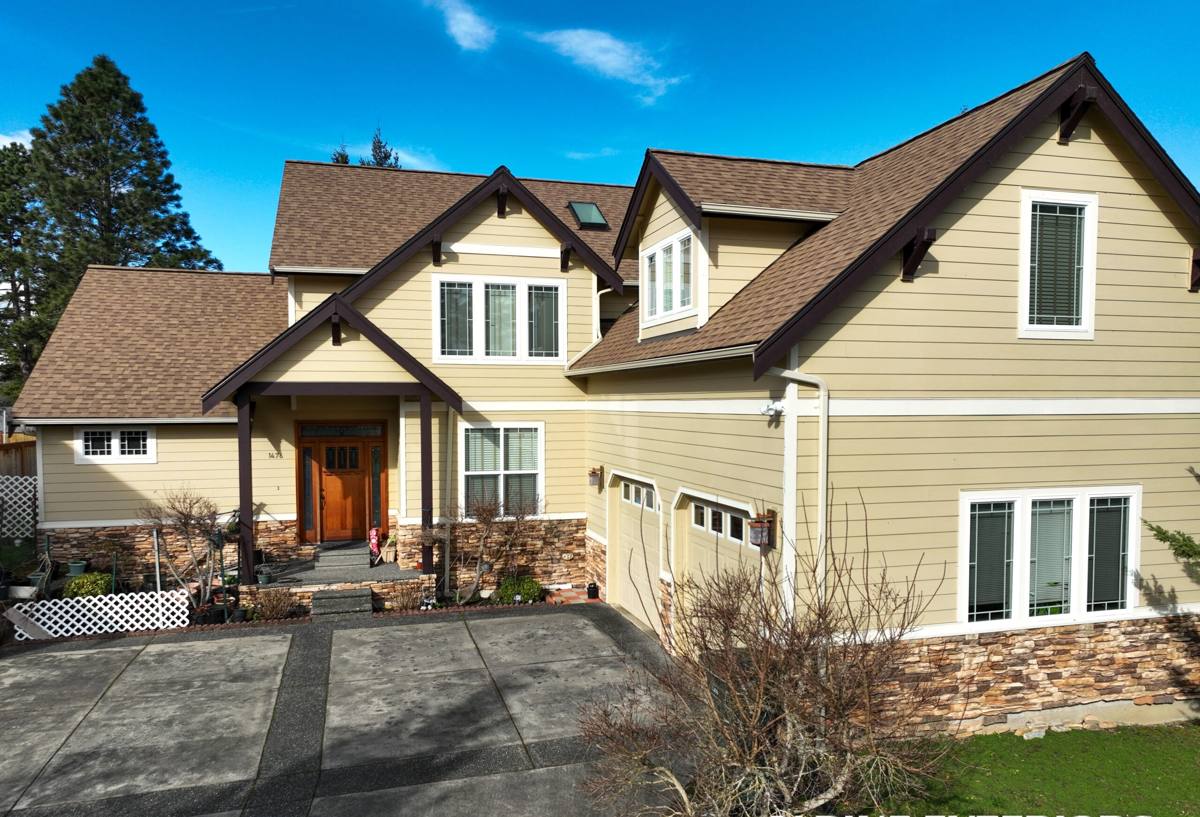
What Salt Air, Driving Rain, and Moss Actually Do to Siding
Salt air
Airborne salt is corrosive and it doesn't stay near the beach — wind carries it inland and deposits it on siding, trim, and especially fasteners. Over years, salt exposure accelerates corrosion of any metal component that isn't rated for it, and it can degrade certain coatings and caulks faster than manufacturers' standard testing assumes. This is one of the biggest reasons material choice matters more here than it does a few miles inland.
Driving rain
Wind off open water pushes rain sideways into wall assemblies, not just down onto rooflines. That means water finds its way into laps, joints, and penetrations that would stay dry in a calmer setting. If the water-resistive barrier, flashing, and drainage details behind the siding aren't done correctly, driving rain is what exposes the mistake — sometimes years later, as rot inside the wall rather than a visible leak.
Moss and prolonged dampness
Whatcom County's moss season is long to begin with, and shaded, humid waterfront lots often stay damp longer after a rain than an open, sunnier lot would. Moss and algae hold moisture against the siding surface, which is hard on paint films and can accelerate deterioration of materials that aren't dimensionally stable when wet.
How Different Siding Materials Actually Hold Up Out Here
We get asked constantly why we don't install certain popular products on Sandy Point homes. Here's an honest, non-hype comparison of how common siding materials behave under salt air, driving rain, and heavy moss exposure — not how they perform in a lab or in a dry climate.
| Material | Behavior Near Salt Air & Heavy Moisture | Long-Term Consideration |
|---|---|---|
| Vinyl siding | Can warp or fade under sun/wind exposure over time; seams and J-channels are common water entry points if not detailed carefully | Lower upfront cost, but limited ability to manage the moisture load a waterfront wall assembly sees |
| LP SmartSide (engineered wood) | Wood-based core is more sensitive to sustained moisture exposure than fiber cement; edge sealing and maintenance matter a great deal | Performs best with diligent upkeep; less forgiving of installation gaps in a wet, salty environment |
| Cedar / primed wood | Traditional look, but organic material that needs regular refinishing to resist moisture, moss, and rot in a shaded, damp setting | Highest ongoing maintenance burden of the common options |
| James Hardie fiber cement | Non-combustible, dimensionally stable when wet, engineered HZ5 product line built for climates like ours | Factory-applied ColorPlus finish resists fading and doesn't rely on field-applied paint for its primary protection |
Every one of these products has a legitimate place somewhere. We simply made a standard for our own crews: on homes exposed to this much salt, rain, and dampness, we only install James Hardie fiber cement, and we stand behind that decision because we've seen how the alternatives age out here over the long run.
What a Correct Siding Replacement Involves on a Sandy Point Home
Replacing siding correctly on a waterfront property is not the same job as re-siding a house on a dry, inland lot. The material matters, but so does everything underneath it. A proper replacement here includes:
- Full removal of old siding down to the sheathing, so hidden rot, soft spots, or prior moisture damage get caught before new siding goes up
- A continuous water-resistive barrier, correctly lapped and sealed at every seam, penetration, and transition
- Properly integrated flashing at windows, doors, decks, and roof-to-wall intersections — the details driving rain finds first
- A drainage gap or rain-screen approach where conditions call for it, so any moisture that does get behind the cladding can drain and dry instead of sitting against the wall
- Corrosion-resistant fasteners appropriate for a salt-air environment, installed per the manufacturer's spacing and clearance requirements
- Correct minimum clearance between the siding's bottom edge and grade, decks, roofs, and walkways, so splash-back and standing moisture don't sit against the material
- Manufacturer-specified caulking and sealant only at the joints designed to be sealed — over-caulking traps moisture just as badly as under-caulking lets it in
Skip or rush any one of those steps and the siding itself almost doesn't matter — the wall assembly will fail at its weakest point, and on a waterfront lot, that weak point gets tested constantly.
Why We Install Only James Hardie Fiber Cement Here
James Hardie's HZ5 product line is engineered specifically for climates that see a lot of moisture and temperature swings, which describes Sandy Point about as well as anywhere in Western Washington. Fiber cement is non-combustible, holds its shape and dimensions when wet, and doesn't rely on a coat of paint sitting on top of it as its primary defense against the weather — the ColorPlus factory finish is baked on under controlled conditions and backed by its own finish warranty, separate from the product warranty on the siding itself.
That matters most in exactly the conditions Sandy Point sees: sun, salt, and rain cycling on the same wall, week after week, for decades. We're not against every other product on the market — we simply won't put our name on an installation where we don't trust the material to hold up to this specific environment, and Hardie is the one we've standardized on for that reason.
Our Process for a Sandy Point Siding Replacement
| Step | What Happens |
|---|---|
| 1. On-site assessment | We walk the exterior, check for existing moisture or rot damage, and evaluate sun/shade exposure and wind direction specific to your lot |
| 2. Written estimate | You get a clear scope of work and pricing before anything is scheduled — no pressure, no surprise add-ons hidden in fine print |
| 3. Tear-off and sheathing check | Old siding comes off and we inspect the sheathing underneath before anything new goes on |
| 4. Barrier and flashing installation | Water-resistive barrier, flashing, and drainage details go in first — this is the step that determines whether the job lasts |
| 5. Hardie installation | Siding is installed to manufacturer spec, with corrosion-resistant fasteners and correct clearances throughout |
| 6. Final walkthrough | We review the finished exterior with you and go over basic care before we consider the job done |
Cost Factors for a Sandy Point Siding Replacement
Every home is different, so we won't quote a number here — but these are the factors that actually move the price on a job like this:
| Factor | Why It Affects Cost |
|---|---|
| Condition of the sheathing underneath | Hidden moisture damage found during tear-off adds repair work before new siding can go on |
| Home size and wall complexity | Cutouts, corners, and multiple stories all add labor time |
| Siding profile and trim selection | Different Hardie profiles and trim packages carry different material costs |
| Access and site logistics | Waterfront lots sometimes have tighter access, slope, or seasonal scheduling considerations |
| Existing flashing and drainage detail work needed | Bringing older moisture-management details up to a proper standard takes time but pays off in longevity |
The only way to get an accurate number is a walk-through of your specific home, which is exactly what our free estimate covers.
After Installation: What Sandy Point Homeowners Should Keep an Eye On
James Hardie siding installed correctly is genuinely low-maintenance, but "low-maintenance" doesn't mean "no attention needed" in a salt-air, high-moss environment. A short seasonal checklist goes a long way:
- Rinse salt residue and grime off the siding surface periodically, especially on walls facing the water
- Keep gutters and downspouts clear so water isn't overflowing and running down the wall face
- Trim back vegetation and tree cover that keeps a wall shaded and damp longer than it needs to be
- Check caulking at trim and penetrations once a year and have any cracked or missing sealant addressed promptly
- Watch for moss or algae buildup at the base of walls and in shaded corners, and address it before it spreads
Why It Matters to Hire a Crew That Already Works Sandy Point
A contractor who mostly works inland, drier lots in Ferndale or Bellingham can do fine work and still get the details wrong on a waterfront home, simply because they're not used to designing for this level of salt and wind-driven rain exposure. A crew that already works Sandy Point knows to slow down on flashing details, knows which fastener specs actually hold up out here, and has seen firsthand what happens to a wall assembly when those details get skipped. That experience doesn't show up in a sales pitch — it shows up ten years later, in whether the siding is still doing its job.
If you're weighing a siding replacement on a Sandy Point home, we're happy to walk the exterior with you, point out anything we notice, and put together a clear, honest estimate — no pressure, no obligation.