 Ferndale Siding
 Bellingham's Climate Is Harder on Siding Than It Looks
Bellingham sits close enough to Bellingham Bay and the Salish Sea that homes here deal with a combination most siding products were never designed for: salt-laden air moving inland off the water, long stretches of driving rain pushed sideways by wind off the Strait, and a moss and algae season that can run most of the year on shaded or north-facing walls. None of these forces are dramatic on their own. The damage they do is cumulative, and it shows up as soft trim, peeling paint, swelling panel edges, and dark green staining that keeps coming back no matter how many times it gets pressure-washed off.
Whatcom County's marine climate keeps humidity high for most of the year, which means siding rarely gets a long, dry stretch to fully release moisture it has absorbed. Wood-based products and some fiber cement alternatives depend on exactly that kind of drying window to stay stable. When it doesn't come, moisture just accumulates in the material, layer after layer, season after season.
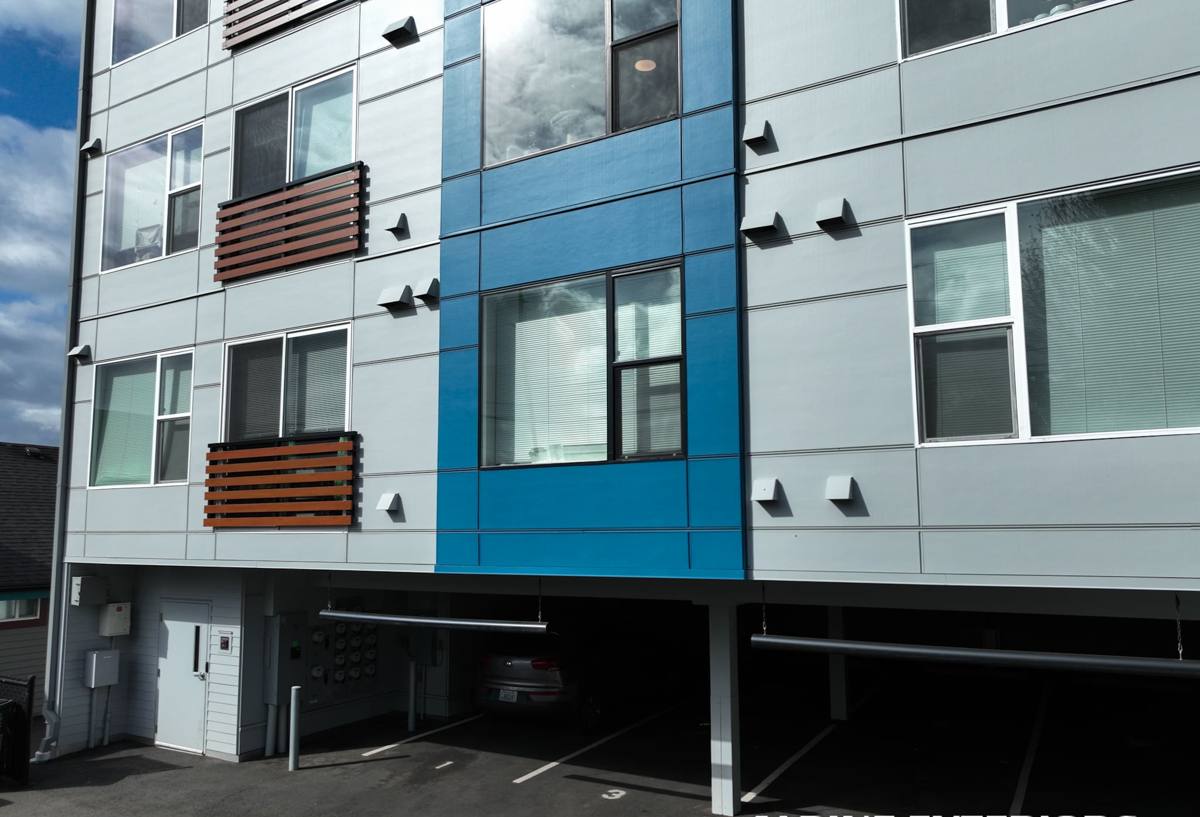
Why We Only Install James Hardie in This Area
We made a deliberate decision to install James Hardie fiber cement siding exclusively, and not vinyl, not LP SmartSide, not Cemplank or Allura, and not primed spruce or cedar. That is not a marketing position. It's a standard we hold because of what we've seen these products do, and not do, in exactly this climate over time.
Vinyl siding can warp and become brittle under repeated wet-dry cycling and UV exposure, and its seams give wind-driven rain more opportunities to find a way behind the cladding. Engineered wood products like LP SmartSide use wood strand cores that are more moisture-resistant than raw lumber but still rely on intact factory sealant and careful field sealing at every cut edge to keep water out over the long run. Primed spruce and cedar are natural products, and natural products absorb water, which is exactly what a salt-air, high-rainfall environment tests hardest. James Hardie's fiber cement formulation is cement, sand, and cellulose fiber. It doesn't rot, it doesn't feed insects, and it isn't a fuel source, which matters in a region that also deals with wildfire smoke and occasional ember exposure during dry summer stretches.
The HZ5 Engineering Difference
James Hardie engineers its siding by climate zone, and homes in this part of Washington fall into the HZ5 category, formulated for wetter, more moisture-variable conditions than the HZ10 product sold in the arid Southwest. That distinction matters more than most homeowners realize. A siding product engineered for a dry climate and installed here will behave differently than one engineered for exactly the conditions Bellingham sees, particularly around moisture absorption rates and long-term dimensional stability.
What Salt Air and Moss Actually Do to a Wall System
Salt air accelerates corrosion on any exposed metal, fasteners, flashing, trim caps, so the quality and placement of those components matters as much as the siding panel itself. A siding job that looks fine on day one but used undersized or improperly coated fasteners can show rust streaking within a couple of seasons, especially on walls facing the water or exposed to prevailing wind.
Moss and algae growth is a moisture and shade problem more than a siding-quality problem, but the wrong material makes it worse. Wood-based sidings that hold surface moisture give moss more time to establish. James Hardie's factory-applied ColorPlus finish is denser and less porous than field-applied paint, which gives biological growth less to grip onto and makes routine cleaning far less abrasive to the surface. It does not make a wall moss-proof. Nothing does, in this climate, on a shaded north wall. But it makes the difference between a wall that needs an occasional soft wash and one that needs repainting every few years just to keep ahead of staining.
What a Correct Installation Involves
James Hardie siding performs the way it's engineered to only when it's installed to the manufacturer's specification, and the specification exists specifically to handle water management in exactly the conditions Bellingham sees. A correct installation is not just nailing panels to a wall. It includes:
- A weather-resistive barrier installed and lapped correctly behind the siding, with all penetrations properly flashed
- Rainscreen or furring strip installation where wall assembly and exposure call for it, to let incidental moisture drain and the wall cavity breathe
- Correct starter strip placement and consistent bottom clearance from grade, decks, and roof lines so water doesn't wick up into the panel edge
- Manufacturer-specified fastener type, spacing, and penetration depth, since undersized or over-driven fasteners are one of the most common causes of premature failure
- Properly caulked and primed cut edges everywhere a panel was field-cut, since a factory-finished edge is the one place ColorPlus doesn't already protect
- Flashing and kick-out details at every roof-wall intersection, window head, and deck ledger, the exact spots where driving rain finds its way in
- Correct panel gaps and expansion allowances so the wall isn't fighting itself as temperature and moisture levels shift through the year
Every one of these details is available in James Hardie's published installation specifications. The difference between a siding job that lasts and one that fails early almost never comes down to the product. It comes down to whether the crew followed the spec on the parts nobody sees once the wall is closed up.
Our Process for Bellingham Homes
1. Assessment and Wall Inspection
Before we talk about siding, we look at what's underneath. Bellingham homes vary widely in age and construction, and existing sheathing, moisture barriers, and trim condition all affect the plan. Any hidden rot or moisture damage found during tear-off gets addressed before new siding goes on, not covered over.
2. Product and Line Selection
We walk through James Hardie's panel and plank options, HardiePlank lap siding, HardiePanel vertical siding, HardieShingle, and the ColorPlus finish palette, based on the home's architecture and exposure. South and west-facing walls that take the brunt of driving rain and wind sometimes call for different detailing than a sheltered, shaded elevation.
3. Installation to Spec
This is where the details above get executed, weather barrier, flashing, fastening, clearances, caulked edges, done in the sequence and to the tolerances James Hardie specifies for HZ5 conditions.
4. Final Walkthrough and Warranty Registration
We register the installation so the homeowner has the benefit of James Hardie's manufacturer warranty on the product itself, in addition to our workmanship coverage, and we walk the finished job with the homeowner before calling it done.
James Hardie Compared to the Alternatives, in This Climate
| Factor | James Hardie Fiber Cement | Vinyl | LP SmartSide / Wood |
|---|---|---|---|
| Moisture behavior in high-rainfall climate | Engineered for wet climates (HZ5); does not rot | Doesn't absorb water, but seams and warping create entry points | Moisture-resistant strand core, but vulnerable at cut edges and gaps in sealant |
| Salt air / coastal exposure | Cement-based, unaffected by salt corrosion itself | Generally stable but seams and fasteners still corrode | Wood components more sensitive to salt-driven moisture cycling |
| Moss and algae resistance | Dense factory finish resists growth better, easier to clean | Smooth surface, but seams and panel flex can trap moisture | More porous surface can hold moisture longer, feeding growth |
| Fire resistance | Non-combustible | Can soften or melt under heat exposure | Combustible, treated but still wood-based |
| Finish longevity | Factory ColorPlus finish, warrantied separately from substrate | Color molded through, can fade and chalk over time | Field-applied or factory-primed finish, needs more frequent repainting |
What Drives the Cost of a Bellingham Siding Job
| Cost Factor | Why It Matters Here |
|---|---|
| Wall exposure and elevation | Water- and wind-facing walls need more flashing and detailing work than sheltered elevations |
| Existing wall condition | Hidden rot or moisture damage found during tear-off adds repair scope before new siding goes on |
| Rainscreen or furring installation | Adds labor and material but is often the right call given how long walls stay damp here |
| Panel and finish selection | HardiePlank, HardiePanel, and HardieShingle profiles, plus ColorPlus color choice, price differently |
| Trim, fascia, and flashing scope | Full replacement of trim and flashing alongside siding reduces future callback risk |
| Home size and architectural complexity | Dormers, multiple roof lines, and cut-heavy elevations add labor time |
We don't quote broad numbers here because every one of these factors moves the estimate, but we're upfront about where a project's cost is coming from during the walkthrough, not after the invoice.
Questions Worth Asking Before You Hire
- Is the crew installing to James Hardie's published HZ5 specification, or their own shortcut version?
- Will they replace or repair damaged sheathing and framing found during tear-off, or side over it?
- Do they register the manufacturer warranty on your behalf after the job is done?
- Can they explain their flashing and rainscreen approach for your specific wall exposure?
- Have they worked on homes in Bellingham or similar Whatcom County coastal conditions before?
- What's covered under their own workmanship warranty, separate from the manufacturer's product warranty?
Why Local Experience in Bellingham Specifically Matters
A crew that has already worked walls in Bellingham knows which elevations tend to take the worst of the driving rain, which neighborhoods see heavier moss growth from tree cover and shade, and how local permitting and inspection expectations run in Whatcom County. That's not something a crew coming from outside the region picks up on the first job. It affects real decisions, like where rainscreen gapping is worth the added cost, and where a standard installation is genuinely sufficient.
Being based out of Ferndale means we're not driving in from out of the area to quote a job and then disappearing if a warranty question comes up two years later. We're working in these conditions on an ongoing basis, which is part of why we stopped installing anything other than James Hardie in the first place. We watched what held up in this climate and what didn't, and standardized on the product that actually performs the way it's supposed to here.
Maintaining James Hardie Siding in This Climate
Correctly installed James Hardie siding is low-maintenance, not no-maintenance. In Bellingham's conditions, that means periodically rinsing salt residue and organic buildup off the surface with a garden hose or soft wash, keeping gutters clear so water isn't sheeting down the wall face, and doing a visual check after major wind and rain events for any caulking that's pulled away at trim joints or penetrations. Catching a failed caulk joint early is a five-minute fix. Left through a wet winter, it can let water behind the siding at exactly the kind of detail that's expensive to repair later.
If you're planning a siding project for a Bellingham home and want a straightforward opinion on what it actually needs, not just a sales pitch, we're glad to walk the property with you. Use the form below to request a free, no-pressure estimate.