 Ferndale Siding
 Birch Bay sits right on the water, and that changes what a deck has to survive. Between the salt-laden wind off the bay, driving rain that comes in sideways off Puget Sound, and a moss season that can run eight months or more in Whatcom County, decks here age faster than the same structure would twenty miles inland. If you're looking at soft boards, rusted fasteners, or a deck that just doesn't feel solid anymore, replacement is often the more honest answer than another round of patch repairs. This page covers what deck replacement actually involves for Birch Bay homes, what to expect from a contractor who knows this stretch of coastline, and how to think through the decisions in front of you.
Why Birch Bay Decks Wear Out Faster
Most of the deck failures we see in Birch Bay trace back to the same handful of causes, and they're almost all environmental rather than a builder simply doing bad work years ago.
Salt Air and Metal Fasteners
Airborne salt from Birch Bay and the surrounding shoreline accelerates corrosion on any exposed metal — nails, screws, joist hangers, and structural connectors. Once fasteners start rusting, they lose holding strength long before the wood around them looks bad. A deck can appear structurally fine on the surface while the hardware underneath is failing.
Driving Rain and End-Grain Saturation
Whatcom County storms don't just fall straight down — wind-driven rain off the water gets pushed sideways into every joint, board end, and ledger connection. Wood soaks up water fastest at end grain and cut edges, which is exactly where most decks are joined together. Repeated wetting and drying at those points is what causes splitting, cupping, and eventually rot at the connections that matter most.
Moss, Algae, and Trapped Moisture
With the long damp season this area gets, moss and algae take hold on any deck surface that doesn't dry out quickly — especially shaded sides of the house or decks under trees. Beyond being slippery, moss holds moisture against the wood surface for weeks at a time, which is a slow but steady path to decay underneath.
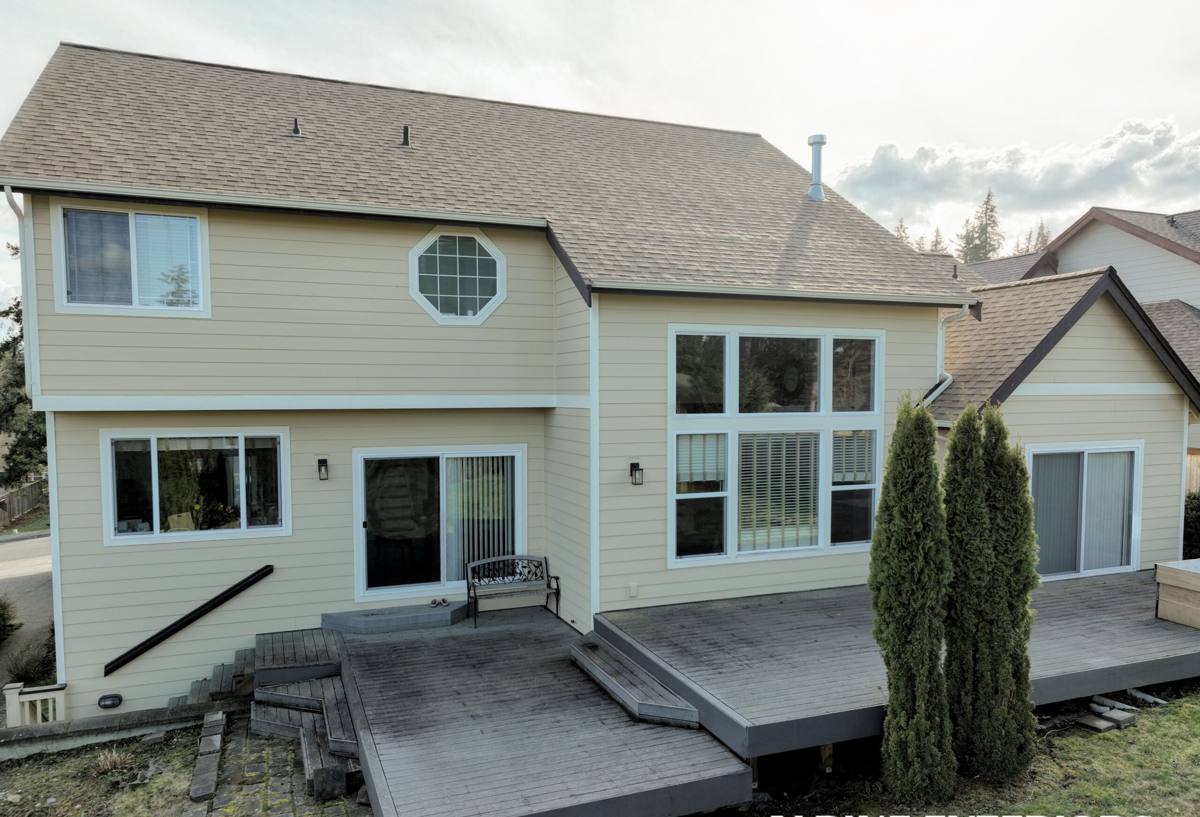
Signs a Birch Bay Deck Needs Replacement, Not Repair
Not every issue means a full tear-off. But there are signs that point past repair territory:
- Soft or spongy spots when you walk the deck, especially near the house or stair connections
- Visible rust streaking from fasteners or hardware
- Railing posts that wiggle or feel loose at the base
- Persistent moss or dark staining that keeps coming back after cleaning
- Gaps opening up between boards, or boards that have cupped or crowned
- A ledger board (where the deck attaches to the house) that looks discolored or feels soft
- The deck is 15-20+ years old and has never had major structural work done
If a handful of boards are bad but the framing underneath is solid, resurfacing can make sense. If the framing itself, the ledger connection, or multiple footings are compromised, replacement is the safer and often cheaper path over time — patch repairs on failing structure tend to become a repeating expense.
What a Correct Deck Replacement Involves
A deck replacement done right isn't just pulling old boards and nailing down new ones. For a coastal property like Birch Bay, the sequence matters.
1. Full Structural Assessment
Before any demo, we check the ledger board attachment, footings, posts, and joists. This is where we find the problems a homeowner usually can't see from the surface — rot behind the ledger flashing, undersized or corroded hardware, or footings that have shifted.
2. Demo and Disposal
Old decking, railings, and any compromised framing come out. We assess as we go — sometimes what looked like a surface problem turns out to be more extensive once boards are off, and that changes the plan before we move forward, not after.
3. Ledger Flashing and Waterproofing
The ledger connection — where the deck meets the house — is the single most common failure point on any deck in a wet climate. Proper flashing here, installed correctly against the house's water-resistive barrier, is what keeps water from working its way behind the siding and into the wall framing. This step gets rushed on budget jobs more than any other part of a deck build, and it's the one that causes the most expensive damage later when it's skipped.
4. Framing and Hardware
For a coastal property, hardware selection matters more than it does inland. We use fasteners and structural connectors rated for high-corrosion environments rather than standard galvanized hardware, because standard hardware is exactly what rusts out first in salt air.
5. Decking Material Installation
Whether you go composite, cedar, or another decking material, correct spacing, fastening pattern, and airflow underneath all affect how long it holds up against Birch Bay's moisture cycle.
6. Railings and Final Details
Railing posts get the same corrosion-resistant hardware treatment, since a loose or rotted post base is a safety issue, not just a cosmetic one.
Decking Material Options for a Salt-Air, High-Moisture Site
There's no single "best" decking material for every homeowner — it comes down to how much maintenance you want to take on versus your upfront budget. Here's how the common options compare for a Birch Bay setting specifically.
| Material | Moisture/Salt Resistance | Maintenance | Typical Lifespan |
|---|---|---|---|
| Composite decking | Strong — engineered not to rot or absorb water like wood | Low — periodic cleaning, no staining/sealing | 25-30+ years |
| Cedar | Naturally decay-resistant but still needs sealing in coastal air | Moderate to high — annual cleaning and re-sealing recommended | 15-20 years with upkeep |
| Pressure-treated pine | Fair — treatment resists rot but end cuts and fasteners are still vulnerable | High — regular sealing, watch for cupping | 10-15 years |
| Tropical hardwoods (e.g., ipe) | Very strong naturally | Moderate — periodic oiling to maintain color | 25+ years |
We'll walk through these trade-offs honestly based on your budget and how much maintenance you actually want to do. There's no wrong answer here — a well-installed pressure-treated deck with proper hardware and flashing will still outperform a poorly installed composite deck.
Framing and Fastener Choices That Actually Matter Here
Homeowners often focus entirely on the decking material — the boards you walk on — and skip past the framing and hardware underneath, which is a mistake in a coastal environment. The framing lumber, joist hangers, structural screws, and post bases are what actually determine whether the deck stays sound for the next 20 years. In Birch Bay specifically, we treat hardware corrosion resistance as a non-negotiable line item, not an upgrade option, because standard hardware failing early is one of the most common reasons we get called out to look at a deck that's only 8-10 years old.
How Our Process Works for Birch Bay Homeowners
- Free on-site estimate. We look at the existing deck, check the ledger and framing where accessible, and talk through what you actually want from the space.
- Written scope and pricing. You get a clear breakdown of what's being replaced, what materials are proposed, and why — no vague allowances.
- Scheduling around Whatcom County weather. We plan demo and ledger/flashing work for drier stretches when possible, since that stage needs to stay dry to be done right.
- Build and inspection. Structural work first, then decking, then railings and details, with our own checks along the way rather than just at the end.
- Walkthrough. We go over the finished deck with you and answer maintenance questions specific to your material choice and your site's exposure.
Why Hire a Crew That Already Works Birch Bay
Deck problems in Birch Bay aren't generic — they're shaped by this specific stretch of coastline: the salt exposure, the wind direction storms tend to come from, and how much shade and moss buildup a given lot gets. A contractor who works Ferndale and the Birch Bay area regularly has already seen how decks in this exact environment fail, which means the ledger flashing detail, the hardware spec, and the material recommendation aren't generic advice pulled from a manual — they're based on what actually holds up here versus what doesn't. That local pattern recognition is worth more than it sounds like on paper; it's the difference between a deck that needs attention again in eight years and one that doesn't.
Maintaining Your New Deck in a Whatcom County Climate
Whatever material you choose, a few habits extend the life of any deck on the water:
- Clean moss and algae off the surface at least once or twice a year, more often on shaded sections
- Keep gutters and downspouts directed away from the deck to avoid concentrated water flow onto it
- Check railing posts and stair connections annually for looseness
- For wood decking, reseal on the schedule recommended for that species — don't wait until it looks obviously weathered
- Watch the area right where the deck meets the house; that's the spot most likely to show early trouble
If your Birch Bay deck is showing its age, or you just want an honest read on whether repair or replacement makes more sense, we're glad to come take a look. The estimate is free, there's no pressure, and you'll get a straight answer about what your deck actually needs.