 Ferndale Siding
 Why Birch Bay Roofs Work Harder Than Most
Birch Bay sits right on the water, and that changes what a roof has to survive year after year. Salt-laden air moves inland off the bay and settles on every exposed surface, including the roof deck. Add Whatcom County's long wet season, wind-driven rain that gets pushed sideways under loose flashing, and heavy tree cover that keeps large sections of roof shaded and damp for months at a time, and you have a climate that finds every weak point in a roofing system faster than it would almost anywhere else in the region.
Asphalt shingles hold up reasonably well inland, but along the waterfront they take a beating from UV, moisture cycling, and moss that gets a foothold in shaded valleys and north-facing slopes. Metal roofing is a good answer to that problem, but only when it's specified and installed correctly for a coastal, moss-prone environment. A metal roof installed the same way you'd install one in a dry inland town will not perform the same way in Birch Bay. The material, the fasteners, the flashing details, and the maintenance plan all need to account for salt exposure and near-constant moisture.
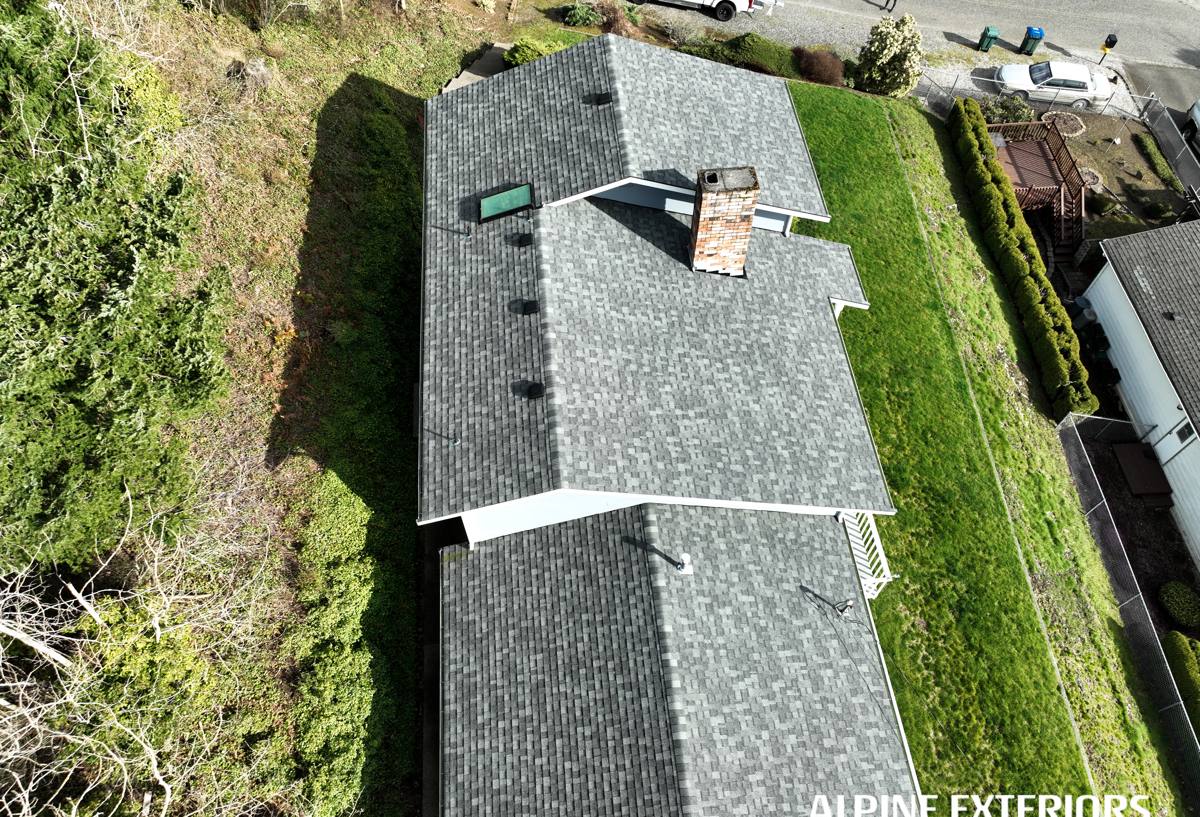
What a Correctly Installed Metal Roof Needs Here
A metal roof that's going to last on a Birch Bay home needs to address four things at once: corrosion resistance, water shedding under wind pressure, moss and debris management, and proper ventilation so moisture doesn't get trapped underneath the panels. Skipping any one of these shortens the life of the whole system, even if the panels themselves are rated for decades of service.
Corrosion Resistance Isn't Optional This Close to the Water
Bare or poorly coated steel will show rust streaking within a few years this close to salt water, especially at cut edges and fastener penetrations where the protective coating gets compromised during installation. The panel finish and the metal underneath both matter, and so does how carefully the installer handles cut edges and touch-up.
Wind-Driven Rain Needs More Than a Watertight Panel
Standard installs assume rain falls mostly straight down. On an open, water-facing lot, wind pushes rain sideways and up under laps, ridge caps, and flashing that would be fine on a sheltered inland roof. Fastening patterns and flashing overlaps need to be tightened up accordingly.
Choosing the Right Metal for a Salt Air Environment
Not every metal roofing product is a good fit for a waterfront or near-waterfront property. The base metal and the factory finish both affect how the roof handles airborne salt over time.
| Option | How It Handles Salt Air | Trade-Offs |
|---|---|---|
| Galvalume steel, standing seam | Good corrosion resistance from the aluminum-zinc coating; performs well if cut edges are sealed | Cut edges and scratches need touch-up paint or sealant to stay protected |
| Aluminum, standing seam | Excellent — aluminum doesn't rust and is a common choice for true waterfront homes | Costs more up front; slightly softer, so care is needed during handling and foot traffic |
| Exposed-fastener steel panels (corrugated/ag-style) | Workable if fasteners and coating are upgraded, but more penetration points to maintain | Lower material cost, but the exposed screws are the first thing to show wear near salt water |
| Stone-coated steel | Reasonable, with the same coating caveats as standard steel underneath | Heavier system; good for wind and hail resistance, adds cost |
For most Birch Bay homes, standing seam in either a quality Galvalume finish or aluminum is our default recommendation, because the concealed fastener system means fewer penetration points for salt-laden moisture to work into over time. Exposed-fastener panels aren't wrong, but they carry a higher maintenance burden this close to the water and we're upfront with homeowners about that trade-off rather than downplaying it.
Fasteners and Flashing: Where Roofs Actually Fail First
Panels rarely fail first. The details around them do. On a coastal re-roof, we pay particular attention to a few things that get skipped or done to a lower standard on jobs where salt exposure isn't a factor:
- Fastener material and coating rated for coastal/corrosive environments, not the cheapest stock screw
- Neoprene washers on exposed fasteners inspected and replaced as needed, since UV and salt both degrade rubber seals faster here
- Extra attention to valley, chimney, and dormer flashing, which is where wind-driven rain finds its way in first
- Sealed and painted cut edges on steel panels rather than leaving raw metal exposed
- Ridge cap and eave detailing tightened up for wind, not just built to the minimum manufacturer spec
These aren't upsells. They're the difference between a metal roof that looks the same in year fifteen and one that's showing rust streaks and leaks by year seven.
Moss, Algae, and Long-Term Roof Care
Metal sheds moss and algae far better than asphalt, since there's no granule surface for spores to grip. That said, "moss-resistant" doesn't mean "moss-proof." Shaded valleys, north-facing slopes, and areas under overhanging branches still collect organic debris, and that debris holds moisture against the panel and fasteners longer than an open, sun-exposed section of roof. Over time that can stain a finish or, worse, keep moisture sitting on a fastener long enough to start corrosion at the head.
Basic upkeep matters more here than in drier parts of the state: keeping gutters clear so water doesn't back up under the eave edge, trimming branches back from the roofline where practical, and a periodic rinse-down of shaded sections. None of this is complicated, but it's easy to let slide, and a metal roof that's otherwise correctly installed will still show its age faster if debris is left to sit.
Our Installation Process
The steps themselves aren't unusual, but the standard we hold each one to is built around this specific climate:
- Deck inspection. Before anything goes down, we check the existing roof deck for rot or soft spots, which are more common on older Whatcom County homes that have carried moss and moisture for years.
- Underlayment. A synthetic underlayment across the field, with self-adhered ice-and-water membrane at eaves, valleys, and around every penetration — the areas most exposed to wind-driven rain and freeze-thaw cycling.
- Ventilation check. We confirm intake and exhaust venting are balanced so moisture doesn't condense on the underside of the panels, which is a common cause of hidden deck rot under an otherwise sound metal roof.
- Panel and fastener installation. Panels and fasteners matched to the home's exposure — closer to open water gets the more corrosion-resistant hardware and tighter fastening pattern.
- Flashing and trim. Custom-fit flashing at every transition, sealed and fastened to hold up under sideways rain, not just standard vertical drainage.
- Final walk-through. We go over the finished roof with the homeowner, including what routine upkeep looks like going forward.
What Drives the Cost
Metal roofing costs more up front than asphalt, and coastal-grade details add to that further. Here's what actually moves the number on a Birch Bay job:
| Cost Factor | Why It Matters |
|---|---|
| Panel material (steel vs. aluminum) | Aluminum costs more but needs less long-term corrosion management |
| Roof complexity (valleys, dormers, chimneys) | More flashing detail work, more labor, more places for wind-driven rain to test the install |
| Tear-off vs. overlay | A full tear-off lets us inspect and repair the deck, which matters more on older, moss-affected roofs |
| Fastener and flashing upgrades | Coastal-grade hardware and sealed cut edges cost more than standard stock but avoid early corrosion |
| Ventilation corrections | Adding or rebalancing intake/exhaust venting if the existing setup is inadequate |
We give homeowners a straightforward number after a walk of the actual roof — not a phone estimate — because these factors vary house to house even within the same neighborhood.
Signs Your Roof Needs a Closer Look
- Rust streaking below fastener heads or panel seams
- Moss buildup in valleys or on shaded slopes that hasn't been cleared in a season or more
- Granule loss or curling on an existing asphalt roof nearing the end of its service life
- Water stains on interior ceilings near chimneys, skylights, or dormers after wind-driven storms
- Loose, lifted, or missing ridge caps and flashing after a windy winter
- Visible daylight or gaps in the soffit/ridge venting
Catching these early is almost always cheaper than waiting for a leak to show up inside the house.
Why a Crew That Already Works Birch Bay Matters
A roofing crew that mostly works dry, inland jobs will build a technically sound roof — for a different climate. Working Birch Bay regularly means we already know which fastener and coating specs hold up on an open-water lot versus a more sheltered inland one, where wind-driven rain tends to test a roof hardest, and how much moss pressure to expect based on tree cover and roof orientation. That's not something you can fully account for from a spec sheet; it comes from having done the work here repeatedly and seen how different details hold up over the following years.
It also means faster response when weather does damage something — a familiar crew that already knows the area doesn't need to relearn local conditions on your dime, and can get eyes on storm damage without the delay of a contractor driving in from out of the county.
If you're weighing a metal roof for a Birch Bay home, we're happy to walk the roof, talk through material options honestly, and give you a straightforward, no-pressure estimate using the form below.