 Ferndale Siding
 Siding Repair in Sumas: Built for Whatcom County Weather
Siding damage in Sumas rarely shows up overnight. It builds slowly — a hairline crack that lets in a little more water each winter, a section of trim that stays damp two days longer than it should, a north-facing wall that never quite dries out between storms. By the time a homeowner notices soft spots or peeling paint, the underlying damage is usually further along than the surface suggests. That's the pattern we see again and again on siding repair calls in this part of Whatcom County, and it's why a "quick patch" mentality tends to cost more in the long run than a properly diagnosed repair done once.
Sumas sits inland from the coast, but the marine air that moves through the rest of Whatcom County reaches it too — humid, moisture-laden weather that doesn't fully let up for much of the year. Combine that with driving rain events, long stretches of overcast damp, and a moss season that can run eight months or more, and you have conditions that punish any siding material with a weak point. Repair work here has to account for all of it, not just fix what's visible.
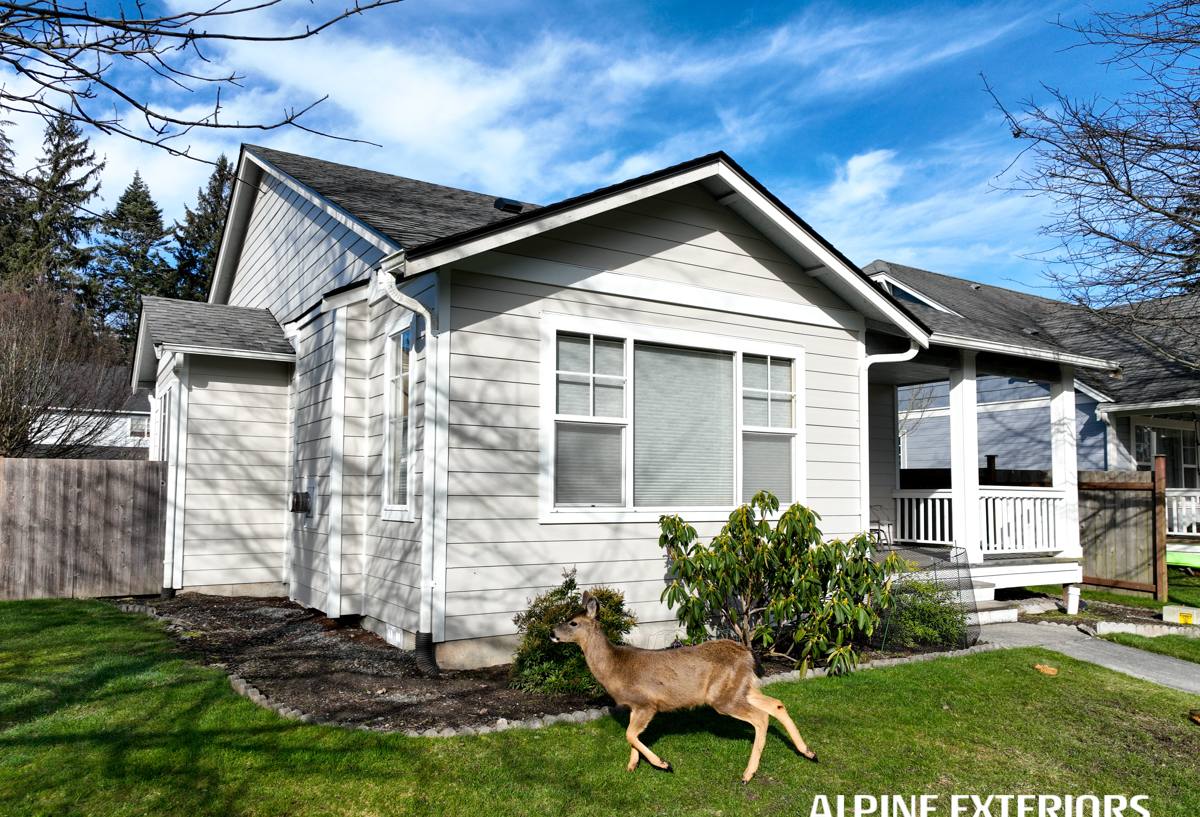
What Local Climate Does to Siding Over Time
Moisture Intrusion
Once water finds a way behind siding — through a failed caulk joint, a cracked board, or a poorly flashed penetration — it doesn't evaporate quickly in this climate. Trapped moisture feeds rot in wood-based products, causes swelling and delamination in engineered products that weren't detailed correctly, and can travel along framing members well beyond the original entry point. A repair that only addresses the visible crack and ignores the water path behind it is not a real repair.
Moss and Organic Growth
Whatcom County's long wet season is ideal for moss, algae, and mildew. On siding, organic growth does more than look bad — it holds moisture against the surface, breaks down caulk and paint film faster, and can work into seams and butt joints where boards meet. Siding in shaded areas or under tree cover in Sumas often needs closer inspection because growth can mask damage underneath it.
Temperature Swings and Material Movement
The Pacific Northwest doesn't get extreme heat, but the freeze-thaw cycles and seasonal humidity swings still cause siding materials to expand and contract. Over years, this movement stresses caulk joints, fasteners, and butt seams. Materials that weren't engineered for this specific moisture cycle — or that were installed with gaps too tight for expansion — tend to show stress cracks and popped nails well before their expected lifespan.
Signs Your Sumas Home Needs Siding Repair
Most siding problems give warning signs before they become structural. Worth checking for:
- Visible cracks, chips, or holes in siding panels, especially near corners and seams
- Soft or spongy spots when pressed gently by hand
- Paint that's bubbling, peeling, or flaking in patches rather than evenly across a wall
- Persistent moss, algae, or dark staining that returns shortly after cleaning
- Warped, bowed, or buckled boards, particularly on walls that get less direct sun
- Gaps opening up at seams, trim, or around windows and doors
- Musty smells or visible staining on interior walls that share an exterior wall with damaged siding
- Fastener heads showing through the surface or streaking with rust
Any one of these on its own might be minor. Several together, or any sign paired with interior moisture symptoms, usually means it's time for an actual inspection rather than a wait-and-see approach.
What a Correct Siding Repair Actually Involves
A repair that holds up in this climate is more than swapping a damaged board for a new one. Done right, it typically includes:
Diagnosis Before Demolition
Before anything gets removed, a competent repair starts with figuring out why the damage happened — a flashing failure, a caulk joint that was never sealed correctly, a drainage plane gap, or simple impact damage. Repairing the symptom without correcting the cause means the same failure happens again in the same spot.
Matching Material and Finish
Replacement boards need to match the existing siding in profile, exposure, and finish as closely as possible. With factory-finished products, this means working from the same color line and, where possible, a compatible finish batch so the repaired section doesn't stand out as an obvious patch.
Correcting Water Management, Not Just Appearance
Proper repair addresses house wrap integrity, flashing at penetrations, kick-out flashing at roof-wall intersections, and caulk joints at trim and corners. Sealing a crack without confirming the water-resistive barrier behind it is intact is a cosmetic fix, not a structural one.
Fastening and Clearance Standards
Replacement pieces need to be fastened per manufacturer specification — correct nail type, placement, and depth — and reinstalled with proper clearance from grade, roofing, and decks so the repaired section doesn't immediately start trapping moisture again.
Repair or Replace? How We Help You Decide
Not every siding problem calls for full replacement, and not every crack is safely fixed with a patch. The right call depends on a few honest factors:
| Factor | Favors Repair | Favors Replacement |
|---|---|---|
| Extent of damage | Isolated to a few boards or one wall section | Spread across multiple walls or elevations |
| Underlying cause | Localized impact or one failed joint | Systemic water intrusion or widespread rot |
| Age of existing siding | Siding is mid-life and otherwise sound | Siding is near or past its expected service life |
| Material match availability | Same product line and finish still available | Discontinued profile or finish, poor match likely |
| Cost over time | Repair cost is a small fraction of replacement | Repeated repairs are approaching replacement cost |
We'll always tell you honestly which side of that table your home falls on. A targeted repair that solves the actual problem is often the right answer, and we'd rather do that well than push a full replacement a home doesn't need yet.
Why We Repair With James Hardie Fiber Cement — and Nothing Else
We install and repair one siding system: James Hardie fiber cement. That's a deliberate standard, not a limitation we apologize for. Vinyl siding is inexpensive and low-maintenance in mild climates, but it can become brittle in cold snaps, distorts under sustained heat reflection, and doesn't hold paint if a homeowner ever wants to change color. LP SmartSide and other wood-strand products perform reasonably when installation and maintenance are perfect, but they're an engineered wood product at the core — any breach in the factory coating that goes unnoticed in a climate this wet can lead to swelling at cut edges and seams. Primed spruce and cedar look great new, but they demand a repainting and caulking schedule most homeowners underestimate, and both are combustible.
Fiber cement doesn't share those weak points. It's non-combustible, dimensionally stable across our seasonal moisture swings, and resistant to the rot and moss-related deterioration that shortens the life of wood-based siding here. James Hardie's ColorPlus factory finish is baked on under controlled conditions and backed by a real finish warranty, which matters directly for repair work — when we replace a damaged section, we're matching into a finish system with documented color lines, not guessing at a field-applied paint match. That's a practical advantage on repair jobs specifically, not just new installs.
Our Repair Process
- Inspection and diagnosis — We identify not just the visible damage but what caused it, checking flashing, caulk joints, and the water-resistive barrier where accessible.
- Written scope and honest recommendation — You get a clear explanation of what needs to happen and why, including whether repair or a larger scope makes more sense.
- Material sourcing and color matching — We source Hardie boards and trim in the matching profile and ColorPlus line, or discuss options if an exact match isn't available.
- Removal and correction — Damaged material comes out, and any underlying issue — flashing, sheathing, house wrap — gets corrected before new siding goes back on.
- Installation to manufacturer spec — Fastening, clearances, and joint sealing follow James Hardie's published installation requirements, not shortcuts.
- Final walkthrough — We review the completed repair with you before calling the job done.
Why a Crew That Already Works in Sumas Matters
Siding repair is very location-specific work. A crew that regularly works Whatcom County homes already understands how the region's moss cycle, driving rain, and marine humidity interact with different siding materials and installation ages. That translates into faster, more accurate diagnosis — knowing which failure patterns to check for first instead of working through a generic checklist. It also means realistic scheduling around the wetter months, since starting repair work at the wrong point in the weather cycle can compromise the very fix you're paying for.
Local experience also matters for material logistics. Sourcing the correct James Hardie profile and ColorPlus color match takes established supplier relationships; a crew unfamiliar with the area may not have that dialed in, which shows up as mismatched repairs or long delays waiting on material.
If your Sumas home has siding damage, cracked or missing boards, or recurring moisture or moss issues, we're happy to take a look and give you a straightforward, no-pressure assessment of what it actually needs. Use the form below to request a free estimate.