 Ferndale Siding
 Cordata Sits in a Tougher Weather Lane Than Most Homeowners Realize
Cordata is close enough to Bellingham Bay and the Strait of Georgia to pick up salt-laden air on the regular westerly flow, and far enough into Whatcom County's marine layer to sit under low cloud and drizzle for long stretches of the year. That combination is harder on exterior siding than people expect. It's not one dramatic storm that does the damage — it's the accumulation of hundreds of gray, damp days a year working on the same wall.
We replace siding on homes in and around Cordata regularly, and the failure patterns we see are consistent: moisture that got behind the cladding instead of running off it, finishes that chalked and faded years ahead of schedule, and moss that took hold on shaded north and west walls and never really left. A siding replacement done right here has to account for all three, not just cover the old wall with something new.
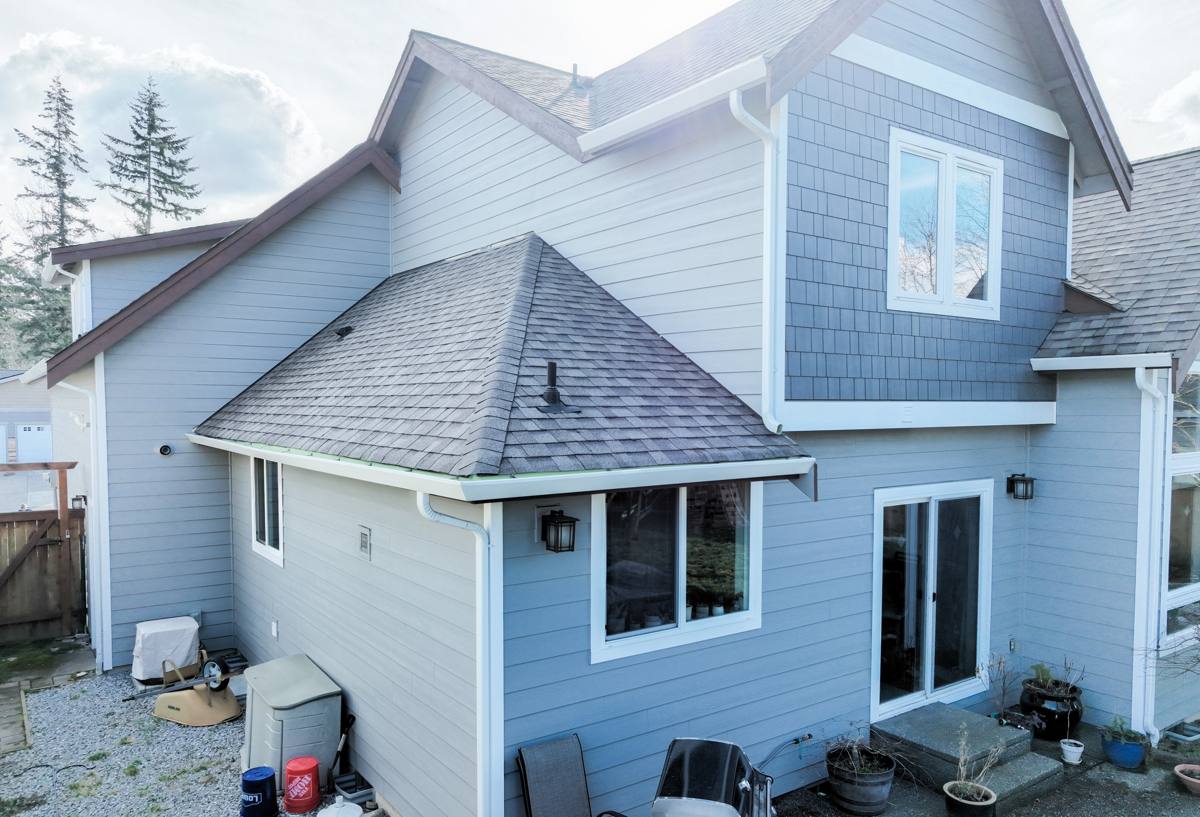
What Salt Air, Driving Rain, and Moss Season Actually Do to a Wall
Salt Air
Airborne salt is corrosive to exposed metal — fasteners, flashing, trim caps — and it accelerates the breakdown of paint and lower-grade factory finishes over time. On a home this close to the water and the Strait, that's a slow, steady tax on anything not built to shed it.
Driving Rain
Wind-driven rain doesn't just wet the surface of a wall — it finds every gap, seam, and fastener penetration and pushes water sideways and upward. If the water-resistive barrier, flashing, and drainage plane behind the siding aren't detailed correctly, that water gets trapped in the wall assembly instead of draining back out, and you don't see the consequence until the sheathing or framing is already compromised.
Moss Season
Whatcom County's wet season can run the better part of eight months. Moss and algae take hold anywhere shade and moisture linger — north walls, under eaves, behind shrubs — and once established, they hold water against the surface far longer than an open, sun-exposed wall ever would. Wood-based and cellulose-containing siding products are especially vulnerable here, because trapped moisture is exactly what starts rot at the core of the material, not just the surface.
What a Correct Siding Replacement Involves — Not Just a New Skin
A siding replacement that's actually built for this climate is a wall system, not a cosmetic swap. That means:
- Full tear-off of the old siding so the sheathing underneath can be inspected — not siding installed over existing rot or hidden damage
- Correction of any soft or water-damaged sheathing found during tear-off, before anything new goes up
- A continuous, properly lapped water-resistive barrier that directs incidental moisture down and out, not into the wall
- Correct flashing at every window, door, and roof-to-wall intersection — the details that actually stop driving rain
- A drainage gap or rainscreen approach where the wall assembly calls for it, so moisture that does get behind the cladding can dry out
- Manufacturer-specified fastening patterns and clearances, not shortcuts that void the warranty and open the door to moisture intrusion
Skip any one of these steps and the new siding can look right for a season or two while the underlying problem keeps building. This is where a lot of the corner-cutting in this trade happens — it's invisible until it isn't.
Why We Only Install James Hardie Fiber Cement
We made a standing decision as a company to install one siding system — James Hardie fiber cement — and not vinyl, not LP SmartSide, not Cemplank, Allura, primed spruce, or cedar. That's not a marketing position, it's a practical one, and it's worth explaining honestly.
Fiber cement is non-combustible, which matters on its own merits, and it's also dimensionally stable in a way wood-based products aren't — it doesn't swell, cup, or delaminate the way wood fiber siding can when it stays damp for months at a time, which is exactly the condition Cordata's wet season creates. Hardie's ColorPlus factory-applied finish is baked on under controlled conditions rather than field-painted, which gives it better fade and wear resistance against sun and salt exposure than a job-site coat typically achieves. Hardie also engineers specific product lines — including HZ5 formulations — for climates with significant moisture exposure, which is a direct match for this part of Washington.
None of this means fiber cement is maintenance-free. It still needs correct installation, proper caulking at joints, and periodic washing to keep surface moss and grime from building up. But when it's installed to spec, it holds up to this climate better than the alternatives we chose not to carry, and it comes with a strong, transferable manufacturer warranty that backs that up.
Our Process, Start to Finish
- Site walk and assessment. We look at the existing siding, check for soft spots, staining, and moss buildup, and get a read on what's happening behind the current cladding, not just its surface condition.
- Written estimate. You get a clear scope — tear-off, any sheathing repair anticipated, Hardie product and profile selection, and a realistic timeline.
- Tear-off and inspection. Old siding comes off, sheathing is inspected and repaired as needed, and we don't move forward over a problem we haven't shown you.
- WRB, flashing, and install. The water-resistive barrier and flashing go in first, followed by the Hardie siding installed to manufacturer fastening and clearance specs.
- Final walk-through. We go over the finished work with you, register the warranty, and make sure you know what upkeep, if any, is expected going forward.
What Actually Drives the Cost of a Cordata Siding Job
Every home is different, but the same handful of factors decide where a project lands in scope and price. We'd rather walk you through these up front than give you a number that doesn't hold once we're on the wall.
| Factor | Why It Matters | Typical Cost Impact |
|---|---|---|
| Sheathing condition found at tear-off | Hidden rot or moisture damage has to be repaired before new siding goes on | Low to High, depends on what's found |
| Home size and wall area | More square footage means more material and labor | Scales directly |
| Trim and architectural detail | Corners, dormers, and window trim add labor time beyond flat wall area | Medium |
| Siding profile and accessories | Lap width, trim boards, and soffit/fascia work chosen affect material cost | Low to Medium |
| Access and site conditions | Tight lots, slopes, or landscaping close to the house can slow staging and tear-off | Low to Medium |
| Existing paint or coating removal | Some older finishes require extra prep before a clean tear-off | Low |
Signs Your Cordata Home May Already Need Replacement
A lot of homeowners wait longer than they should because siding damage doesn't always look dramatic from the ground. Worth checking for:
- Persistent moss or dark staining on the same section of wall every year, even after cleaning
- Soft, spongy spots when you press on the siding, especially near the bottom courses or below windows
- Visible cracking, buckling, or separation at seams and corners
- Paint or finish that's chalking heavily or peeling in sheets rather than wearing evenly
- Interior signs — musty smell, peeling interior paint, or staining near exterior walls
- Siding that feels cool and damp to the touch well after a dry spell
Any one of these on its own isn't necessarily an emergency, but a few together usually mean water has been getting into the wall assembly for a while.
Why It Matters That We Already Work Cordata
A crew that only shows up in this pocket of Whatcom County occasionally is guessing at how the local climate behaves — how long moss season actually runs here, how much salt exposure a given orientation gets, how wet the ground stays into a normal spring. A crew that works Cordata and the surrounding Ferndale area regularly isn't guessing. We know what wall assemblies show up most often in homes built in this area and era, we know which orientations take the worst of the driving rain, and we plan tear-off and install around actual Whatcom County weather windows instead of a generic schedule that assumes drier conditions than we get.
That familiarity also means fewer surprises during permitting and inspection, because we're not learning local requirements for the first time on your project.
After Your Siding Is Replaced
Fiber cement siding done right is low-maintenance, not no-maintenance. A yearly rinse-down helps keep surface salt film and early moss growth from taking hold, especially on shaded walls. Keep gutters clear so overflow doesn't run down the siding face, and give caulked joints a visual check once a year — caught early, a small gap is a five-minute fix instead of a moisture problem down the line.
If you're seeing any of the warning signs above, or you just want a straight answer on what shape your current siding is in, we're glad to take a look. The estimate is free, there's no pressure, and you'll get a clear explanation of what we find — fill out the form below to get started.