 Ferndale Siding
 Why Storm Damage Looks Different in Custer
Custer sits close enough to the water and open farmland north of Ferndale that roofs here take a different kind of beating than roofs twenty minutes inland. There's less tree cover to break the wind in a lot of the area, which means gusts off Bellingham Bay and the Strait hit rooflines directly and drive rain sideways under shingle tabs and flashing edges that were never designed to handle water moving uphill. Add in the salt content of that air and a moss season that can run eight or nine months out of the year in Whatcom County, and you've got a roof that's fighting on three fronts at once: wind uplift, moisture intrusion, and slow organic growth that holds water against the roof deck long after a storm has passed.
A lot of storm damage in Custer doesn't show up as a dramatic hole in the roof. It shows up as a few lifted shingles near a ridge, a soft spot where moss has been sitting for two winters, or a stain on a ceiling three months after the wind event that actually caused it. That lag is exactly why storm damage repair here needs to be diagnostic, not just cosmetic.
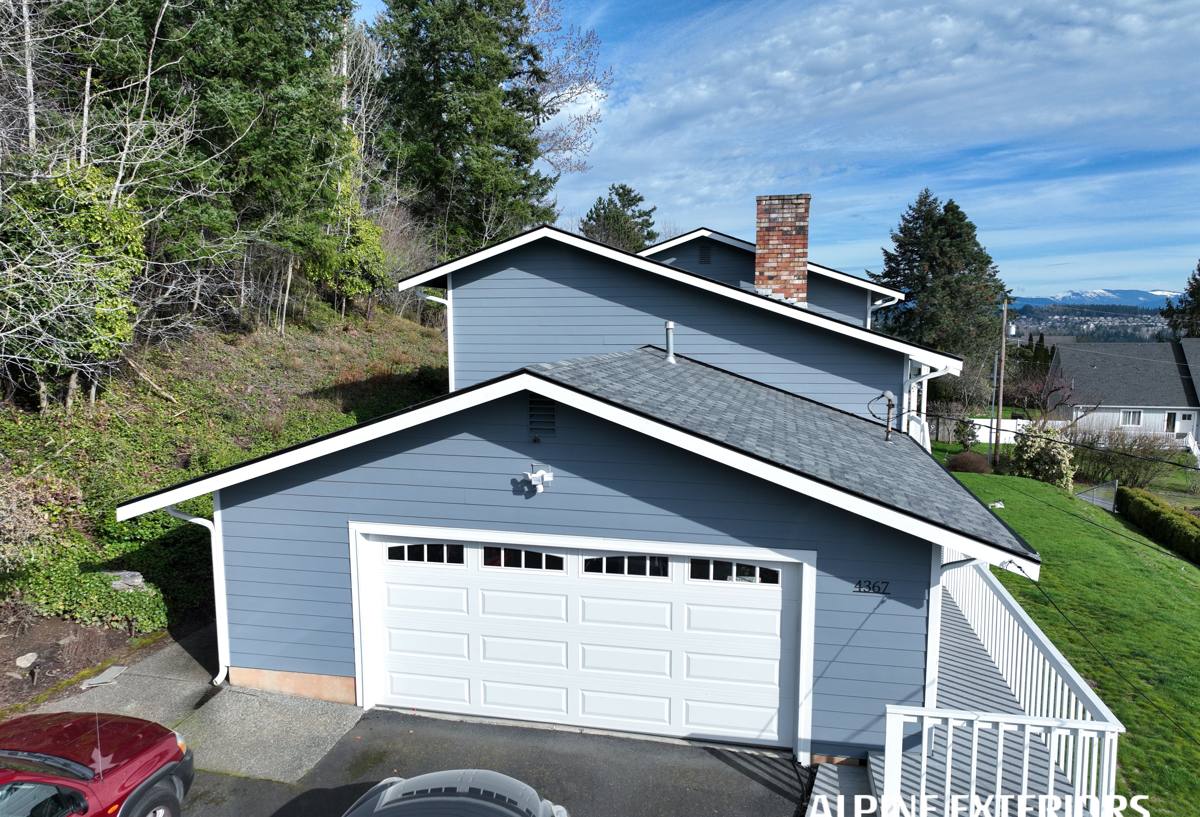
What a Correct Storm Damage Repair Actually Involves
Patching the shingle you can see from the driveway isn't a repair — it's a temporary cover. A correct job starts with figuring out what the storm actually did, not just what's visible from the ground.
Full Inspection Before Any Repair
We get on the roof (not just a pair of binoculars from the yard) and check the deck, the underlayment where it's exposed, all flashing points, and the attic side if it's accessible. Wind damage frequently starts at edges and penetrations — ridge caps, pipe boots, chimney flashing, valleys — long before it shows up mid-field on a slope. We're also checking for moss intrusion under tabs, since a wind event that lifts a shingle already softened by trapped moisture behaves very differently than the same wind hitting a clean, dry roof.
Matching the Repair to the Damage, Not the Other Way Around
Small area of lifted or torn shingles with a sound deck underneath: spot repair, replacing the damaged courses and re-securing flashing. Damage that's concentrated at a valley, chimney, or dormer: that's usually a flashing and underlayment issue as much as a shingle issue, and treating it as "just shingles" is how the same leak comes back after the next storm. Widespread granule loss, soft decking, or multiple leak points across the roof: at that point we tell you honestly if you're better off with a full replacement rather than chasing repairs on a roof that's past the point where patching makes financial sense.
The Role Moss Plays in Storm Damage Here
Whatcom County's moss season is long enough that it's not really a "season" anymore on north-facing slopes or anywhere shaded — it's closer to a year-round condition that gets worse in the wet months. Moss itself doesn't cause the storm damage, but it sets the roof up for it. Moss holds moisture against the shingle surface and the deck beneath it, which softens the mat over time and makes shingles more prone to tearing or lifting when wind gets under an edge. A roof with active moss growth going into a windstorm is starting from a weaker position than a clean one.
Part of an honest storm repair in this area includes addressing existing moss, not just the wind damage on top of it. Repairing a section without dealing with the moss that compromised it in the first place is a short-term fix.
Practical Signs a Custer Homeowner Should Check For
- Shingle tabs that look lifted, curled, or are missing entirely, especially near ridges and edges
- Granules collecting in gutters or downspouts after a windstorm
- Dark streaking or thick moss mats on north-facing or shaded slopes
- Visible daylight or water staining in the attic near roof penetrations
- Flashing around chimneys, vents, or skylights that looks bent, separated, or rusted
- Ceiling stains that appear weeks after a storm, not necessarily right away
Salt Air and Materials: What Holds Up, What Doesn't
Proximity to the water means more than just wind — it means airborne salt that accelerates corrosion on anything metal. Flashing, fasteners, and vent components take the brunt of this. A repair that reuses corroded fasteners or unprotected metal flashing is a repair that's going to need attention again sooner than it should.
| Component | Common Storm Issue in Custer | What We Check/Do |
|---|---|---|
| Ridge & hip caps | Lifted or torn from direct wind exposure | Re-secure or replace with proper nailing pattern for wind zone |
| Flashing (valley, chimney, step) | Corrosion from salt air, separation from wind flexing | Inspect for rust/gaps, reseal or replace with corrosion-resistant material |
| Fasteners | Rust weakening hold, backing out over time | Replace with appropriate corrosion-resistant fasteners |
| Underlayment | Saturated from long-term moss moisture or wind-driven rain intrusion | Assess and replace in the affected section, not just surface shingles |
| Shingles/tabs | Torn, lifted, granule loss from wind and age | Match existing product where possible, replace damaged courses |
Our Process for a Storm Damage Call in Custer
We keep this straightforward because homeowners dealing with storm damage usually don't want a sales process, they want to know what's wrong and what it costs to fix.
- Inspection: We walk the roof and check the attic where accessible, documenting exactly what the storm did versus what was pre-existing wear.
- Honest scope: We tell you whether this is a spot repair, a larger section replacement, or a case where full re-roofing makes more sense long-term.
- Written estimate: Clear line items — no vague "storm package" pricing that doesn't explain what you're paying for.
- Repair: Matching materials where we can, addressing the underlying cause (moss, corroded flashing, weak fastening) alongside the visible damage.
- Follow-up notes: If we see other areas that are trending toward trouble — moss buildup, aging flashing — we'll flag it so you can plan for it rather than get surprised by it.
What Repair Costs Typically Depend On
- Size of the affected area versus a whole-slope or whole-roof issue
- Whether flashing and underlayment need replacement alongside shingles
- Roof pitch and access difficulty
- Age and condition of the existing roofing material (matching older shingle profiles can add time)
- Whether moss removal and treatment is needed as part of the job
We don't quote a number without seeing the roof — anyone who does hasn't actually assessed the damage.
Insurance and Documentation
Storm damage repairs often involve a homeowner's insurance claim. We document what we find with clear photos and a written description of the damage tied to the storm event, which helps support your claim. We're not a public adjuster and don't promise a claim outcome, but we make sure the physical evidence and scope of work are documented clearly so your adjuster has what they need.
Why It Matters That We Already Work in Custer
A crew that works this stretch of Whatcom County regularly already knows which slopes catch the worst of the wind off the water, which roof ages and material types are common in the area, and what moss buildup looks like on a roof that's had two or three wet seasons without maintenance. That familiarity means less time spent explaining local conditions and more time spent actually fixing the problem correctly the first time. It also means we're not guessing at wind exposure or salt air effects from a general playbook — we're applying what we've actually seen hold up and what hasn't, roof after roof, in this specific area.
We service Ferndale and the surrounding Whatcom County communities, and Custer's coastal-adjacent exposure and moss load are conditions we plan for as a matter of course, not an unusual case.
When to Call Versus When to Wait
Not every bit of storm-related wear needs an emergency call. Missing granules in the gutter after a windstorm with no other symptoms is worth a note for your next inspection. Active leaking, visibly lifted or missing shingles, or exposed underlayment after a storm should get looked at promptly — those are the conditions that turn into deck damage or interior water intrusion if they sit through the next rain event, which in this area might be a matter of days, not weeks.
If a recent storm has you wondering what shape your roof is really in, we're happy to take a look and give you a straight answer — no pressure, no obligation. Fill out the form below for a free estimate.