 Ferndale Siding
 Building Decks for Birch Bay's Marine Environment
Birch Bay sits close enough to the water that every deck we build there has to answer to conditions a few miles inland don't deal with. Salt-laden air moves in off the bay, driving rain comes in sideways during fall and winter storms, and the shoulder seasons stay damp long enough that moss and algae get a real foothold on any horizontal surface that doesn't shed water well. A deck built to a generic spec sheet will often look fine the first year and start showing problems by year three — fastener bleed, soft spots at the ledger, green film on the boards by February. A deck built for Birch Bay specifically holds up because every material and detail was chosen with that exposure in mind.
This page covers what we actually do differently for a custom deck in this part of Whatcom County: material selection, framing and fastening choices, water management at the house connection, and the ongoing care that keeps a deck looking good through a Pacific Northwest winter. If you're comparing quotes, the details below are the ones worth asking every contractor about.
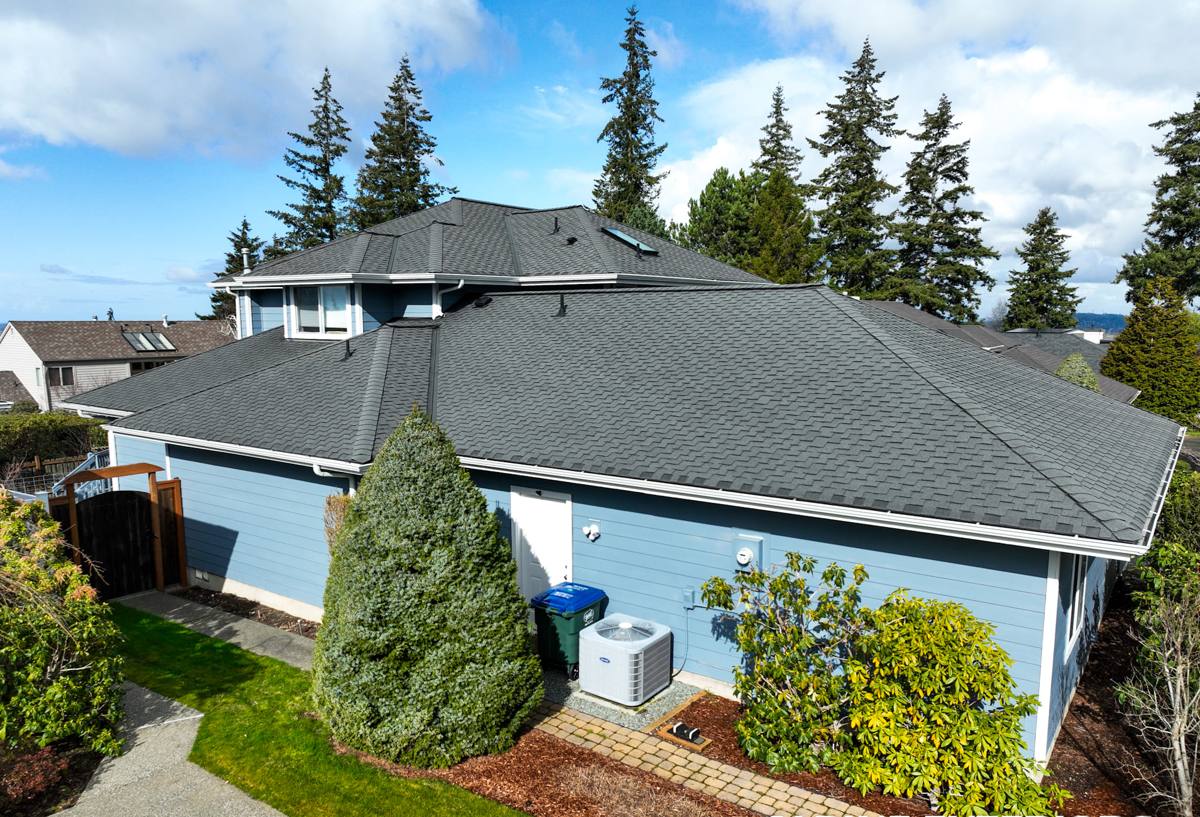
What Salt Air, Rain, and Moss Actually Do to a Deck
It helps to understand the specific failure modes before talking about how to prevent them, because it changes what "quality" means on a coastal build.
Salt air and metal
Airborne salt accelerates corrosion on any exposed metal — fasteners, joist hangers, post bases, railing hardware. Standard electro-galvanized coatings can start showing rust streaks within a couple of seasons this close to the water. Once a fastener starts corroding, it weakens at the exact point where it's holding boards or structural connections together.
Driving rain and water intrusion
Wind-driven rain doesn't just fall on a deck, it gets pushed sideways and upward into gaps — under rail caps, behind ledger boards, into end grain that isn't sealed. Water that gets into wood and can't dry out is what causes rot, and a deck that's shaded by trees or the house itself dries more slowly than one in full sun, which is common on lots around Birch Bay with mature evergreen cover.
Moss, algae, and surface wear
A long damp season means moss spores have months to establish on any deck surface that stays wet — especially in shaded corners, under furniture, and on boards installed without enough of a drainage gap between them. Beyond looking bad, moss holds moisture against the board surface and becomes a slip hazard on stairs and low-traffic areas.
Choosing the Right Decking Material for This Coastline
There's no single "best" decking material — the right choice depends on your budget, how much upkeep you want to do, and how exposed the deck is to sun, wind, and salt spray. Here's how the common options stack up specifically for a Birch Bay setting.
| Material | Moisture behavior here | Maintenance | Typical lifespan |
|---|---|---|---|
| Pressure-treated fir/hem-fir | Absorbs water at cut ends and fastener holes; needs sealing to perform near the coast | Annual cleaning and re-sealing recommended | 10-15 years with upkeep |
| Cedar | Naturally rot-resistant, but still needs finish maintenance in salt air to avoid graying and checking | Periodic cleaning and oil/stain | 15-20 years with upkeep |
| Capped composite | Doesn't absorb water into the board body; resists moss better if gapped correctly | Occasional washing, no sealing | 25-30 year product warranties, common |
| PVC decking | Fully closed-cell, essentially immune to rot; performs consistently in wet, salty conditions | Low — washing only | 25+ year product warranties, common |
We're not going to tell you composite or PVC is the only "correct" answer — plenty of homeowners want the look and feel of real wood and are willing to keep up with sealing on a schedule. What we will say honestly: if low maintenance is a priority for a deck this close to salt air, a capped composite or PVC board earns its higher upfront cost back in years of skipped sealing and sanding. If you go with wood, we build in the extra sealing and end-cut treatment steps that a generic install often skips.
Framing and Substructure: Where Most Deck Failures Actually Start
The decking boards are what you see, but the framing underneath is what determines whether the deck is still solid in fifteen years. This is the part that's easy to under-build and hard to inspect once the boards are down.
Joist protection
Untreated cuts on pressure-treated lumber, drilled holes for hardware, and joist tops that sit under decking without any barrier are the most common places rot starts. We treat cut ends and cap or tape joist tops so standing moisture from rain that gets between boards doesn't sit directly on exposed wood.
Post bases and footings
Posts that sit in direct contact with wet soil or concrete for years are a slow-motion failure. We keep post bases elevated on standoff hardware rather than burying posts, and we size footings for our soil and frost conditions rather than guessing.
Hardware grade
Given the salt exposure, we spec joist hangers, screws, and structural connectors rated for coastal or ACQ-treated lumber use — stainless steel or heavy-duty coated hardware rather than standard galvanized, particularly at the ledger and any hardware within a few feet of grade.
Fasteners, Flashing, and the Ledger Connection
If a deck attaches to the house, the ledger board connection is the single most important water-management detail on the whole project — and it's the one spot most likely to be shortcut on a rushed job.
- Self-adhesive flashing tape behind the ledger board, lapped correctly with the house's existing water-resistive barrier so water sheds outward, not behind the siding
- A visible drainage gap or flashing kickout at the base of the ledger so any water that does get behind the board has somewhere to go besides the framing
- Through-bolts or structural screws rated for the connection, not just nails, since this joint carries live load as well as lateral force
- Corrosion-resistant fastener coatings throughout, given the salt air moving in off the bay
We also pay attention to the gap between decking boards themselves — too tight and water sits on the surface and behind fascia, too wide and it's uncomfortable underfoot and catches debris. We set spacing based on the specific board material's expansion behavior in our wet winters and drier summers.
Our Custom Deck Process, Start to Finish
Every deck we build in Birch Bay follows the same sequence, adjusted for the specific lot, sun exposure, and how close the site sits to the water.
- On-site walkthrough: we look at grade, drainage, existing structure attachment points, sun/shade pattern, and how exposed the site is to wind off the bay.
- Design and material selection: size, layout, railing style, and decking material chosen against your budget and how much upkeep you want long-term.
- Permitting: most decks above a certain height or attached to the house need a permit through the county or city — we handle that paperwork rather than leaving it to you.
- Framing: footings, posts, ledger connection, and joists built to the spec above, with all coastal-specific protection steps included, not optional add-ons.
- Decking, railing, and stairs installed with fastening and spacing set for the chosen material.
- Final walkthrough: we go over care and maintenance specific to the material you chose before we consider the job done.
Railings, Fascia, and Finishing Details for Coastal Exposure
Finishing details matter more here than they would somewhere drier. Metal railing components and hardware get the same corrosion-resistant treatment as the structural fasteners — cable rail and aluminum systems hold up well against salt air, while lower-grade painted steel components can show rust streaks within a season or two if they're not rated for coastal use. Fascia boards, which cap the visible edge of the deck, are a common spot for moisture to wick in from the end grain if they're not sealed or capped properly — we treat that edge the same way we treat any exposed cut on the frame.
Maintenance That Actually Keeps a Birch Bay Deck Looking Good
No deck is maintenance-free, even the low-upkeep composite and PVC products — "low maintenance" means less work, not none. Here's what actually matters through a Whatcom County winter:
- Sweep debris off the surface regularly in fall — trapped leaves and needles hold moisture and feed moss growth
- Rinse or wash the deck surface a couple of times a year, more often in shaded areas, to knock back algae and moss before it establishes
- Check and re-seal wood decking on the schedule the product calls for — don't wait until it's visibly graying
- Keep gutters and downspouts near the deck clear so runoff isn't dumping extra water directly onto or under the structure
- Look at the ledger flashing and any visible fasteners once a year for early rust or gaps — catching it early is cheap, replacing rotted framing later isn't
Why Hiring a Crew That Already Works Birch Bay Matters
A lot of deck problems we get called to look at weren't built badly out of laziness — they were built to a spec that works fine somewhere with less salt air and less standing moisture. Building for Birch Bay means treating hardware grade, flashing detail, and material choice as core parts of the job, not upgrades. It also means knowing which local permitting requirements apply and building footings and framing to hold up against the specific rain and wind patterns this stretch of Whatcom County actually sees, rather than a generic regional average.
If you're planning a new deck or replacing one that's showing its age, we're happy to come take a look, walk the site with you, and put together a straightforward estimate — no pressure, no hard sell. Use the form below to get started.