 Ferndale Siding
 Decks in Kendall Face a Different Climate Than Decks Downtown
Kendall sits up along the North Fork Nooksack River corridor, closer to the foothills than the water, and that changes what a deck has to survive. You get less direct salt exposure than homes closer to Bellingham Bay or the Ferndale waterfront, but you make up for it with more shade, more standing moisture, and a longer moss season thanks to the tree cover and the cooler, damp air that settles into the valley. Add in Whatcom County's long stretch of driving rain from fall through spring, and a deck out here is dealing with near-constant dampness for a big chunk of the year, not just an occasional wet week.
That combination — shade, moisture, and moss — is actually harder on a deck than open salt air in some ways. Salt air degrades hardware and finishes. Shade and standing moisture rot wood, grow moss on walking surfaces, and hide problems under a deck's structure where you can't see them from the yard. A deck built without that in mind will look fine for a year or two and then start showing soft spots, black staining, and slick, mossy boards right when it's used the most.
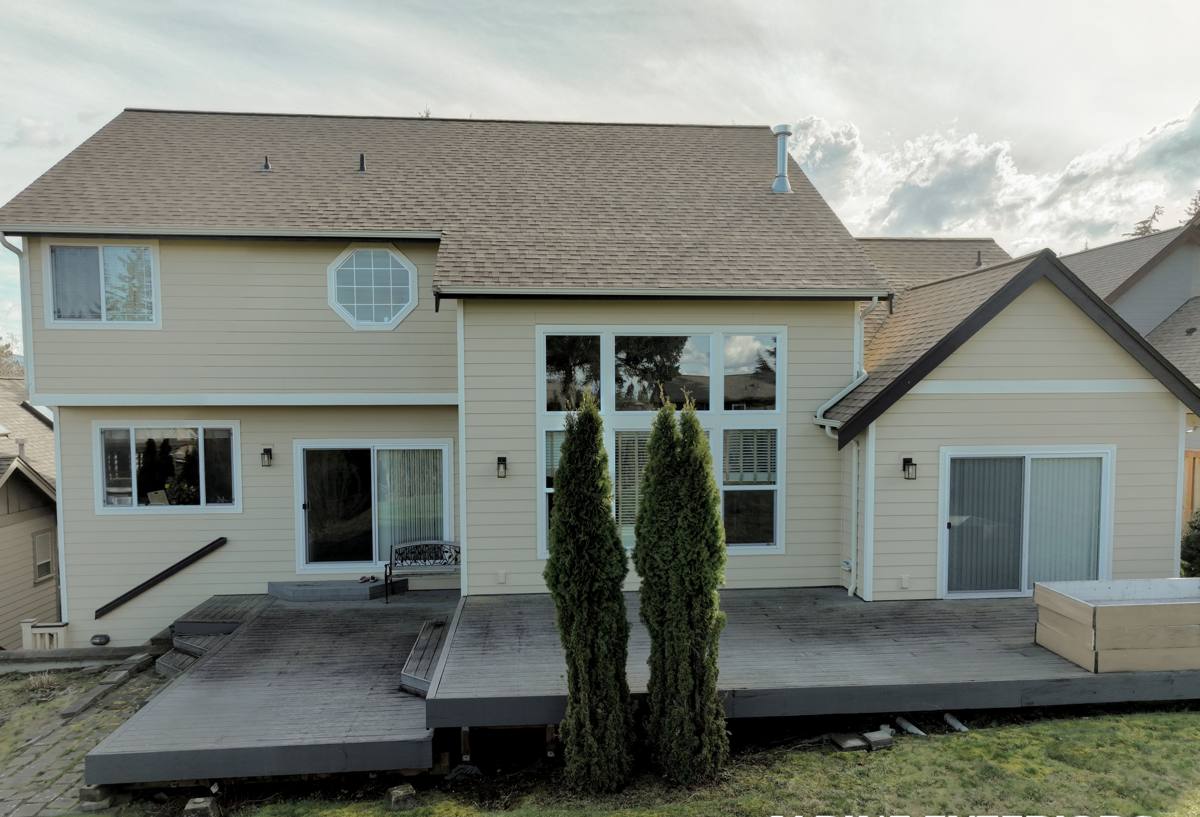
What We See Go Wrong on Older Decks Out Here
Most of the deck failures and repair calls we see in this area come down to the same handful of causes, repeated:
- Ledger boards attached to the house without proper flashing, letting water track behind the siding and rot the rim joist
- Joists and beams left unprotected, absorbing water through end grain and fastener holes
- Decking boards installed tight together with no drainage gap, trapping moisture and debris
- Standard fasteners that corrode and streak the decking within a few seasons
- Low-clearance framing under shade trees that never fully dries out between rains
- No ventilation or skirting gaps underneath, which turns the crawlspace under the deck into a moss and mildew incubator
None of these are exotic problems. They're the predictable result of building a deck the same way you'd build one in a dry climate, then leaving it to a wet, shaded lot to sort out on its own.
What a Correctly Built Deck Requires in Kendall
Framing and Structure
Footings need to go below frost depth per Whatcom County code, and on a lot with drainage issues or heavier tree root systems, we look at soil conditions before we set posts rather than assuming a standard depth is enough. Beams and joists should be pressure-treated rated for ground contact where they're close to grade or shaded soil, not just treated for general use. Where a deck sits under significant tree cover, we build in extra clearance between the ground and the framing so air can actually move underneath — a few extra inches of clearance does more to prevent moss and rot than almost any product choice.
Flashing and Moisture Management
The ledger connection — where the deck attaches to the house — is the single most important moisture detail on the whole structure. It needs proper flashing that sheds water away from the rim joist, not just caulk and a hope. We also run joist tape over the tops of framing members before decking goes down, so any water that gets through the boards doesn't sit directly on exposed wood and fastener holes. This is the kind of detail that's invisible once the deck is finished but decides whether the frame is still sound in ten years or rotting out in three.
Fasteners and Hardware
We use stainless steel or hot-dip galvanized fasteners and structural connectors rated for treated lumber, full stop. Standard fasteners corrode faster in a consistently damp, shaded environment, and corroding fasteners don't just look bad with black streaking down the boards — they lose holding strength over time. This isn't a premium upsell; it's the baseline for a deck that's going to sit wet more often than dry.
Choosing a Decking Surface for a Shaded, Damp Lot
The decking material you walk on matters as much as what's underneath it, especially where moss and algae growth is a real concern. Here's how the common options actually perform in conditions like Kendall's:
| Material | Moss/Algae Behavior | Maintenance | Typical Lifespan Here |
|---|---|---|---|
| Pressure-treated wood | Prone to moss and mildew in shade without regular cleaning | Annual cleaning, periodic sealing/staining | 10–15 years with upkeep |
| Cedar | Naturally more rot-resistant but still needs cleaning in shade | Cleaning and re-sealing every 1–2 years | 15–20 years with upkeep |
| Composite decking | Resists rot but can still grow surface algae/moss film in deep shade | Periodic washing, no sealing/staining needed | 25+ years |
| PVC/capstock decking | Best resistance to moisture absorption and staining | Occasional washing | 25+ years |
There's no wrong answer here as long as the choice matches how much upkeep you're willing to do. Wood costs less up front but demands the most attention in a shaded, damp spot like Kendall. Composite and PVC cost more but hold up with far less maintenance — which matters more on a deck that doesn't get much direct sun to dry it out between rains.
Our Process for a Kendall Deck Project
- On-site visit to assess the lot — sun exposure, drainage, tree cover, and how the deck ties into the house
- Design and material discussion based on your budget and how much maintenance you want to take on long-term
- Permit pull through Whatcom County where required, and structural plan sized to actual load and soil conditions
- Demo of any existing structure, with an honest look at whether ledger and framing underneath were built correctly
- Framing built with ground-contact-rated lumber, proper footing depth, and clearance for airflow underneath
- Ledger flashing and joist tape installed before any decking goes down
- Decking installed with correct fastener spacing and drainage gaps between boards
- Final walkthrough covering what maintenance your specific material choice actually needs
Permits and Whatcom County Considerations
Most decks above a certain height or attached to the house require a permit through Whatcom County, and inspections typically check footing depth, ledger attachment, and guard/railing height and spacing. We handle the permit process as part of the job rather than leaving it to the homeowner, and we build to pass inspection the first time rather than treating code minimums as something to negotiate around later. On a rural or wooded Kendall lot, setback and septic system locations can also affect where a deck can go, which is worth checking before design work gets too far along.
Keeping a Deck Ahead of Moss and Moisture
Even a well-built deck needs some seasonal attention in this climate. A short list of what actually matters:
- Sweep debris — needles, leaves, seed pods — off the deck surface regularly, especially in fall
- Wash the surface at least once a year to remove early moss and algae growth before it gets established
- Check the ledger flashing area annually for any staining or gaps where water might be tracking behind it
- Keep gutters and downspouts near the deck clear so runoff isn't dumping directly onto or under the structure
- Trim back overhanging branches where practical to let more light and air reach the deck surface
- Watch for soft spots, discoloration, or fastener staining as early warning signs, not just cosmetic issues
Cost Factors on a Kendall Deck
| Factor | Why It Moves the Price |
|---|---|
| Decking material | Wood costs less upfront; composite/PVC cost more but need far less upkeep |
| Size and height | Larger decks and multi-level or elevated decks need more framing, footings, and railing |
| Site access and slope | Wooded or sloped Kendall lots can require extra excavation or footing work |
| Railing and stairs | Material and complexity of railings/stairs add labor and material cost |
| Ledger and flashing complexity | Older homes may need siding removed and repaired to flash the ledger properly |
We give a firm, itemized quote after seeing the site — not a phone estimate — because lot conditions in this area vary enough that a number given sight-unseen usually isn't accurate either way.
Why a Crew That Already Works Kendall Matters
A deck built to a generic spec sheet doesn't account for the fact that a shaded, wooded lot in Kendall behaves differently than a sunny, open lot closer to town. We work this area regularly, so we're not guessing at how a north-facing deck under fir trees is going to hold up, or which flashing details actually matter once fall rains start. That local, repeated experience with Whatcom County's climate and code requirements is what separates a deck that still looks good in year eight from one that's already showing rot and moss by year three.
If you're planning a new deck or looking at replacing one that's past its useful life, we're happy to come take a look and give you a straightforward, no-pressure estimate — just fill out the form below.