 Ferndale Siding
 Replacing a Deck on a Lummi Nation Property
Lummi Nation sits out on the peninsula west of Ferndale, close enough to Bellingham Bay and the Strait that most homes there deal with a heavier, more constant version of the marine exposure the rest of Whatcom County only sees occasionally. A deck takes the brunt of that exposure more than almost any other part of a home's exterior. It has no roof over it, it sits low to the ground where moisture collects, and it's built from materials and fasteners that are, by design, more exposed than siding or roofing ever is.
When a deck out here starts failing, it's rarely one thing going wrong. It's usually a combination of salt-laden air, wind-driven rain finding its way into joints and ledger connections, and a moss season that runs long enough to keep the surface damp for months at a stretch. This page covers what that exposure actually does to an aging deck, how to tell when replacement makes more sense than another round of repairs, and what a correct replacement looks like for a property in this specific part of the county.
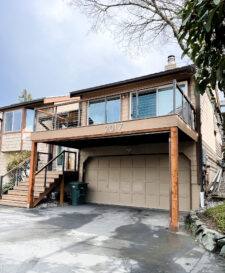
What This Climate Does to an Aging Deck
Salt Air, Concentrated
The closer a deck sits to open water, the more salt-laden moisture works into its fasteners, connectors, and finish over time. On an older deck, that shows up as corroding nail or screw heads, rusted joist hangers, and hardware that's lost holding strength well before it looks obviously bad. Salt exposure doesn't announce itself with a single dramatic failure — it just quietly shortens the life of everything metal on the structure.
Wind-Driven Rain Off the Water
Open water exposure means fewer windbreaks, and wind is what turns ordinary rain into a sideways problem. On a deck, that means water gets pushed up under railings, into ledger connections at the house, and between boards that have swollen, cupped, or lost their original gapping over the years. An older deck that was built for calm, dry conditions rarely accounts for how much water gets driven into it here.
A Moss Season That Runs Most of the Year
Peninsula terrain, tree cover in places, and near-constant moisture give moss and mildew a long growing season around Lummi Nation. Horizontal deck boards are some of the first surfaces to show it, since they hold water longer than a vertical wall and stay damp between rain events. On an aging deck, sustained moss growth isn't just cosmetic — it holds moisture against the board and framing underneath, which accelerates rot in wood decks and can trap moisture against fastener points on any material.
Repair or Full Replacement: How to Tell
Not every deck problem calls for tearing the whole thing out. A single cracked board, a loose railing baluster, or isolated fastener corrosion can often be repaired without touching the rest of the structure. Full replacement makes more sense once the problems are structural, widespread, or tied to the framing rather than the surface.
- Soft, spongy, or spring-y decking boards in more than a few isolated spots
- Joists or beams that feel soft when probed, or show visible rot, splitting, or insect damage
- A ledger board connection at the house that's soft, stained, or separating from the wall
- Support posts with visible rot at the base or where they meet the ground or footing
- Railing posts that wobble under normal pressure rather than just needing a tightened bolt
- Fastener corrosion widespread enough that individual hardware replacement isn't practical
- A deck original to a home that's 20-plus years old and has had only surface-level maintenance
If what you're seeing is limited to one or two of those, a repair may genuinely be the more sensible call, and we'll tell you that rather than push a full replacement that isn't needed yet. Once the framing itself is compromised, though, patching around it usually just delays the inevitable while spending money that would have gone toward a real fix.
Choosing Decking Material for a Replacement Here
A deck replacement is also a chance to reconsider the material, not just rebuild what was there before. In a salt-air, high-moisture environment like this, the gap in performance between a well-suited product and a poorly-suited one shows up faster than it would on a drier, more sheltered inland lot.
| Material | Handling Salt Air & Moisture | Moss Resistance | Upkeep |
|---|---|---|---|
| Cellular PVC | Excellent — no wood fiber to absorb moisture | Strong, smooth non-porous surface | Occasional washing |
| Capped composite | Strong — cap layer resists moisture and staining | Good on most lines | Occasional washing |
| Uncapped composite | Moderate — some moisture absorption at exposed fiber | Fair; more prone to buildup over time | Periodic cleaning |
| Cedar | Moderate — natural resistance, but needs sealing | Fair when sealed and maintained | Regular oiling or sealing |
| Pressure-treated wood | Weak against sustained salt exposure over time | Poor without regular treatment | Regular sealing or staining |
None of these are wrong choices outright — wood still has a place for homeowners who want that look and are willing to keep up with sealing. But for a replacement deck on a Lummi Nation property, we generally steer homeowners toward capped composite or cellular PVC, simply because the maintenance burden and moisture behavior line up better with what this specific location puts a deck through.
What a Correct Replacement Involves
Swapping out old boards for new ones on top of the existing framing is sometimes offered as a cheaper alternative to full replacement, and it can be appropriate when the substructure genuinely checks out. But a real replacement, done right for this exposure, means starting from the ground up rather than assuming what's underneath is still sound.
- Full removal of the old decking, and inspection of every joist, beam, and post before anything new goes back
- Framing material sized and rated for sustained moisture exposure, not just whatever spans the old layout happened to use
- Stainless steel or coastal-grade corrosion-resistant fasteners throughout, not standard hardware that starts corroding within a few seasons here
- Proper ledger board flashing at the house connection, since that's one of the most common places water was getting into the old deck in the first place
- Correct board gapping for drainage and material movement, matched to the new decking product's actual specifications
- Hidden fastener systems on the walking surface where the product allows, cutting down on exposed metal
- Post footings and framing checked or replaced if the old ones show any sign of movement, rot, or undersizing for current code
- Grading and ventilation underneath addressed so water doesn't sit against the new framing the way it may have against the old
A replacement that reuses questionable framing to save money usually just resets the clock on the same problems that took out the old deck, on a faster timeline given how much this location tests a structure.
Permitting and Property Considerations
Deck replacement on Lummi Nation land can involve different permitting or jurisdictional requirements than a standard Whatcom County property, depending on exactly where the home sits relative to reservation boundaries. That's worth confirming for your specific property before work starts, since the right permitting path isn't always the same one that applies a few miles away in Ferndale proper. We're glad to talk through what we've seen on past projects in the area, but we'd encourage any homeowner here to verify current requirements for their particular lot rather than assume.
How Our Replacement Process Works
We start with a site visit to actually get under the deck and look at the framing, not just walk the surface. That tells us whether we're looking at a straightforward like-for-like replacement or a job that also needs footing, post, or ledger work addressed. From there we talk through decking material options against your budget and how the space actually gets used, and we handle any permitting questions specific to your property as part of the job.
Once the plan is set, the old deck comes out completely, the framing gets inspected and rebuilt or repaired as needed, and the new decking goes down with fastening and gapping matched to the product's spec and this site's exposure. We finish with a walkthrough covering what your specific new material actually needs going forward — for most modern decking that's minimal, but it's not nothing, especially here.
Cost Factors for a Lummi Nation Deck Replacement
| Factor | What It Affects | Why It Matters Here |
|---|---|---|
| Framing condition underneath | Whether joists, beams, or posts need repair or replacement | Sustained moisture exposure on this peninsula makes hidden framing damage more common than on inland decks |
| Decking material chosen | Material cost and long-term upkeep | Higher moisture and salt exposure widen the performance gap between material tiers |
| Ledger and flashing condition | Whether the house connection needs rework | A common failure point where wind-driven rain has been getting behind the siding |
| Size and footprint | Material quantity and labor time | Larger or multi-level decks take proportionally more framing inspection and fastening work |
| Site access | Labor time and equipment needs | Peninsula lots can have tighter staging areas or steeper grades to the water side |
Exact numbers depend on what we find once the old decking comes off, which is why we give a real estimate after walking the property rather than a number off a generic price sheet.
Why It Matters That We Already Work Lummi Nation
A crew that mostly replaces decks further inland can still do competent work here, but a Lummi Nation job has variables that come up more consistently than they would on a sheltered inland lot in Whatcom County: corrosion-grade fastener requirements from sustained salt exposure, framing that's more likely to have hidden moisture damage after years near open water, and a moss season long enough to have already worked its way into an older deck's boards and joints. Working this peninsula regularly means we're not guessing at any of that on your project. We've pulled up enough old decking here to know which framing details tend to fail first and which fastener and material choices are actually worth the added cost rather than just an upsell.
That familiarity also shows up in the smaller judgment calls — knowing which side of a deck typically stays wettest given the site's orientation to the water, or being straightforward about whether your existing structure is worth saving before we ever quote a full tear-out.
Get a Straight Answer About Your Deck
Whether your deck is showing its age, you're not sure if it needs repair or full replacement, or you already know it's time and want it done right for this location, we're happy to walk the site with you and lay out the options plainly. Reach out below for a free, no-pressure estimate.