 Ferndale Siding
 Why Fairhaven's Climate Is Harder on Siding Than It Looks
Fairhaven sits close enough to Bellingham Bay that salt-laden air is a constant companion, not an occasional visitor. Add Whatcom County's long wet season — months of driving rain pushed sideways by wind off the water — and you have a climate that quietly works against whatever material is on the outside of a house. Then there's moss. Shaded lots, damp air, and mild temperatures year-round make this part of Washington nearly ideal moss-growing conditions, and moss doesn't stay on the roof. It creeps into siding laps, trim joints, and anywhere moisture likes to sit.
None of this is dramatic on its own. It's cumulative. A siding material that's merely "fine" in a drier climate can start showing real problems here after a decade — soft spots, cupping, peeling paint, or streaks of algae and moss that never fully wash off. Homes in Fairhaven need a siding system that's engineered for sustained moisture exposure and salt air, not one that's tolerating it.
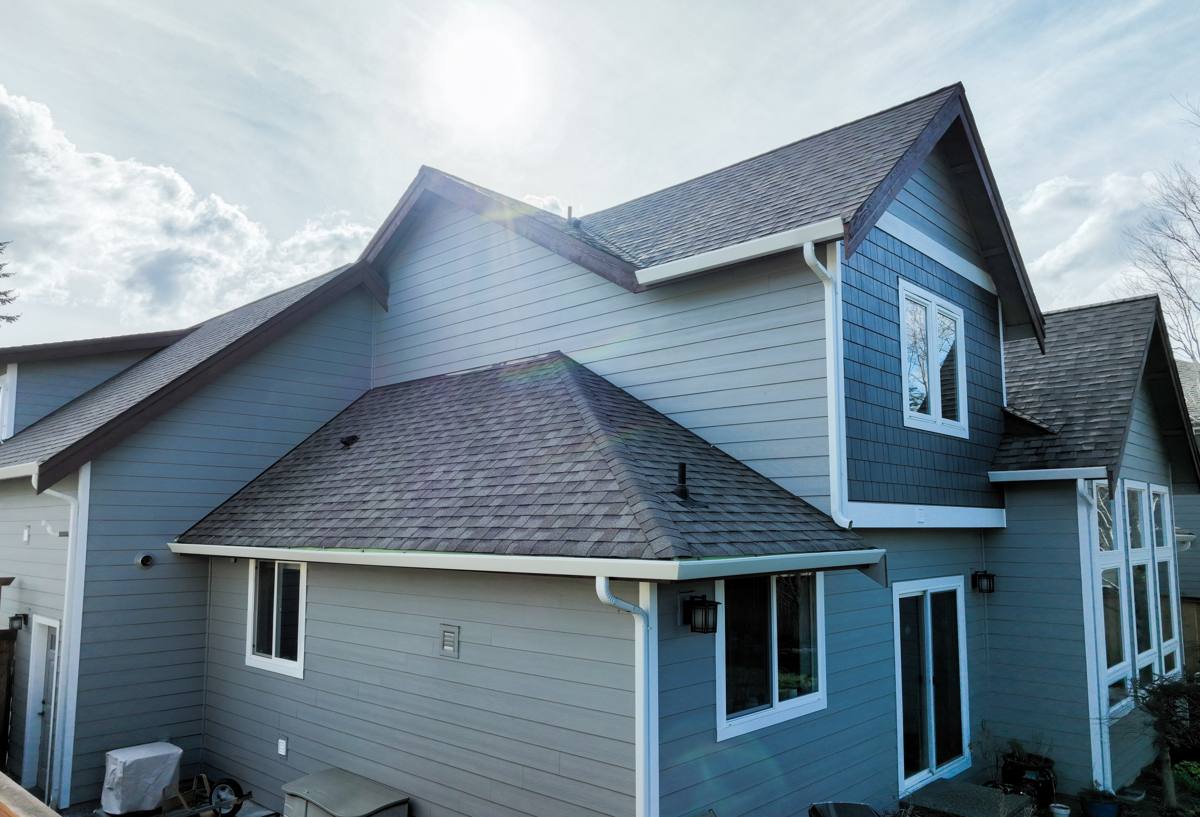
Why We Install James Hardie Here — and Only Hardie
We're a James Hardie-only contractor. We don't install vinyl, LP SmartSide, cedar, or primed spruce, and in a coastal, high-rainfall environment like Fairhaven, that standard matters more than in most places.
- Fiber cement is non-combustible and doesn't warp, rot, or feed insects the way wood-based sidings can when moisture gets behind them.
- It doesn't expand and contract with humidity swings the way wood products do, which matters when you're cycling between soaking wet winters and drier summer stretches.
- ColorPlus factory finish is baked on under controlled conditions, not brushed or rolled on-site — it holds color and resists the fading and streaking that salt air and UV accelerate.
- Vinyl can become brittle in cold snaps and shows heat distortion in full summer sun on south- and west-facing walls, and it doesn't take paint if a color update is wanted down the road.
We're not saying every other product fails outright — we're saying that after years of doing exterior work in this county, Hardie is the one system we're comfortable standing behind on every job, in every microclimate this area throws at a house.
The Right Hardie Product Line for a Fairhaven Home
HZ5 Engineering
James Hardie manufactures its siding in different "HZ" (HardieZone) formulations matched to regional climate demands. Whatcom County — with its wet winters, moderate freeze risk, and coastal moisture — falls into the zone that calls for Hardie's HZ5 product engineering, which is formulated for wetter, more variable climates than the dry-heat HZ10 formulation used in the Southwest.
Common Profiles for Fairhaven's Housing Stock
Fairhaven has a mix of older homes with real character and newer infill construction, and the right siding profile depends on the house:
- HardiePlank lap siding — the most common choice, available in several exposure widths and textures (smooth or cedar-shake-style grain), works well on both traditional and updated exteriors.
- HardiePanel with battens — a board-and-batten look that suits craftsman and farmhouse-style homes and is common on accent walls or gable ends.
- HardieTrim — used around windows, corners, and fascia; matching trim to the field siding is what makes an installation look finished instead of assembled.
Color selection matters here too. Darker ColorPlus tones show less algae streaking than some light colors in shaded, damp spots, though any color will need occasional washing in a climate this wet.
What a Correct Installation Actually Involves
James Hardie siding performs the way it's rated to perform only when it's installed to spec. In a high-moisture area like Fairhaven, the installation details matter more than the material choice itself.
Before the Siding Goes On
- Inspect and repair the water-resistive barrier (house wrap) — any tears or gaps get fixed before siding covers them up.
- Check sheathing for existing moisture damage, especially on older homes or walls facing prevailing wind and rain.
- Flash every window, door, and penetration correctly — this is the single most common failure point in siding installs generally, not just with Hardie.
During Installation
- Maintain James Hardie's specified clearances: siding kept off the roofline, deck surfaces, and grade by the manufacturer's minimum gaps so water has somewhere to go.
- Use the correct fastener type, spacing, and placement — over-driven or misplaced nails are a leading cause of premature cracking.
- Caulk only where Hardie's instructions call for it — sealing joints that are supposed to allow drainage traps water instead of shedding it.
- Field-cut edges get primed or sealed per Hardie's guidelines to protect against moisture wicking into the cut end.
Skipping any of these steps doesn't usually show up as a problem on day one. It shows up two, five, or ten years later — as a callback nobody wants, on a house that's harder to fix once it's occupied and landscaped.
Our Process for Fairhaven Jobs
- On-site assessment — we look at the existing siding, sheathing condition, moisture history, sun/shade exposure, and drainage around the foundation before quoting anything.
- Detailed proposal — product line, profile, color, trim scope, and a clear breakdown of what's included, in writing.
- Tear-off and inspection — old siding comes off, and we check the sheathing underneath before covering it back up. Anything found gets flagged and discussed, not buried.
- Weather barrier and flashing correction — repaired or replaced as needed before a single piece of Hardie goes up.
- Installation to Hardie's published specifications — proper gaps, fastening, and trim detailing.
- Final walkthrough — we go over the finished job with the homeowner and address anything before calling it complete.
Cost Factors on a Fairhaven Siding Project
| Factor | Why It Moves the Price |
|---|---|
| House size and wall complexity | More corners, gables, and dormers mean more cutting, trim, and labor time |
| Existing sheathing condition | Rot or moisture damage found during tear-off requires repair before new siding goes on |
| Siding profile and texture | Board-and-batten and specialty trim details cost more in labor than straight lap siding |
| Access and site conditions | Tight lots, slopes, and mature landscaping near the house affect setup and scaffolding time |
| Trim and detail scope | Full trim replacement (window, corner, fascia) adds material and labor beyond the field siding |
We give a firm, itemized quote after the on-site assessment rather than a rough phone estimate — moisture damage found during tear-off is the biggest reason ballpark numbers change, and we'd rather flag that possibility upfront than surprise anyone mid-job.
Why a Crew That Already Works This Area Matters
Siding contractors who work Fairhaven and the surrounding Whatcom County coastline regularly develop a feel for things that don't show up in a spec sheet: which wall orientations take the worst weather, how much moss buildup to expect between washings, where drainage tends to pool around older foundations, and how local permitting and inspection typically go. That familiarity shows up in fewer surprises during the job and a finished product that's detailed for the conditions it'll actually face — not just installed to a generic checklist.
It also matters for older homes, which make up a meaningful share of Fairhaven's housing stock. Older construction sometimes hides past moisture issues, non-standard framing, or prior repairs that a crew unfamiliar with the area's building patterns might miss or misjudge.
Maintenance and What to Expect Long-Term
- Rinse siding annually (a garden hose is usually enough) to keep salt residue and organic buildup from accumulating, especially on shaded or north-facing walls.
- Trim back vegetation and tree limbs that keep siding damp and shaded — moss and algae take hold fastest where sunlight and airflow are limited.
- Inspect caulking at trim joints every year or two; caulk is a maintenance item on any siding system and needs occasional touch-up.
- Watch for any soft spots, especially near ground level or under downspouts — catching an issue early is always cheaper than repairing it late.
James Hardie backs its siding with a strong, transferable limited warranty, and ColorPlus finishes carry their own separate finish warranty — details worth reviewing so expectations are clear from day one, not discovered later.
Signs It's Time to Talk About Siding Replacement
- Paint that's peeling, bubbling, or needing repainting more often than every few years
- Soft, spongy, or visibly warped sections, especially near the bottom of walls or below windows
- Persistent moss or algae staining that returns quickly after cleaning
- Visible gaps, cracking, or separation at seams and trim joints
- Rising heating bills that suggest the wall assembly isn't performing the way it used to
If a few of these sound familiar, it's worth getting an honest, no-pressure look at what's going on before it turns into a bigger repair. We're happy to walk your property, point out what we see, and put together a straightforward estimate — no obligation either way.