 Ferndale Siding
 Why Fairhaven's Coastal Air Is Harder on Siding Than Most Homeowners Expect
Homes near the Fairhaven area sit close enough to saltwater that the air itself becomes part of the maintenance equation. Salt-laden moisture rides in on the wind and settles on exterior surfaces, where it accelerates corrosion of fasteners, trim, and any material that isn't built to shrug it off. Add in the driving, wind-pushed rain that comes through this stretch of Whatcom County during the wet months, and siding here takes on water from angles that inland siding rarely sees — not just straight down, but sideways, up under laps, and into every gap a builder-grade installation leaves open.
Then there's the moss. Long, cool, damp stretches of the year create ideal conditions for moss and algae to colonize any surface that holds moisture even a little too long. On siding, that means green-black staining, trapped dampness behind growth, and — on materials that aren't dimensionally stable — slow softening or swelling underneath the surface you can see. None of this is exotic weather. It's just Whatcom County doing what Whatcom County does, year after year, to every exterior surface on a house.
The practical result: siding installed the way it's installed in a dry inland climate does not perform the same way a few blocks from saltwater. Material choice, flashing detail, and fastener spec all have to account for salt exposure, wind-driven rain, and near-constant moisture pressure — not just "will it look good on install day."
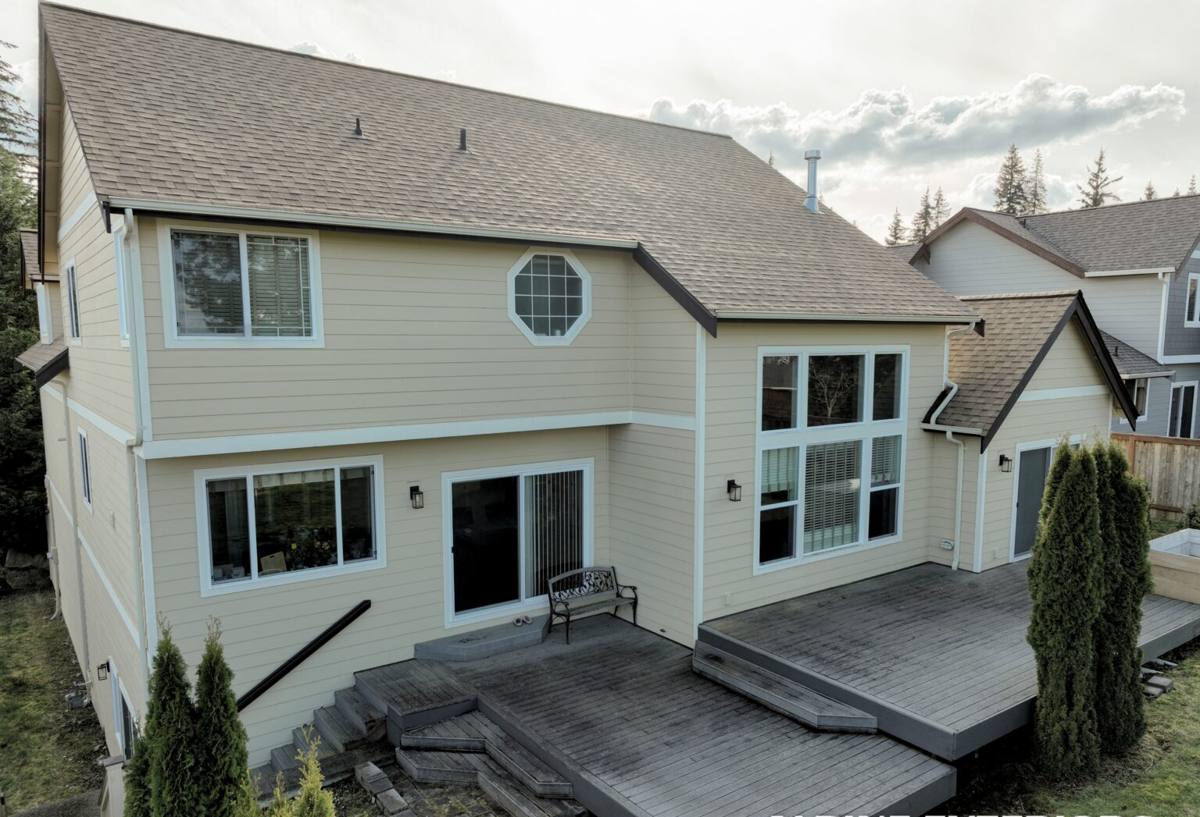
What a Correct Siding Installation Actually Involves Here
A siding job that holds up on the Fairhaven side of Ferndale is won or lost in the details most homeowners never see once the job is finished. The visible plank or panel is maybe a third of the story.
Water management comes first
Every siding installation is really a drainage system with a finish layer on top. That means a correctly installed weather-resistive barrier, properly lapped and taped house wrap seams, flashing at every window and door head, and a drainage gap or rainscreen behind the siding so that any moisture that does get past the first line of defense has somewhere to go besides straight into your wall assembly. Skip this and it doesn't matter how good the siding itself is — water finds the weak point.
Fastening has to account for salt air
Fasteners are one of the first things salt air attacks. Corroding nail heads bleed rust streaks down a wall, and a compromised fastener eventually loses its grip on the siding it's supposed to hold. Corrosion-resistant fastener specs aren't a nice-to-have this close to the water — they're the difference between siding that stays tight for decades and siding that starts telling on itself within a few winters.
Joints and butt seams are where failures start
Horizontal lap siding fails, when it fails, almost always at the seams — end joints, corners, and anywhere two pieces meet. Correct installation means factory-primed or factory-finished cut edges get sealed, joints are flashed rather than just caulked, and butt joints land on studs with proper gapping for material movement. Caulk alone, without flashing behind it, is a maintenance item waiting to happen in a climate this wet.
Quick reference: what to check before, during, and after the job
- Weather-resistive barrier installed and lapped correctly before any siding goes up
- Flashing at every window, door, and roof-to-wall intersection — not just caulk
- A drainage gap or rainscreen behind the siding, not siding nailed flat to the sheathing
- Corrosion-resistant fasteners specified for the coastal exposure
- Factory-finished or properly sealed cut edges at every joint and corner
- Clearance maintained between siding and grade, decks, and roof lines to avoid standing moisture
- A clear written scope before work starts, not a verbal understanding
Why We Standardized on James Hardie Fiber Cement
We install James Hardie fiber cement siding exclusively. That's not a marketing position — it's a decision made after weighing how different siding materials actually perform against this region's specific combination of salt air, sustained rain, and moss pressure.
Fiber cement is non-combustible, which matters in any Pacific Northwest wildfire-adjacent conversation, but for Fairhaven-area homes the bigger everyday factor is moisture behavior. James Hardie's fiber cement is engineered to resist swelling, cracking, and moisture intrusion in a way that wood-based and some engineered-wood products simply are not built to match. It doesn't feed moss the way organic-fiber products can, and it holds its factory finish instead of relying on field-applied paint to keep water out over the long run.
James Hardie also builds region-specific product lines through its HZ5® engineering — climate-engineered formulations meant for different moisture and temperature zones across the country. That regional engineering is part of why we trust it here specifically, rather than treating siding as a one-spec-fits-all material.
The factory-applied ColorPlus® finish is another piece of the equation. Instead of a color that has to be brushed on after installation and repainted every several years, the color is baked on at the factory under controlled conditions, giving a more consistent, fade-resistant, and touch-up-friendly finish than field painting — a real advantage when a house is getting hit with salt air and UV on an ongoing basis.
Why we don't install other common siding products
We get asked, reasonably, why we don't offer more options. The honest answer is that other products each carry a real trade-off we're not willing to install and stand behind on homes in this climate:
- Vinyl siding is affordable and low-maintenance in mild conditions, but it can warp or become brittle under temperature swings and UV exposure over time, and it's not the same fire-resistance category as fiber cement.
- Primed spruce or cedar are attractive, traditional materials, but they're organic — meaning they're food for moisture, rot, and moss in exactly the conditions this area produces, and they demand a repainting and recaulking cycle that never really ends.
- LP SmartSide is an engineered wood product with real strengths, but it's still wood-based at its core and depends heavily on correct field sealing of cut edges to avoid moisture wicking at seams.
- Other fiber cement brands (Cemplank, Allura) compete on price but don't carry the same factory finish system, warranty structure, or climate-specific engineering that we've standardized around with Hardie.
None of that means those products can't work anywhere — it means we made a professional call about what we're willing to put our name behind on homes exposed to this specific coastline, and Hardie fiber cement is what we landed on.
Comparing Siding Materials for a Coastal Whatcom County Home
| Material | Moisture/Salt Resistance | Moss Resistance | Finish Longevity | Fire Rating |
|---|---|---|---|---|
| James Hardie fiber cement | Engineered for damp climates (HZ5) | Non-organic surface, doesn't feed growth | Factory ColorPlus finish, long fade resistance | Non-combustible |
| Vinyl | Doesn't absorb moisture but can warp/crack over time | Moderate — smooth surface but seams collect grime | Color molded in, but fades and chalks with UV | Combustible, can melt/deform near heat |
| Cedar/primed wood | Absorbs moisture, prone to swelling and rot | Low — organic material feeds growth | Requires repainting/staining on a recurring cycle | Combustible |
| LP SmartSide (engineered wood) | Better than solid wood but still wood-based, needs sealed edges | Moderate, dependent on coating integrity | Factory-treated but wood substrate ages differently than fiber cement | Combustible |
Our Installation Process, Step by Step
A siding job on a Fairhaven-area home follows a sequence, and skipping steps to save a day is where problems get baked into a wall for the next twenty years.
- On-site assessment — we look at existing siding, sheathing condition, water staining, and any signs of past moisture intrusion before quoting anything.
- Removal and inspection — old siding comes off and the sheathing underneath gets a real look. Soft or delaminated sheathing gets addressed before anything new goes up; covering a problem is not an option.
- Weather barrier installation — a new, correctly lapped weather-resistive barrier goes on, with attention to every penetration and transition.
- Flashing at every opening — windows, doors, and roof-to-wall intersections get properly integrated flashing, not just a bead of caulk.
- Rainscreen/drainage gap — furring or a drainage mat creates a gap behind the siding so bulk water and vapor have somewhere to go.
- Hardie siding installation — panels or planks go up per James Hardie's fastening and clearance specifications, with corrosion-resistant fasteners and sealed cut edges.
- Trim, corners, and caulking — detail work at corners, trim boards, and any remaining joints, using products suited to this climate's moisture load.
- Final walkthrough — we go over the finished job with the homeowner before calling it done.
What Correct Installation Means for Long-Term Maintenance
Homeowners near saltwater often assume ongoing maintenance is unavoidable no matter what siding goes up. Correct installation changes that math significantly. A properly installed, factory-finished fiber cement siding job doesn't need repainting on the cycle that wood or field-painted materials do, and it isn't feeding moss the way organic materials can. That doesn't mean zero maintenance — gutters still need cleaning, and any exterior surface benefits from an occasional rinse to knock off accumulated salt and grime — but it means the maintenance burden shifts from "recurring repainting and recaulking" to "occasional cleaning and periodic inspection."
James Hardie backs its siding with a strong, transferable product warranty, which matters both for the current homeowner and for resale value down the line — a documented warranty on file is worth something to a future buyer in a market where siding condition gets scrutinized.
Why Hiring a Crew That Already Works Ferndale and the Fairhaven Area Matters
Siding crews that split time across dramatically different climates don't always adjust their default specs for coastal exposure — a crew that mostly works drier inland jobs may not think twice about skipping a rainscreen gap or using standard fasteners, because it's never bitten them in that climate. A crew that regularly works Whatcom County's coastal side treats salt-air fastener corrosion, wind-driven rain, and moss pressure as the baseline assumption, not an afterthought.
There's also a practical logistics side: a local crew knows the permitting expectations in this part of Whatcom County, isn't guessing at what inspectors here look for, and isn't adding travel time and unfamiliarity costs into your project. When something needs a follow-up visit — a piece of trim, a warranty question — a crew already working in the area can get back to your house without it turning into a scheduling ordeal.
Questions worth asking any contractor before you hire
- Do you install a rainscreen or drainage gap behind the siding, or nail directly to the sheathing?
- What fastener spec do you use, and is it rated for coastal/salt exposure?
- How do you flash window and door openings — caulk only, or integrated flashing?
- Will you inspect and address the sheathing underneath before installing new siding?
- What's covered under the manufacturer's warranty, and is it transferable if I sell the house?
What This Means for Your Fairhaven-Area Home
If your current siding is showing green-black staining, soft spots, cracking, or fastener rust streaks, that's the climate here doing exactly what it does to a wall system that wasn't detailed for it. A correct James Hardie installation — proper water management, corrosion-resistant fastening, sealed joints, and a factory finish built for sustained exposure — is how a home in this part of Whatcom County stops fighting its own siding every winter.
If you'd like a straightforward look at what your home actually needs, we offer a free, no-pressure estimate — no obligation, just an honest assessment of your siding and what correct installation would involve for your specific house.