 Ferndale Siding
 Sudden Valley's Climate Is Harder on Siding Than Most of Ferndale
Whatcom County sits in a marine climate, and every contractor here works around the same baseline conditions: salt-tinged air moving in off the water, long stretches of driving rain through fall and winter, and a moss season that can run most of the year. Sudden Valley adds its own layer on top of that. The community sits among dense stands of second-growth conifer on the south side of Lake Whatcom, and that tree cover changes how a house dries out. Walls that would get several hours of direct sun on a more open lot stay shaded most of the day here, which means siding holds moisture longer after every storm, and moss and algae get a head start they don't get on more exposed properties closer to the water or downtown.
None of that makes siding in Sudden Valley a lost cause — it just changes what "correct" looks like. A material that tolerates being damp for extended stretches without breaking down, an installation that assumes water will find every gap eventually and routes it back out, and a finish that doesn't feed the organic growth this much shade produces. That's the standard we hold every Sudden Valley siding job to, and it's a different job than the same siding install on an open lot a few miles away.
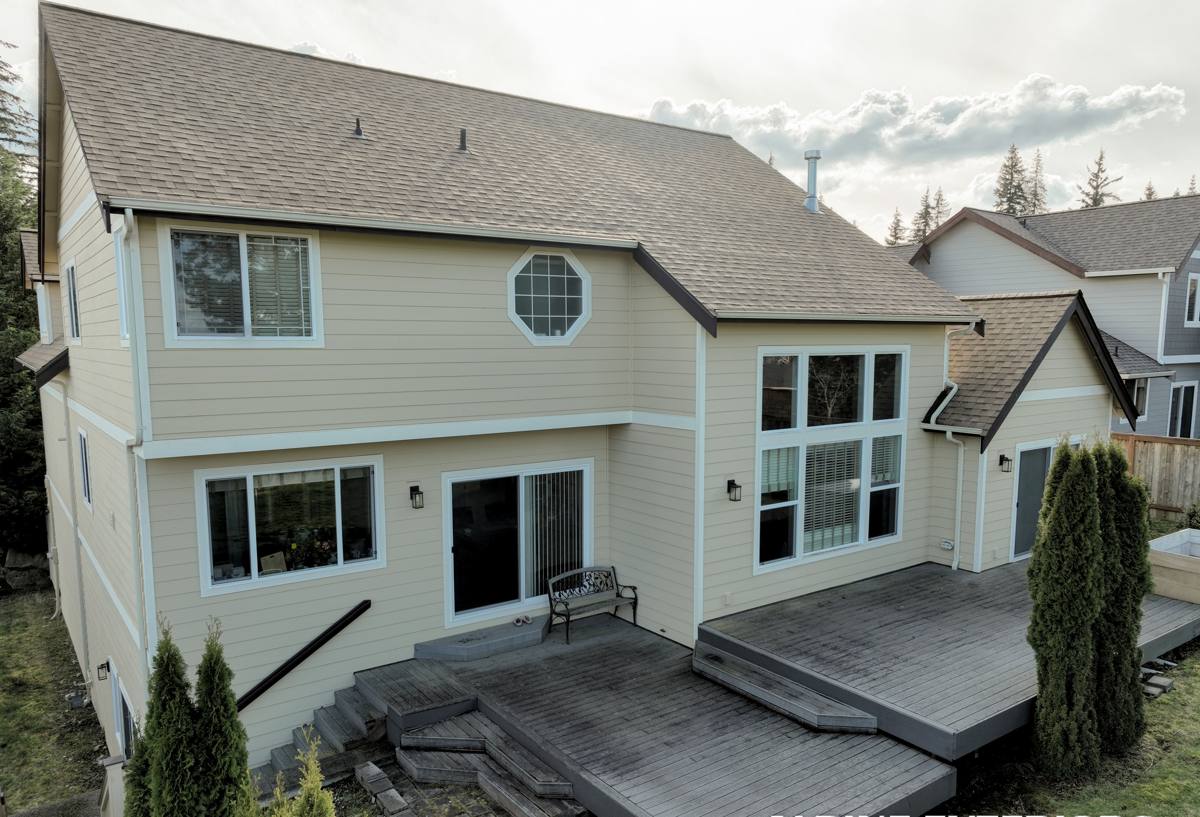
Why We Only Install James Hardie Fiber Cement Here
We install one siding product on every job, in every part of our service area: James Hardie fiber cement. We don't offer vinyl, LP SmartSide, Cemplank, Allura, primed spruce, or cedar as alternatives, and a shaded, lake-adjacent lot like the ones in Sudden Valley is exactly the kind of property that explains why.
Fiber cement is Portland cement, sand, and cellulose fiber cured into a rigid board. It doesn't rot, it isn't a food source for the mold and mildew that thrive in shade, and it doesn't expand and contract with humidity the way wood and engineered wood products do. It's also non-combustible, which is worth noting for a heavily treed community like this one — summers in Western Washington have trended drier in recent years, and cladding that doesn't add fuel to a structure is a real, if secondary, consideration on a wooded lot. Vinyl has its own problem in this setting: it's a plastic product that goes brittle with age, and the gaps and waviness that develop as it moves give shaded, damp walls behind it exactly the dark, still air that moss and mildew want. Engineered wood siding carries a standing moisture-management requirement — keep it painted, keep cut edges sealed, keep water off — that only gets harder to stay ahead of on a lot where the siding rarely fully dries between rains.
James Hardie also builds region-specific product formulations rather than one national version, and the HZ5 line sold in Western Washington is engineered for a wet, moderate marine climate rather than the freeze-thaw cycles of the Midwest or the heat of the Southeast. That's not a marketing detail — it's the difference between a board designed for what actually happens on your wall and one that's a compromise everywhere it ships.
Which Hardie Product Fits a Sudden Valley Home
HardiePlank Lap Siding
Lap siding is the right call for most Sudden Valley homes. It's the traditional look most of the community already has, it sheds water course by course by design, and it's available in a Cedarmill woodgrain texture that reads naturally against a backdrop of fir and cedar, or a Smooth profile for a cleaner, more contemporary face.
HardiePanel and Board-and-Batten Accents
Vertical panel siding shows up well on gables, entries, and accent walls, and it pairs naturally with the cabin- and lodge-influenced architecture common around the lake. We'll often spec HardiePlank lap on the main walls with a HardiePanel or board-and-batten accent at a gable or entry — same manufacturer, same warranty, one coordinated look instead of two systems bolted together.
ColorPlus Factory Finish
On a shaded lot, finish quality carries more weight than it does on a sun-exposed one, because a weaker finish shows dirt, mildew staining, and fade faster when the wall stays damp longer between dry spells. ColorPlus is baked on at the factory under controlled conditions rather than sprayed or rolled on site, and it carries its own 15-year finish warranty against peeling, chipping, and cracking. For a home tucked under tree cover, that head start against the elements is worth having.
What a Correct Installation Has to Get Right Under This Tree Cover
Clearance and Drainage
James Hardie's installation manual specifies minimum clearances above grade, roof lines, and decks, and on a shaded, tree-lined lot those clearances aren't a formality. They're what keeps needle litter, damp soil, and standing debris from wicking moisture straight into the bottom of the wall. We check and correct grading and clearance issues before the first board goes up, not after a callback two years later.
Flashing and the Weather-Resistive Barrier
Every roof-to-wall intersection, window, and door needs proper flashing and a continuous weather-resistive barrier behind the siding — the housewrap system that catches anything that gets past the cladding and carries it back out. On a lot that holds moisture longer than an open one, a shortcut here is the kind of thing that doesn't show up for two or three years and then shows up as rot in the sheathing, well after the crew that cut the corner is gone.
Fastening to Manufacturer Spec
Fastener type, spacing, and placement are all specified by James Hardie, and following that spec is also what keeps the manufacturer's warranty intact. It's invisible once the job is painted and finished, which is exactly why it's worth asking about before you hire anyone.
Comparing Siding Materials for a Shaded, Wet Lot Like Sudden Valley
| Material | How It Handles Shade and Moisture | Maintenance Burden Here | Our Position |
|---|---|---|---|
| James Hardie Fiber Cement | Doesn't rot or feed mold growth; dimensionally stable when damp | Occasional rinse; repaint only needed if not ColorPlus | What we install |
| Vinyl | Won't rot, but gaps and warping trap damp, still air behind panels | Low upfront, replacement often comes sooner | Not installed |
| LP SmartSide (engineered wood) | Wood-based core is moisture-sensitive; cut edges need ongoing sealing | Regular caulk and paint upkeep required | Not installed |
| Cedar | Natural material; absorbs and releases moisture constantly in shade | Frequent refinishing plus rot and pest watch | Not installed |
Warranty Coverage That Matters on a Long-Term Property
James Hardie backs its fiber cement siding with a 30-year non-prorated limited warranty, and the ColorPlus factory finish carries its own 15-year warranty against peeling, chipping, and cracking. Both are transferable to a new owner if the home sells within the coverage window, which is worth knowing in a community like Sudden Valley, where homes tend to change hands through retirement moves and inheritance about as often as through the open market. A warranty like this also depends on correct installation — a manufacturer can reduce or deny a claim over installation errors — which is one more reason the crew matters as much as the product itself.
Our Process for a Sudden Valley Siding Project
- Walk the property. We look at tree cover, drainage paths, and any existing moisture damage before we talk numbers, since those conditions drive what the job actually needs.
- Check behind the old siding. On a shaded wall, tear-off is when hidden rot or trapped moisture in the sheathing turns up. We document what we find and price it honestly instead of covering it back over.
- Confirm product and finish. HardiePlank or HardiePanel, profile, and ColorPlus color are locked in before materials are ordered.
- Install to spec. Clearances, flashing, weather-resistive barrier, and fastening schedule all follow James Hardie's published requirements rather than a generalized "how we always do it."
- Final walk-through. We go over the finished job with you in person before we consider it done.
What to Check Before You Hire Anyone for This Job
- Confirm the crew is licensed and insured to work in Washington, and ask to see it.
- Ask what siding product they're proposing and why — on a shaded, wet lot, that answer should go beyond "it's what we usually use."
- Ask specifically how they'll handle clearance above grade and roof lines given the tree cover.
- Ask whether they've worked in Sudden Valley before and what they specifically watch for on lots like this.
- Get the color and profile confirmed in writing before materials are ordered, especially if the homeowners association has design guidelines to satisfy.
- Ask how hidden sheathing or framing damage found during tear-off would be priced.
Why It's Worth Hiring a Crew That Already Works This Community
Sudden Valley is a private, HOA-governed community with its own road network, and a crew that has already worked here knows the practical realities: how deliveries and material staging work on a private road, that most lots have real tree cover to protect during a tear-off, and generally what a homeowners association here tends to expect in terms of look and color approval. That's not a substitute for asking the questions above — it just means less time spent explaining the basics and more time spent on the parts of the job that actually determine how the siding performs ten years from now.
If you're planning a re-side in Sudden Valley, we're glad to walk the property with you, talk through profile and color options in person, and put together a free, no-pressure estimate — no obligation, just a straight look at what your home needs. The form below is the easiest way to get started.