 Ferndale Siding
 Lynden's Weather Doesn't Go Easy on a Roof
Whatcom County sits under one of the wettest, greyest weather patterns in the state, and a roof here earns its keep. The same marine air that moves in off the Salish Sea carries a faint salt content that speeds up corrosion on exposed metal — nail heads, flashing seams, gutter hangers — long before a homeowner notices a leak. Add in driving, sideways rain during fall and winter storms, and a moss season that can run eight or nine months out of the year on shaded, north-facing slopes, and you have a roof system that's under near-constant low-grade stress even when nothing looks obviously wrong.
None of that means a Lynden roof is destined to fail early. It means the roof needs to be built and repaired with that weather in mind — the right flashing details, the right approach to moss, and repairs that solve the actual cause instead of just patching the symptom. Most of the emergency calls we get started as small, ignorable problems two or three winters earlier.
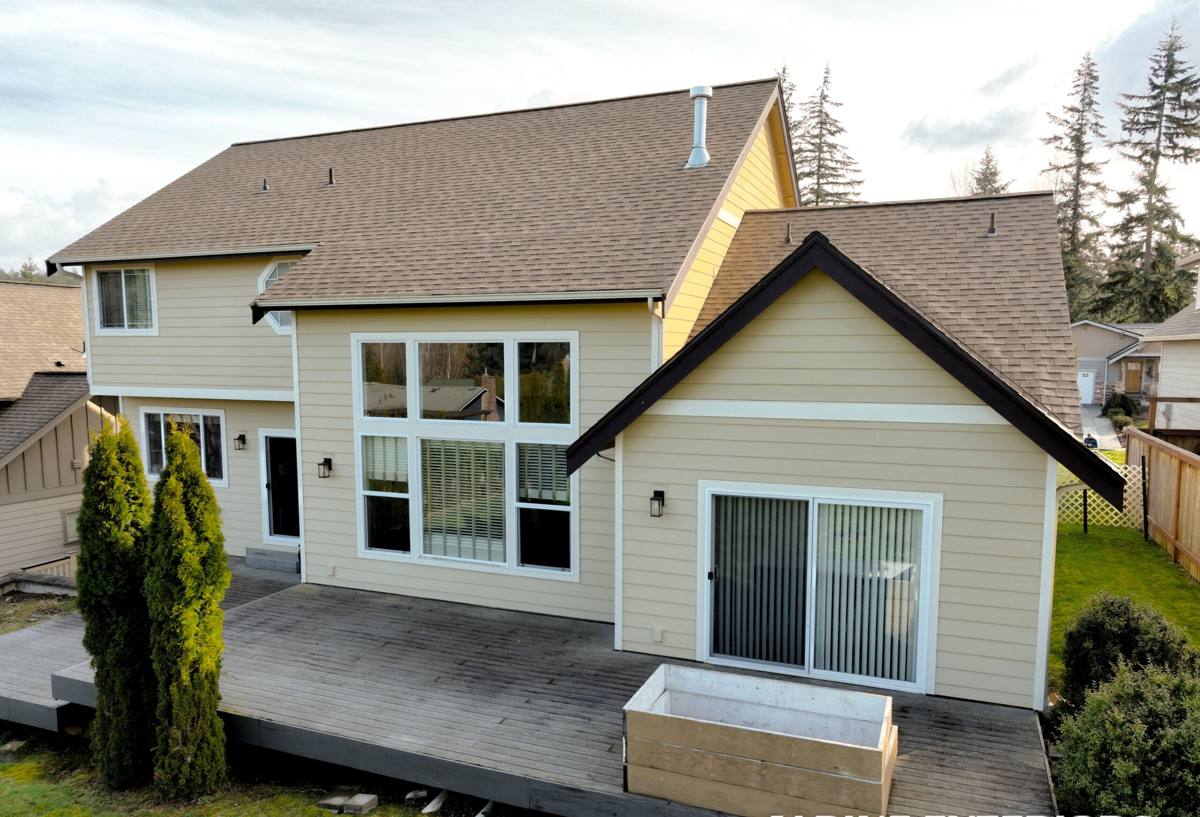
Signs a Repair Is Needed — Not Just a Look
A roof rarely announces trouble the way people expect. Water finds the path of least resistance, so what shows up inside the house is often several feet from where it's actually getting in. Watch for these warning signs before they turn into a bigger repair:
- Brown or yellow staining on ceilings or upper interior walls, especially after a heavy rain
- Granules collecting in gutters or at downspout outlets, a sign the shingle surface is wearing thin
- Thick moss mats or dark streaking on shade-heavy slopes, particularly under overhanging trees
- Curling, cupping, or lifted shingle edges along ridges, valleys, or the roof's lower edge
- Daylight visible through the roof deck when viewed from inside the attic
- Soft or spongy spots underfoot near chimneys, skylights, or plumbing vents
Any one of these on its own is usually a manageable repair. Left alone through another wet season, most of them turn into deck rot, insulation damage, or interior drywall and framing repair — costs that have nothing to do with the roof itself.
The Repair Issues We See Most Often Around Lynden
Moss and Organic Growth
Moss doesn't just look bad — it holds moisture directly against the shingle surface and works its way under the tabs, which lifts them and breaks the seal that keeps water out. On the shaded, tree-lined lots common around this part of the county, moss can establish itself within a year or two of a roof going on if it isn't managed. Left untreated for several seasons, it accelerates granule loss and shortens the life of an otherwise sound roof by years.
Flashing Failures
Flashing — the metal that seals roof penetrations and transitions — is where most leaks actually originate, not the shingle field itself. Chimneys, skylights, dormers, and roof-to-wall intersections all depend on flashing that's lapped correctly and hasn't corroded or pulled loose. Caulk-only patches over failed flashing are a common shortcut we get called to fix, usually because the caulk has already cracked and let water back in.
Valley and Gutter Backups
Roof valleys concentrate a huge volume of water during a heavy Pacific storm system, and if they're clogged with needles, moss debris, or undersized for the roof's pitch, water backs up under the shingles instead of running off. The same goes for gutters — a clogged or poorly pitched gutter run during a hard winter rain can push water back up under the roof edge.
Wind and Storm Lift
Winter windstorms that move through the county can lift or crease shingle tabs, especially on roofs already weakened by age or moss damage underneath. A few missing or torn shingles rarely cause an emergency on their own, but they're an open door for the next heavy rain.
What an Honest Roof Repair Actually Involves
Finding the Real Source, Not Just the Symptom
Because water travels before it drips, a repair that only addresses the spot where a stain appeared often misses the actual failure point entirely. A proper repair starts with tracing the leak path — checking flashing, underlayment, valleys, and penetrations uphill from the visible damage — before any shingles come off or new material goes on.
Matching Materials Correctly
Shingle color, profile, and weight vary by manufacturer and by production run, so a patch repair needs material that's a genuine match, not just "close enough." We also match flashing metal and fastener type to what's already on the roof and to what holds up best against the moisture and mild salt exposure typical of this region — mixing incompatible metals at a flashing joint can actually accelerate corrosion.
Doing Moss Removal the Right Way
Pressure washing a mossy roof is one of the fastest ways to strip granules and shorten the life of otherwise good shingles. A correct moss treatment uses a low-pressure soft wash approach and, where it makes sense, zinc or copper control strips near the ridge that release trace metal ions with every rain to slow regrowth going forward — without damaging the shingle mat underneath.
Our Roof Repair Process
- Inspection. We get on the roof (not just a ground-level look) and check the shingle field, flashing, valleys, vents, and attic ventilation.
- Diagnosis. We explain, in plain terms, what's actually failing and why — including photos of anything hard to see from the ground.
- Honest options. If a targeted repair will hold, we say so. If the roof is past the point where repair makes sense, we tell you that too, with the reasoning behind it.
- The repair itself. Matching materials, correct flashing technique, and proper fastening — done to hold up through the next several wet seasons, not just pass a quick visual check.
- Cleanup and walkthrough. Debris cleared, gutters checked, and a final look together before we consider the job done.
Repair or Replace? What Actually Decides It
Homeowners understandably want a straight answer, and most of the time there is one once you look at a few concrete factors together rather than any single one in isolation.
| Factor | Leans Toward Repair | Leans Toward Replacement |
|---|---|---|
| Roof age | Under 12–15 years | Approaching or past its expected lifespan |
| Extent of damage | Isolated to one section or penetration | Spread across multiple slopes |
| Decking condition | Solid, dry sheathing underneath | Soft, rotted, or delaminated decking |
| Repair history | First or second repair on this roof | Repeated patch repairs in the same areas |
| Moss/granule condition | Light coverage, granules still intact | Heavy moss with visible bald, granule-stripped patches |
None of these decide it alone — a 20-year-old roof with one small flashing leak and a sound deck is often still a good repair candidate. The point of a real inspection is weighing all of these together instead of defaulting to "replace" because it's the easier sell.
Materials We Work With
Most homes in and around Lynden are roofed in asphalt composition shingle, and that's where the bulk of our repair work happens — matching existing shingle lines, correcting flashing details, and rebuilding valleys where needed. We also work on metal roofing, which is common on outbuildings, shops, and a fair number of homes in the more rural stretches of the county; metal repair is a different discipline, focused on seam integrity, fastener condition, and panel-to-panel sealing rather than shingle matching. For flashing and edge metal, we favor materials that hold up against sustained moisture exposure rather than the cheapest option available, since that detail work is what determines whether a repair lasts five years or fifteen.
Why a Crew That Already Works in Lynden Matters
Roofing done right in this part of Whatcom County isn't generic — it accounts for the tree cover and shade patterns that drive moss growth, the storm direction that tends to find weak flashing first, and the pace at which organic debris builds up in valleys and gutters between visits. A crew that's already working roofs in this area day to day recognizes these patterns quickly instead of treating every job as a blank slate. That familiarity shows up in faster, more accurate diagnosis and in repair choices that are built for how this specific climate behaves over years, not just how the roof looks on the day the work is finished.
Simple Roof Maintenance Between Repairs
A handful of habits go a long way toward keeping small issues small in this climate:
- Clear gutters and valleys of needles and debris at least twice a year, more often under heavy tree cover
- Trim back branches that keep a roof section shaded and damp longer than the rest of the roof
- Have moss treated before it forms thick mats, not after tabs are already lifting
- Check the attic after a hard storm for damp insulation, daylight gaps, or musty odor
- Have flashing around chimneys and skylights inspected every few years, since that's where most leaks start
- Address small repairs promptly — a $200 flashing fix now is a lot cheaper than deck and insulation repair later
If something on your Lynden roof looks off — a stain, a soft spot, a patch of heavy moss, or damage after the last windstorm — we're glad to take a look and give you a straight, no-pressure assessment of what it actually needs. Use the form below to request a free estimate.