 Ferndale Siding
 Marietta's Roofs Work Harder Than Most
Marietta sits right where Bellingham Bay meets the mouth of the Nooksack, a stretch of Whatcom County that gets more weather thrown at it than homes just a few miles inland. Roofs here deal with three things at once, year-round: salt-laden air off the bay, driving rain that comes in sideways during winter storms, and a moss season that can run eight or nine months out of the year in shaded, north-facing sections of a roof. None of these problems is dramatic on its own. Together, over ten or fifteen years, they're what turns a roof that "looked fine last spring" into one that's leaking by January.
When we install a new roof in Marietta, we're not just matching what's required by code. We're building for this specific combination of exposure — salt air that accelerates corrosion on fasteners and flashing, wind-driven rain that finds every underlayment gap, and moss that holds moisture against shingles long after the rest of the neighborhood has dried out. A roof designed with those three factors in mind lasts meaningfully longer than one that wasn't.
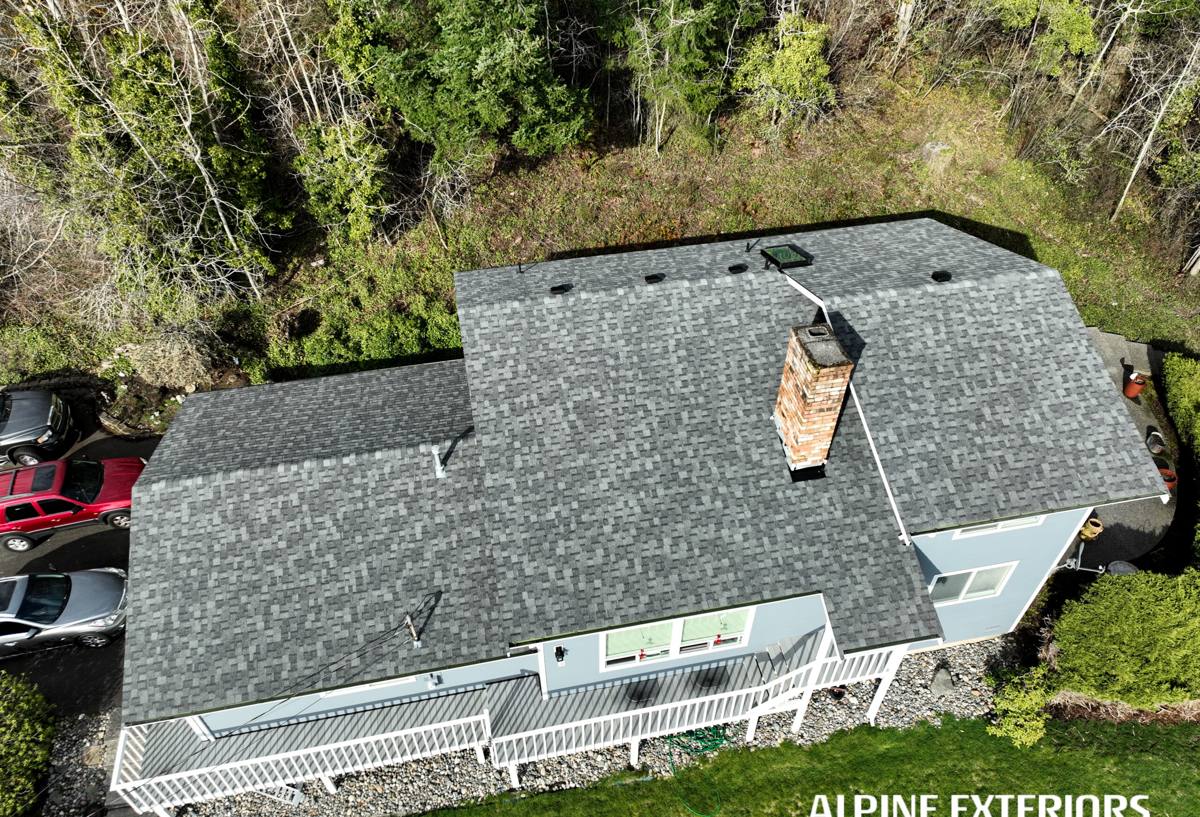
Salt Air: The Slow Corrosion Problem
Homes within a mile or two of Bellingham Bay get a steady, low-level dose of salt in the air, especially on windy days. It's not enough to notice day to day, but it's constant. Over years, that salt exposure attacks unprotected metal — nails, staples, drip edge, flashing, and vent boots — faster than it would on a roof further inland.
- Fasteners: we use corrosion-resistant nails rated for coastal exposure, not standard electro-galvanized nails that can start rusting within a few years near the bay.
- Flashing: flashing around chimneys, walls, and valleys is where salt-driven corrosion shows up first. We spec metal that holds up to marine-influenced air, not the thinnest option that meets minimum code.
- Vent boots and pipe collars: rubber and plastic components degrade under UV and salt exposure faster here than in drier inland climates, so we treat these as maintenance points from day one, not afterthoughts.
None of this shows up as a dramatic failure. It shows up as a nail head that's lost its grip, a flashing seam that's started to lift, a vent boot that's cracked two years before it "should" have. Small, quiet failures that let water in.
Driving Rain: Where Standard Installs Fall Short
Whatcom County rain isn't always the gentle, straight-down kind. Storms coming off the Strait and up the bay can push rain sideways with real force, and Marietta's low elevation and open exposure to the water mean it catches more of that wind-driven rain than roofs tucked further into town. Wind-driven rain doesn't behave like normal rainfall — it can be pushed up under shingle tabs, through nail penetrations, and along valleys and eaves where standard underlayment coverage is thin.
A correct install for this kind of exposure means paying close attention to the details that a rushed or budget install skips:
Underlayment
We use synthetic underlayment as a full water-resistant layer under the roofing material, not just a code-minimum liner. In valleys, around chimneys, and along eaves — the areas most exposed to wind-driven rain — we add self-adhered ice-and-water membrane for a second line of defense.
Fastening Pattern
Shingles and panels rated for high-wind exposure need the correct nailing pattern to actually perform that way. We follow manufacturer high-wind nailing specs, which usually means more fasteners per shingle than a standard install, placed in the manufacturer's nailing zone rather than wherever's fastest.
Valleys and Transitions
Valleys are where roofs most often fail first in driving rain, because water concentrates there under pressure instead of just sheeting off. We use metal or woven valley details built for high water volume, not the minimum treatment.
Moss: Managing a Season That Never Really Ends
North-facing slopes, roofs shaded by mature trees, and anything near the tree line hold moisture longer, and moss takes hold anywhere moisture sits. Once established, moss lifts shingle edges, holds water against the roof deck, and works its way under the roofing material over time. In parts of Marietta with heavy tree cover, moss season can effectively run most of the year.
A new roof install is the best point to build in moss resistance, because retrofitting it later is far more limited:
- Zinc or copper strips installed near the ridge, which release trace metal ions with every rain and inhibit moss growth on the slopes below.
- Choosing algae-and-moss-resistant shingle products where the granules themselves are treated, rather than relying on strips alone.
- Confirming the roof has enough slope and drainage in shaded areas that water doesn't sit — sometimes this means adjusting how valleys and crickets are built, not just the shingle choice.
None of this makes a roof moss-proof forever. Moss is a maintenance item on any roof in this climate. But a roof built with these details needs far less aggressive intervention down the road, and won't have moss working its way under shingles within the first few years.
Material Options for Marietta's Climate
There's no single "right" roofing material for every home — it depends on the roof's exposure, the home's style, and the owner's budget and timeline. Here's how the common options stack up against Marietta's specific conditions:
| Material | Salt Air Performance | Wind-Driven Rain | Moss Resistance | Typical Lifespan Here |
|---|---|---|---|---|
| Architectural asphalt shingle | Good, with corrosion-rated fasteners | Good with proper underlayment and nailing | Fair — benefits from algae-resistant granules | 20-25 years |
| Standing seam metal | Very good with coated/coastal-rated panels | Excellent, minimal seams for water to find | Very good — sheds moisture, hard for moss to hold | 40-50+ years |
| Synthetic/composite shingle | Good, low water absorption | Good | Good | 30-40 years |
| Wood shake | Fair — needs regular treatment near salt air | Fair, more seams and gaps | Poor without frequent maintenance | 20-30 years with upkeep |
For most Marietta homes, we recommend architectural asphalt with corrosion-rated hardware and algae-resistant granules as the best balance of cost and durability, or standing seam metal for owners who want to minimize long-term maintenance and are planning to stay in the home for decades. We'll walk through the honest trade-offs for your specific roof rather than push one product.
How Our Install Process Works
- On-site assessment: we inspect the existing roof, deck condition, ventilation, and note exposure-specific risk areas — which slopes face the bay, which stay shaded, where valleys concentrate water.
- Deck inspection and repair: once the old roofing is off, we check the deck for soft spots, rot, or prior water damage before anything new goes down. This is the step that gets skipped on rushed jobs and causes problems years later.
- Underlayment and ice-and-water membrane: full synthetic underlayment with reinforced membrane at valleys, eaves, and penetrations.
- Flashing: new flashing at all chimneys, walls, skylights, and valleys — we don't reuse old flashing on a new roof.
- Ventilation check: intake and exhaust ventilation confirmed or corrected as part of the install, not treated as a separate project.
- Roofing material install: installed to manufacturer high-wind specifications, with moss-resistant details built in where appropriate.
- Final walkthrough: we go over the finished roof with you, including what maintenance to expect and when.
Ventilation: The Detail That Protects the Whole Roof
A new roof is only as good as the attic underneath it. Without balanced intake and exhaust ventilation, moisture from daily living gets trapped in the attic, condenses against the underside of the roof deck, and creates conditions for rot and mold — regardless of how good the roofing material above it is. In a climate as damp as Whatcom County's, this matters more than it does in drier regions.
We check soffit intake vents, ridge or box vents, and attic insulation as part of every new roof install. If ventilation is undersized or blocked, we address it during the reroof — it's far more cost-effective to fix at this stage than to open the roof back up later.
Signs Your Marietta Home May Need a New Roof
- Granules collecting in gutters or at the base of downspouts
- Shingles that are cupping, curling, or missing tabs
- Moss or dark streaking covering more than a small section of the roof
- Daylight visible through the attic roof deck
- Soft or spongy spots when walking the roof
- Interior water stains on ceilings, especially after wind-driven storms
- A roof that's 20+ years old and has never been fully inspected
Cost Factors for a Marietta Reroof
Every roof is priced individually after an on-site look, but the main variables that move the number are consistent. Broad, honest ranges depend heavily on roof size, pitch, and material — here's what actually drives the cost:
| Factor | Why It Matters |
|---|---|
| Roof size and pitch | Steeper roofs take longer to work safely and use more material per square foot of coverage. |
| Deck condition | Rotten or soft decking found during tear-off adds material and labor to replace before new roofing can go down. |
| Material choice | Standing seam metal costs more upfront than asphalt but needs less long-term maintenance in this climate. |
| Number of penetrations | Chimneys, skylights, and vents each need proper flashing, which adds labor and material. |
| Access and site conditions | Tree cover, steep driveways, or tight lot access can affect staging and disposal logistics. |
| Ventilation corrections | Adding or upgrading intake/exhaust vents during the reroof is more efficient than a separate project later. |
Why a Crew That Already Works Marietta Matters
A roofing crew that works this specific area regularly knows things a generalist company won't think to ask about: which slopes in Marietta take the worst of the bay wind, which older homes here were built with ventilation that's since been blocked by insulation upgrades, and which products actually hold up to salt air over a decade rather than just on paper. That local pattern recognition shows up in small decisions throughout the job — where to add extra membrane, which flashing detail to upgrade, whether a shaded slope needs a different moss strategy than the rest of the roof.
It also matters for accountability. A roof is a long-term investment, and it helps to work with a crew that's going to still be answering the phone in Ferndale five or ten years from now if a question comes up — not a crew that worked the area for one storm season and moved on.
Get a Free, No-Pressure Estimate
If your Marietta home's roof is showing its age — or you just want an honest read on how many years it has left — we're happy to take a look. The estimate is free, there's no pressure, and you'll get a straight answer about what your roof actually needs, not an upsell. Use the form below to get started.