 Ferndale Siding
 Why Metal Roofing Makes Sense for Lynden
Lynden sits inland from Ferndale in the Nooksack River valley, which means less direct salt exposure than homes right along Bellingham Bay or the Strait of Georgia, but the same wet, gray Whatcom County winters apply here just as much as anywhere else in the county. Long stretches of low-intensity rain, wind that drives moisture sideways under poorly lapped shingles, and shaded rooflines that stay damp for days at a time all add up over the years. A metal roof handles that combination better than most other materials because it sheds water fast, doesn't absorb moisture into the material itself, and gives moss far less to grip onto compared to a granular asphalt surface.
We're not saying metal is the right choice for every house or every budget — asphalt composition shingle still has its place, and we'll tell you honestly when it does. But for a lot of Lynden homeowners looking at a 40-plus year roof that shrugs off the wet season with minimal upkeep, metal is worth a serious look.
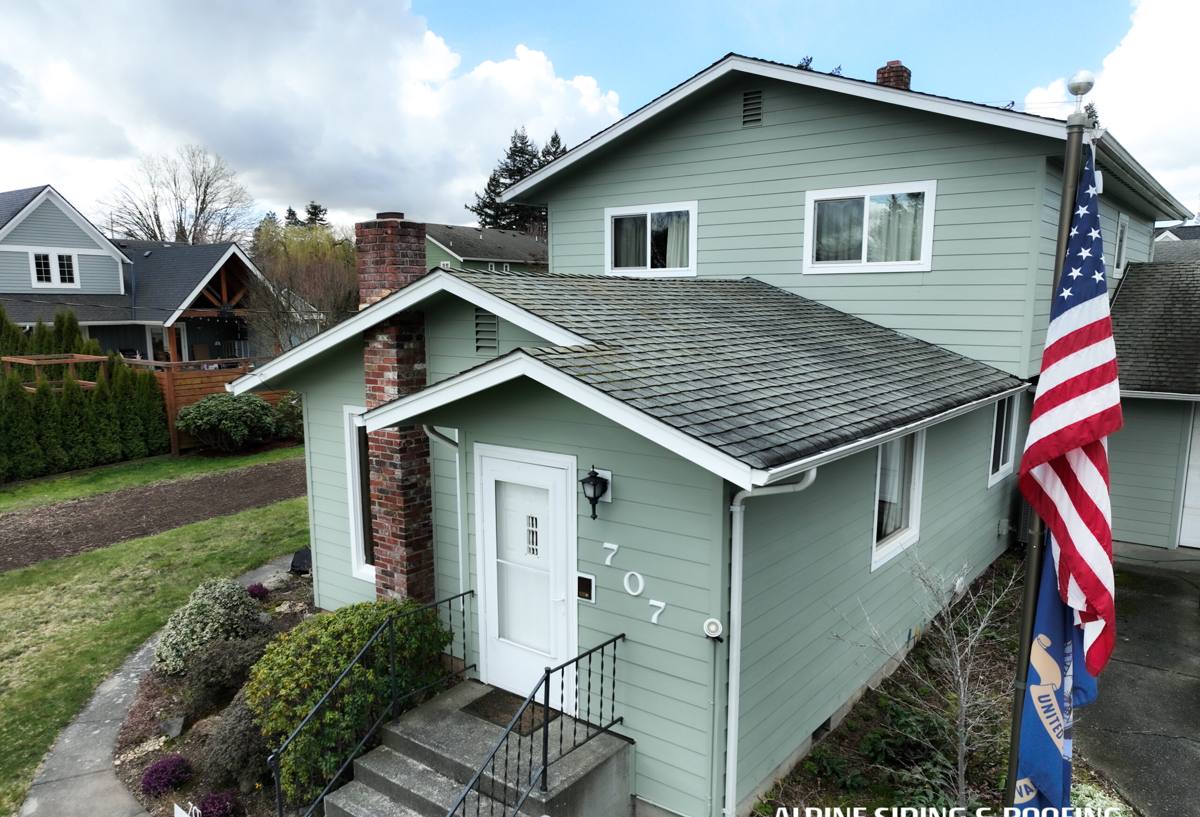
What Lynden's Weather Actually Does to a Roof
Driving rain and wind-lap issues
Whatcom County storms often come with enough wind to push rain sideways instead of straight down. On a roof with marginal underlayment or shallow shingle laps, that wind-driven rain finds its way under the surface material at hips, ridges, and valleys. Metal roofing, installed correctly with proper laps and sealed seams, is far more resistant to this because water has fewer entry points to begin with.
Moss and shade
Lynden has plenty of mature tree cover and north-facing slopes that stay damp long after a storm passes. Moss doesn't just look bad — it holds moisture against the roof surface and, on asphalt shingles, works its way under the granules over time. Metal's smooth, non-porous surface gives moss spores much less to hold onto, and what does grow tends to sit on the surface where it can be rinsed or brushed off rather than embedded in the material.
Temperature swings and condensation
Whatcom County isn't extreme in temperature, but the daily swing between cool, damp mornings and warmer afternoons causes expansion and contraction in any roofing material. Metal panels are designed to move with fastening systems (or clip systems on standing seam) that account for this. Roofs installed without that in mind can develop oil-canning, loose fasteners, or leaks at penetration points within a few years.
Panel Types and Finishes We Install
Not all metal roofing is the same product wearing different colors. The panel profile and fastening method matter as much as the metal itself, especially in a climate that stays wet for months at a stretch.
| Panel Type | How It's Fastened | Best Fit | Trade-Offs |
|---|---|---|---|
| Standing seam | Concealed clips, no exposed fasteners | Homes wanting the longest service life and cleanest look | Higher upfront cost, requires experienced installers |
| Exposed-fastener panel | Screws through the panel face into decking | Budget-conscious projects, outbuildings, shops | Fasteners and washers need periodic inspection and eventual replacement |
| Metal shingle/shake profile | Interlocking panels, concealed fasteners | Homeowners who want a traditional look with metal's durability | More seams and detail work than standing seam |
For most Lynden homes, we lean toward standing seam or a quality interlocking shingle profile precisely because concealed fasteners remove one of the most common long-term leak points. Exposed-fastener panels can be a sound choice on a garage, shop, or barn where cost matters more than long-term maintenance, but we'll walk you through that trade-off rather than assume it for your house.
What a Correct Metal Roof Installation Involves
A metal roof is only as good as what's underneath it. We see plenty of older installs around the county where the panels themselves are fine, but the underlayment, flashing, or fastening was done wrong, and that's where the leaks show up.
- Full tear-off of the old roofing (in most cases) so decking can actually be inspected, not just covered over
- Repair or replacement of any soft, rotted, or delaminated decking before a single panel goes down
- A synthetic or high-temp underlayment rated for the climate, not a bargain felt that degrades under sustained moisture
- Ice-and-water shield at eaves, valleys, and any low-slope transitions where water tends to back up
- Properly lapped, sealed flashing at every penetration — vents, chimneys, skylights — since these are the most common leak sources on any roof, metal or not
- Fastening or clip spacing that matches the manufacturer's spec for our wind exposure, not a generic pattern
- Ridge and hip caps installed with correct venting so the attic can actually breathe
Skipping any one of these doesn't usually cause an immediate problem — it shows up two, five, or ten years later as a leak that's hard to trace because the panels themselves look fine.
Our Process for a Lynden Metal Roofing Project
1. On-site inspection and honest assessment
We look at your current roof, the decking condition where accessible, ventilation, and any trouble spots — valleys, chimneys, dormers — before recommending anything. If your existing roof has a few good years left, we'll say so.
2. Measurement and panel planning
We measure the roof and plan panel runs to minimize seams and cross-seams, which are the weak points on any metal roof. Fewer, longer runs generally mean fewer opportunities for water to find a way in.
3. Tear-off, decking repair, and dry-in
Old material comes off, decking gets repaired as needed, and underlayment goes down the same day where possible so the roof isn't left exposed overnight during our wet stretches.
4. Panel installation and flashing detail
Panels go on with correct fastening or clip spacing, and every flashing detail — valleys, penetrations, wall transitions — is built up in layers rather than sealed over with caulk as a shortcut.
5. Cleanup and walkthrough
We clear debris, run a magnetic sweep for stray fasteners, and walk the job with you before we consider it finished.
Maintenance: Keeping Moss and Debris Under Control
A metal roof needs far less upkeep than asphalt, but "less" isn't "none." In a moss-prone area like Lynden, a little seasonal attention goes a long way toward getting the full lifespan out of the roof.
- Clear leaves and needles from valleys and gutters each fall before the heavy rains set in
- Trim back overhanging branches to reduce shade and debris buildup on north-facing slopes
- Rinse visible moss or algae growth with a soft wash rather than a pressure washer, which can damage finishes and seams
- Check exposed fasteners on screw-down panels every couple of years and replace any with failing rubber washers
- Have flashing and sealant at penetrations checked periodically — sealant is the one component that does wear out over time, even on a well-installed metal roof
Cost Factors for Lynden Homeowners
Metal roofing costs more upfront than asphalt shingles, and the exact number depends on several variables specific to your property. We give firm numbers only after seeing the roof in person, but these are the factors that move the price up or down.
| Factor | Effect on Cost |
|---|---|
| Panel type (exposed-fastener vs. standing seam) | Standing seam typically costs more due to labor and clip hardware |
| Roof complexity (valleys, dormers, penetrations) | More cuts and flashing detail means more labor time |
| Tear-off vs. overlay | Full tear-off costs more but lets us verify and repair decking |
| Decking condition | Rot or delamination found during tear-off adds repair cost |
| Roof pitch and access | Steep or hard-to-access roofs increase labor and safety setup time |
The trade-off most homeowners weigh is a higher upfront cost against a roof that can outlast two or three cycles of asphalt shingle replacement, with far less moss maintenance along the way. For some Lynden properties that math works out clearly in metal's favor; for others, especially rentals or shorter-hold properties, asphalt may still make more financial sense. We'll give you our honest read either way.
Why a Crew That Already Works Lynden Matters
Roofing details that work fine in a drier climate don't always hold up here. A crew that's installed and repaired roofs across Whatcom County knows which valley and flashing details actually stand up to a full wet season, not just what a manufacturer's install guide shows in a diagram. We know which roof lines around Lynden tend to hold shade and moss longer, which orientations catch the worst of the wind-driven rain, and where the older housing stock is likely to have decking issues once the tear-off starts.
That local experience also means we're not guessing at permitting requirements or typical roof configurations in the area — we've already worked through them on other Lynden and Ferndale-area homes. It shows up in fewer surprises mid-project and a roof detailed for the conditions it actually has to survive.
If you're weighing a metal roof for your Lynden home, we're happy to take a look and give you a straightforward read on condition, options, and cost — no pressure, no hard sell. Use the form below to request a free estimate.