 Ferndale Siding
 Point Roberts Decks Live in a Tougher Environment Than Most
Point Roberts sits on its own peninsula at the western edge of Whatcom County, surrounded by water on three sides and reachable by land only by driving through Canada. That geography is part of what makes it a beautiful place to build a deck — and part of what makes an ordinary deck fail there faster than it would ten or fifteen miles inland. A deck on this peninsula is exposed to salt-laden air off the Strait of Georgia and Boundary Bay almost year-round, plus the same driving winter rain that hits the rest of Whatcom County, plus a long moss season that starts earlier and lasts longer than it does in drier pockets of the region. Any two of those factors would be manageable on their own. Together, they're why we build decks differently out here than we would for a covered patio deck twenty minutes inland.
This page is specifically about custom deck construction for Point Roberts properties — what the salt air and moisture actually do to a deck over time, what a correctly built deck needs to resist it, and how we run a project out on the peninsula from first visit to final walkthrough.
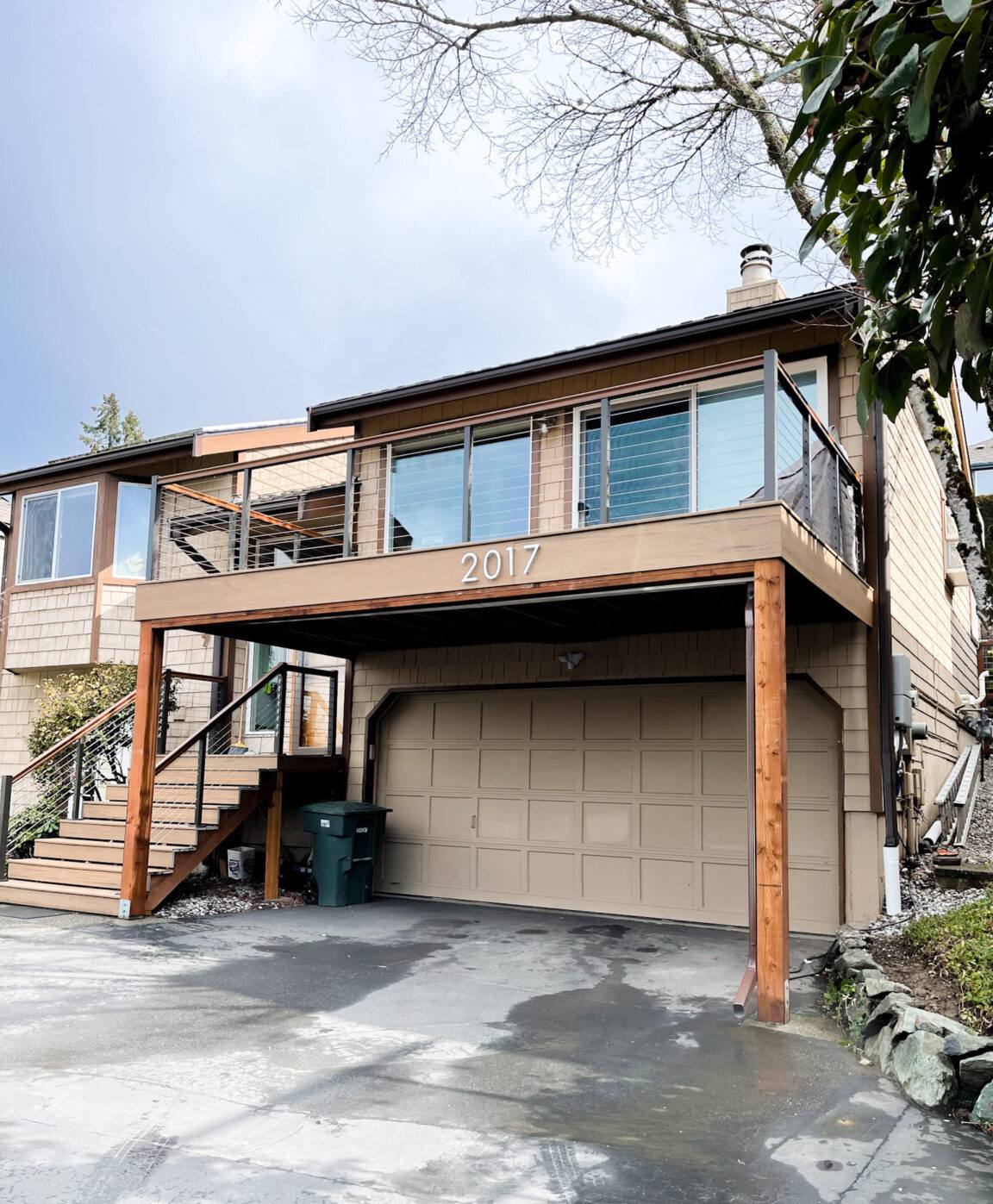
What Salt Air, Rain, and Moss Actually Do to a Deck
Salt air is corrosive to any exposed metal — fasteners, joist hangers, post bases, railing brackets. On a deck that isn't detailed for it, that corrosion usually shows up first as rust streaks bleeding out around nail and screw heads, then as loosening hardware a few years later. Driving rain finds its way into any gap in flashing, decking spacing, or ledger connections and doesn't dry out quickly in our climate, which is what drives rot in framing lumber and delamination in lower-grade composite boards. Moss and algae need shade, moisture, and time to establish — Point Roberts gives them all three, especially on the north and west sides of a house or under tree cover, which is common on wooded lots out there. Left alone, moss holds moisture against the deck surface and turns boards slick and dangerous underfoot.
None of this means a deck can't hold up in Point Roberts. It means the build has to account for all three from the framing up, not just at the surface.
Framing and Structure
The framing is where most long-term deck failures actually start, even though it's the part homeowners see least. We build to current code for footings, post spacing, and beam sizing, but in a marine-influenced environment we also pay close attention to a few details that matter more here than they would in a drier climate:
- Proper ledger flashing where the deck attaches to the house, so water is directed out and away from the wall framing rather than trapped behind the ledger board
- Joist tape over the tops of framing lumber to stop standing water from soaking into end grain and fastener holes
- Post bases and hardware set to keep wood framing off concrete and out of standing water
- Adequate airflow underneath the deck so the structure can actually dry out between rain events instead of staying damp for weeks
Fasteners and Hardware
This is the single most common shortcut we see on older Point Roberts decks, and it's the one that causes the ugliest visible damage. Standard galvanized fasteners are rated for general outdoor use, but in a salt-air environment they corrode faster than their rated lifespan suggests, and once a fastener starts rusting it stains the surrounding wood or composite and weakens its hold. For deck framing and decking attachment on the peninsula, we use stainless steel or heavy-coated, marine-rated fasteners and hardware throughout — hangers, structural screws, and hidden fastener systems included. It costs more up front than standard hardware. It's also the difference between hardware that's still solid in fifteen years and hardware that's bleeding rust through the deck boards in five.
Decking Material
There's no single right decking material for every Point Roberts project — it depends on budget, how the deck will be used, and how much upkeep the homeowner wants to do. What we won't do is recommend a material or fastening approach that looks fine at installation but is a known poor fit for constant salt air and moisture exposure, because that's a callback waiting to happen.
| Material | Upfront Cost | Behavior in Salt Air & Moisture | Maintenance | Realistic Lifespan Here |
|---|---|---|---|---|
| Cedar (real wood) | Moderate | Naturally rot- and insect-resistant, but needs sealing to handle constant moisture and to resist moss growth | Annual cleaning, re-sealing or staining every 2-3 years | 15-20 years with upkeep |
| Pressure-treated fir/pine | Lowest | Treated for rot resistance but more prone to cupping and checking with repeated wet/dry cycling | Regular sealing, more frequent board replacement | 10-15 years |
| Composite decking | Higher | Doesn't absorb moisture the way wood does; quality varies a lot by product line and cap technology | Periodic washing to keep moss/algae from taking hold | 20-30 years, product-dependent |
| PVC/capped polymer | Highest | Fully sealed surface, best resistance to moisture and staining | Lowest — occasional washing | 25-30+ years |
Moss and Drainage: Where a Lot of Decks Go Wrong
Moss doesn't just sit on top of a deck — it holds water against the board surface long after the rain has stopped, which slows drying and, on wood decking, contributes to rot at the board edges. The fix isn't a single product, it's a handful of decisions made at build time: proper gapping between boards so water sheds through rather than pooling, decking run in a direction and slope that actually drains toward the yard instead of back toward the house, and enough clearance underneath the deck for air to move. On heavily shaded or tree-covered lots, which are common on the peninsula, we'll also talk through realistic expectations — a deck tucked under fir trees is always going to need more frequent cleaning than one in full sun, no matter how it's built.
Permits, Setbacks, and Working on the Peninsula
Point Roberts falls under Whatcom County's permitting jurisdiction, and depending on the size, height, and proximity of the deck to property lines or water, that can mean a building permit, setback review, or both before work starts. We handle that process as part of the job rather than leaving it to the homeowner to sort out. Because Point Roberts is a U.S. exclave reached by land only through Canada, there's also a real logistical side to building there that inland contractors don't deal with: crews and material deliveries have to cross the border, and timing a project means planning around that rather than around a five-minute drive. A crew that already works the peninsula regularly has that logistics part figured out — border crossing timing, what can and can't be brought over easily, and how to keep a project moving without losing days to avoidable delays.
Our Process for a Point Roberts Deck Build
The steps below are the same order we follow on every custom deck project on the peninsula, adjusted for the size and complexity of the specific job:
- On-site assessment — we look at sun/shade exposure, existing drainage, soil and slope, and how exposed the site is to prevailing wind and salt air off the water
- Design and material selection — we walk through decking material, railing style, and hardware options based on your budget and how the deck will actually be used
- Permit handling — we pull the required Whatcom County permits and coordinate any setback or height review before framing begins
- Footings and framing — built with corrosion-resistant hardware, proper flashing, and drainage detailing from the ground up
- Decking and railing installation — installed with attention to board spacing, fastening method, and drainage slope
- Final walkthrough — we go over the finished deck with you and explain what upkeep it needs, and when
We schedule material deliveries and crew time around the border crossing as a normal part of planning a Point Roberts project, so it's built into the timeline from the start rather than something that surprises anyone partway through the job.
Keeping a Point Roberts Deck in Good Shape
A well-built deck out here still needs regular upkeep — the climate doesn't let any exterior surface coast on a one-time install. This is the maintenance rhythm we recommend to homeowners after a new deck goes in:
- Sweep debris and standing leaves off the deck surface regularly, especially in fall, so moisture and organic matter don't sit against the boards
- Wash the deck surface at least once or twice a year to knock back moss and algae before it establishes, more often on shaded sections
- Check railing hardware and fastener heads annually for early signs of corrosion or loosening
- Reseal or re-stain real wood decking on a 2-3 year cycle, sooner if the finish is wearing thin in high-traffic areas
- Keep gutters and downspouts near the deck clear so roof runoff isn't dumping extra water onto or under the structure
- Trim back overhanging branches where practical to cut down on shade and falling debris that feed moss growth
Common Problems We See on Older Point Roberts Decks
When we're called out to repair or replace an existing deck on the peninsula, the damage almost always traces back to one of a handful of causes: standard-grade fasteners that have corroded and stained the surrounding wood, missing or inadequate ledger flashing that let water into the house framing behind the deck, decking installed too tight with no drainage gap, or a structure built without enough clearance underneath to ever fully dry out. Every one of those is preventable at the framing stage. None of them are cheap or simple to fix once the deck has been in place for years, which is why getting the build right the first time matters more here than in a milder, drier location.
Why Hire a Crew That Already Works Point Roberts
A deck built to a generic spec sheet, without accounting for constant salt air, heavy rain exposure, and a long moss season, will show problems years before it should. A crew that regularly builds and repairs decks on the peninsula already knows which fasteners and hardware actually hold up here, how to detail flashing and drainage for this specific exposure, and how to plan around the border-crossing logistics that come with working in an exclave. That local experience shows up as fewer callbacks and a deck that still looks and performs the way it should a decade or more after installation, not just at the final walkthrough.
If you're planning a custom deck in Point Roberts, we're happy to take a look at your property and talk through what makes sense for your site, your budget, and how you actually want to use the space. Request a free, no-pressure estimate using the form below.