 Ferndale Siding
 Nooksack's Climate Is Harder on Siding Than It Looks
Nooksack sits inland from the coast, but it doesn't escape the marine weather pattern that defines Whatcom County. Homes here still take on salt-laden air moving in off the Strait, months of low-angle rain that drives sideways under eaves, and a shade-and-moisture combination that keeps north-facing walls damp long after a storm has passed. That last part matters more than most homeowners realize — moss and algae don't just grow on roofs in this part of Washington, they colonize siding, trim, and anything else that stays wet for days at a stretch.
Siding that isn't engineered for this cycle shows it fast: swollen seams on wood-based products, chalky or streaked paint film, soft spots where moisture has worked behind trim, and green-black staining that keeps coming back no matter how often it's pressure washed. We install James Hardie fiber cement exclusively, and on Nooksack homes specifically, that decision comes down to how the product handles sustained moisture exposure and how much upkeep it actually asks of the homeowner over a 20-30 year window.
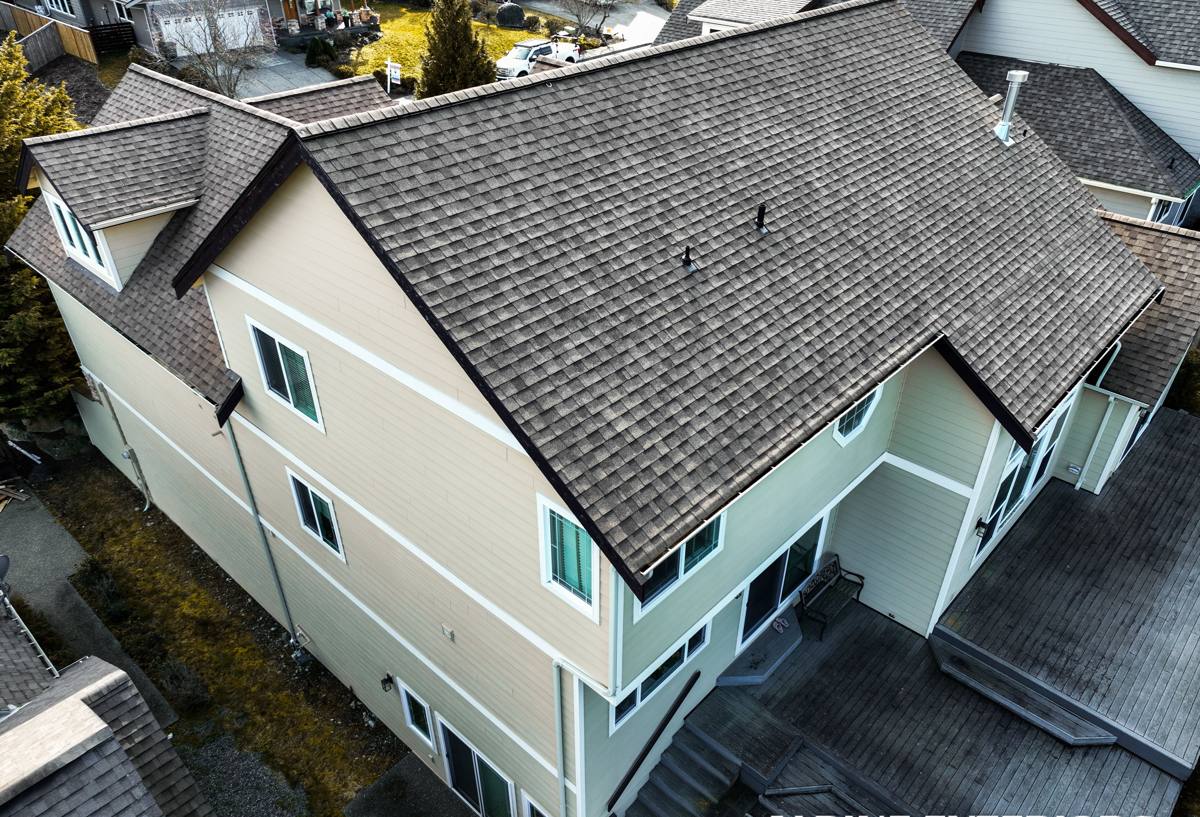
Why We Only Install James Hardie Here
James Hardie siding is fiber cement — sand, cement, and cellulose fiber, cured into a rigid board that doesn't absorb water the way wood-based or wood-composite siding does. That's the core reason it holds up to the wet side of the year in Whatcom County better than the alternatives:
- It doesn't swell or delaminate. Wet-dry cycling is what breaks down wood fiber siding over time; fiber cement doesn't move with moisture the way those products do.
- Factory-baked ColorPlus finish. The paint is cured onto the board at the factory, not brushed on after installation, so it resists the fading and peeling that field-applied paint suffers under years of coastal UV and rain.
- Non-combustible. Not a climate factor specific to Nooksack, but it's part of why we standardized on Hardie for every home we touch.
- Built-in product lines for wet climates. Hardie makes an HZ5 formulation specifically engineered for regions with freeze-thaw and high moisture exposure — the Pacific Northwest is squarely in that category.
We don't install LP SmartSide, vinyl, or other fiber cement brands, and we're upfront about why: those products can be installed correctly and can perform reasonably well, but each carries a trade-off — more maintenance, more installation sensitivity, or a paint/warranty structure we don't think holds up to what this climate does to a house over two or three decades. Hardie is what we've chosen to stand behind.
What "Correct" Installation Actually Means
Fiber cement siding's long-term performance is decided far more by the installation than by the product itself. A Hardie board installed wrong will fail the same way a cheaper product would — the material isn't a substitute for good technique. On a Nooksack home, we pay particular attention to:
Weather Barrier and Drainage Plane
Every wall gets a code-compliant water-resistive barrier, and we detail it so that any moisture that gets behind the siding has somewhere to go — down and out, not trapped against the sheathing. This is the single most important layer for a house that sits through months of steady rain, and it's also the layer that's invisible once the job is done, which is exactly why it's worth asking your contractor about before they start.
Flashing at Every Penetration
Windows, doors, hose bibs, vents, and anywhere else something interrupts the siding plane need proper flashing and head flashing so water sheds outward instead of pooling. These are the spots where we most often find rot and staining on older homes we re-side — not because the siding failed, but because the flashing around it never existed or was done wrong.
Fastening and Clearances
Hardie specifies fastener type, spacing, and placement, and it specifies minimum clearances from grade, roofing, and decks. Skipping those clearances is one of the fastest ways to trap moisture at the bottom edge of a wall — exactly where a shaded, damp Whatcom County yard will keep that edge wet longest.
Caulking and Joint Treatment
Butt joints, trim intersections, and penetrations get sealed with a product rated for the movement and exposure involved, not whatever's on hand. Poor caulking is a slow leak waiting to happen, and it's cheap to do right the first time compared to what it costs to fix later.
Our Process on a Nooksack Job
The steps are the same whether the home is a smaller single-story or a larger multi-story build; what changes is how much of it applies to a given wall.
- On-site assessment. We look at existing siding condition, trim, moisture staining, and anything that suggests hidden rot behind the current cladding before we quote anything.
- Tear-off and sheathing check. Once the old siding is off, we inspect the sheathing itself — this is often the first time hidden water damage becomes visible, and it needs to be addressed before new siding goes up, not covered over.
- Weather barrier and flashing. Installed and detailed around every window, door, and penetration before a single board goes up.
- Hardie board installation. Installed to manufacturer fastening and clearance specs, with attention to the specific HZ product line and profile chosen for the home.
- Trim, caulking, and touch-up. Joints sealed, factory-finish touch-up applied where cuts exposed raw edges, and a final walk-through with the homeowner.
Siding Options Compared
| Factor | James Hardie Fiber Cement | Vinyl | Wood-Based Composite |
|---|---|---|---|
| Moisture tolerance | High — doesn't swell or absorb water | Doesn't absorb water, but seams and panels can warp with heat/cold cycling | Moderate — engineered to resist moisture but relies on sealed edges staying intact |
| Finish durability | Factory-baked ColorPlus, long fade resistance | Color molded through, can fade and chalk over time | Field-applied paint, typically needs repainting sooner |
| Moss/algae resistance | Doesn't feed growth; surface cleans up well | Resists growth but can trap moisture behind panels | More prone to surface staining and growth on damp, shaded walls |
| Fire rating | Non-combustible | Combustible | Combustible |
| Typical lifespan when installed to spec | 30+ years | 20-30 years | 15-25 years |
What Drives Cost on a Job Like This
| Cost Factor | Why It Matters |
|---|---|
| Home size and wall complexity | More corners, gables, and dormers mean more cutting and detail work |
| Existing wall condition | Rot or damaged sheathing found during tear-off adds repair scope |
| Product line and profile | HZ5 boards, lap width, and shingle-style profiles vary in material cost |
| Trim scope | Full trim replacement vs. reusing sound existing trim changes labor hours |
| Access and site conditions | Tight lots, slopes, or landscaping close to the house affect setup time |
We give a firm, written number after walking the actual home — broad national averages don't account for what's behind your existing siding, and we'd rather quote accurately than low-ball an estimate that changes once we start tearing off.
Why a Crew That Already Works in This Area Matters
A contractor who works Ferndale and the surrounding Whatcom County communities regularly already knows what this climate does to a house — where moisture tends to collect on a north wall, how long the moss season really runs, and what a wall assembly needs to hold up through it. That's not something you can fully substitute with a spec sheet. It also means faster response if something needs a look after the job is done, and a crew that isn't learning the region's weather behavior on your house for the first time.
What to Ask Any Siding Contractor Before You Sign
- Do you install one product line, and if so, why — what's the reasoning behind it?
- Will you inspect and address sheathing condition before installing new siding, not just cover it?
- What weather-resistive barrier and flashing details do you use, and can you explain them plainly?
- Is the fastening and clearance work done to the manufacturer's written spec, not just "how we've always done it"?
- What does the warranty actually cover — material only, or labor too — and who backs it if something goes wrong?
Maintaining Hardie Siding in a Wet, Mossy Climate
Fiber cement asks for less upkeep than most siding types, but "less" isn't "none." A short annual routine keeps it performing the way it's supposed to:
- Rinse the siding once or twice a year, focusing on shaded, north-facing, or tree-covered walls where moss and algae take hold first.
- Check caulking at joints and trim intersections for cracking or separation, especially after the first couple of winters.
- Keep gutters clear so overflow doesn't run down the siding face repeatedly in the same spot.
- Trim back vegetation and landscaping that keeps a wall shaded and damp longer than the rest of the house.
- Have any impact damage or exposed cut edges touched up promptly rather than left to weather.
None of that is heavy labor — it's the kind of maintenance that takes an afternoon and prevents the slow moisture problems that show up on siding that gets ignored for years at a stretch.
Get a Straight Answer on Your Nooksack Home
If you're dealing with siding that's staining, softening, or just past its useful life, we're happy to come take a look and give you an honest assessment — no pressure, no inflated scope. Fill out the form below for a free estimate, and we'll walk the house with you and explain exactly what we'd recommend and why.