 Ferndale Siding
 Why Point Roberts Siding Takes a Different Kind of Beating
Point Roberts sits at the end of a peninsula with water on three sides, which means homes there take a steadier, heavier dose of salt-laden marine air than most of the rest of Whatcom County. Add in driving winter rain off the water and a long, shaded moss season, and you get siding that ages on a different timeline than a comparable house a few miles inland in Ferndale. We've seen this pattern often enough to plan repairs around it instead of treating every job like a generic patch-and-paint.
Salt Air and Fastener Corrosion
Salt in the air speeds up corrosion on anything metal — exposed fastener heads, trim coil, flashing, even the little clips and screws holding accessories to the wall. Once a fastener starts rusting, it weeps a dark stain down the face of the board and eventually loses its grip. A repair that just re-caulks over corroding fasteners without replacing them is a repair that fails again within a year or two.
Wind-Driven Rain and Water Intrusion
Storms coming off the water don't just fall straight down — they drive rain sideways and even upward under laps and around corners. Siding that was installed with tight, correct laps and proper flashing sheds that water fine. Siding installed with shortcuts — laps too shallow, missing kick-out flashing, caulk used in place of proper overlap — lets water track behind the cladding, where it can sit against sheathing and framing for months before anyone notices a problem inside the house.
Moss, Shade, and Chronic Moisture
Mature tree cover and near-constant marine humidity keep north-facing and shaded walls damp for long stretches of the year. Moss doesn't just look bad — it holds moisture against the siding surface far longer than open exposure to sun and wind would, which is exactly the condition that lets rot and coating failure get started underneath a board that still looks intact from a distance.
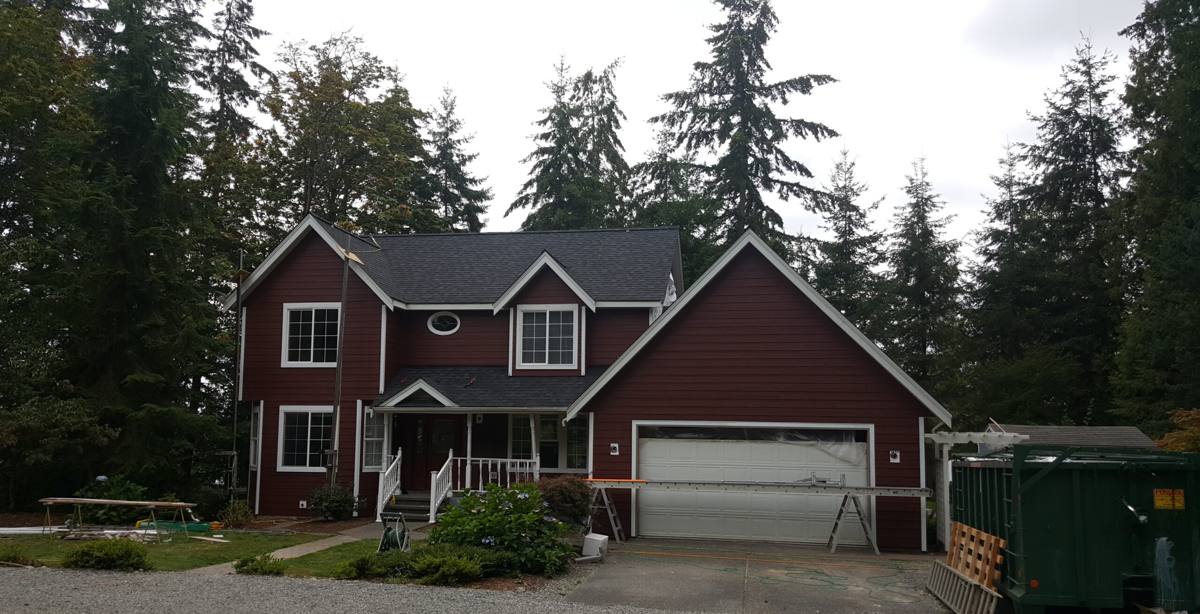
Signs Your Home Needs Siding Repair, Not Just Paint
A fresh coat of paint can hide a lot of problems for a season, but it doesn't fix them. Here's what actually signals a repair issue underneath:
- Soft or spongy spots when you press on the siding, especially near the bottom courses or below windows
- Bubbling, peeling, or alligatored paint that keeps coming back in the same spot after repainting
- Dark streaks running down from fastener heads or trim joints
- Gaps opening up at butt joints, corners, or where siding meets trim
- Moss or algae growth that returns quickly after cleaning, or that leaves the surface stained once removed
- Cracked, chipped, or delaminating boards, particularly on corners and lower walls that take the most weather
- Water stains, musty smell, or soft drywall on interior walls near an exterior corner or window
If you're seeing more than one of these at once, there's a good chance the damage extends further than the visible surface — which is exactly why a proper inspection matters before anyone starts pulling boards.
What a Correct Siding Repair Actually Involves
Diagnosing What's Underneath
A repair that's worth paying for starts by pulling back the damaged section far enough to see the weather-resistive barrier and sheathing behind it — not just caulking the visible crack and calling it done. If the barrier is torn, the sheathing is soft, or there's evidence of long-term moisture, that has to be addressed before any new siding goes back on. Covering up an active moisture problem with new material just delays a bigger repair later.
Matching Materials the Right Way
Fiber cement siding with a factory-applied finish, like James Hardie's ColorPlus system, is manufactured to a specific profile, exposure, and color batch. A repair that just grabs the closest board on the truck often ends up with a visible seam or a color that drifts over time as the two finishes weather differently. Doing it right means ordering matching profile and color, and cutting the repair back to a clean, full section — a stud bay or a full course — rather than a small cosmetic patch that will telegraph through the wall for years.
Repair or Replace? How We Make That Call
Not every damaged section needs a full re-side, and not every problem can be solved with a patch. Here's roughly how we weigh it:
| Factor | Repair Is Usually Enough | Full Replacement Is Warranted |
|---|---|---|
| Extent of damage | Isolated to one or two wall sections | Recurring across multiple elevations |
| Underlying moisture | Contained, no sign of spreading rot | Barrier or sheathing compromised in several areas |
| Age of existing siding | Still well within expected service life | Nearing or past the end of its useful life |
| Original installation quality | Sound overall, one bad section | Systemic flashing or lap errors throughout |
| Color/material match available | Yes, close batch or line still obtainable | Discontinued color or incompatible product |
We'll tell you honestly which side of that table your house falls on. There's no reason to pay for a full re-side when a targeted repair solves the problem, and no reason to keep patching a wall that's telling you it's done.
Our Process for Point Roberts Siding Repair Calls
- Inspection: we look at the damaged area and the surrounding wall, check for soft spots and moisture with a meter where it matters, and look at how the original siding was flashed and lapped.
- Written scope: you get a clear explanation of what's damaged, what's causing it, and what the repair involves — no surprise change orders once we're into the wall.
- Removal back to sound material: we take out damaged siding and, if needed, damaged sheathing or barrier, back to a point where everything remaining is solid.
- Fixing the cause, not just the symptom: if the problem started with a flashing detail, a missing kick-out, or a ventilation issue, that gets corrected as part of the repair.
- Installing matching Hardie material to spec: correct fasteners, correct exposure, correct clearances, so the repair performs the same as the surrounding wall.
- Final walk-through: we show you what was done and why, and clean the site before we leave.
Why We Only Repair and Install James Hardie Fiber Cement
We standardized on James Hardie fiber cement siding, and we don't install or repair with vinyl, LP SmartSide, primed spruce, cedar, or other fiber cement brands. That's a deliberate call, not a sales preference.
Vinyl siding has real advantages — it's inexpensive and low-maintenance in mild conditions — but it expands and contracts significantly with temperature swings, can crack in a hard cold snap, and its color is baked all the way through the material, which means impact damage or fading shows differently than a factory-finished product. In a location that already deals with driving rain and salt air, we'd rather not add material movement and brittleness to the list of things working against a repair.
Wood-based and engineered wood products like cedar or LP SmartSide can look great and perform well when maintained, but they're more sensitive to sustained moisture than fiber cement, and that sensitivity is exactly what a marine, moss-prone climate exploits. They also typically need field-applied paint upkeep on a shorter cycle than a factory-finished product.
James Hardie's fiber cement is non-combustible, engineered in climate-specific HZ product lines, and finished at the factory with ColorPlus technology, which holds color more consistently under UV and salt exposure than a job-site paint job. It carries a strong, transferable warranty when installed to Hardie's specifications — which is the other half of the equation, since even the best material performs poorly if it's installed with shortcuts. That combination is why it's the only product we put on repairs and full installs alike.
Why a Crew That Already Works Point Roberts Matters
Point Roberts is separated from the rest of Whatcom County by water and an international border, which means getting a crew and materials there isn't as simple as a same-day trip across town. A contractor who already schedules work out there knows how to plan material deliveries and crossing logistics so your repair isn't stuck waiting on a part that should have arrived days earlier. Just as important, a crew that's worked multiple homes in the area already understands which elevations tend to take the worst of the wind-driven rain and where moss problems tend to recur, which speeds up diagnosis instead of starting from zero on every visit.
A Few Things Worth Checking Before You Hire
- Ask whether the crew will actually open up the wall to check the barrier and sheathing, or just patch what's visible
- Confirm what siding product and finish they're proposing to match, and whether that match is realistic
- Ask how they'll address the underlying cause of the damage, not just the cosmetic repair
- Get the scope of work in writing before anything is removed from the wall
- Ask directly whether they have experience working in Point Roberts specifically, given the logistics involved
If you're seeing staining, soft spots, moss that won't stay gone, or gaps opening up in your siding, it's worth getting a second set of eyes on it before it gets worse. We're happy to come take a look and put together a free, no-pressure estimate — just fill out the form below.