 Ferndale Siding
 Siding Repair for Homes Near Lummi Nation
Homes in and around Lummi Nation sit close enough to Bellingham Bay and the Strait of Georgia that salt air is part of daily life, not an occasional coastal breeze. Combine that with Whatcom County's driving winter rain and a moss season that can run from October into May, and you get a set of siding problems that show up faster and differently here than they do twenty miles inland. We repair siding in this area regularly, and the failure patterns we see are consistent enough that we can usually tell what's going on before we even get a ladder out.
This page is specifically about siding repair — fixing damaged, failing, or deteriorating siding on a home that doesn't necessarily need a full re-side. If your siding is more broadly worn out across the whole house, a full replacement conversation makes more sense, but a lot of homes just need targeted repair done correctly.
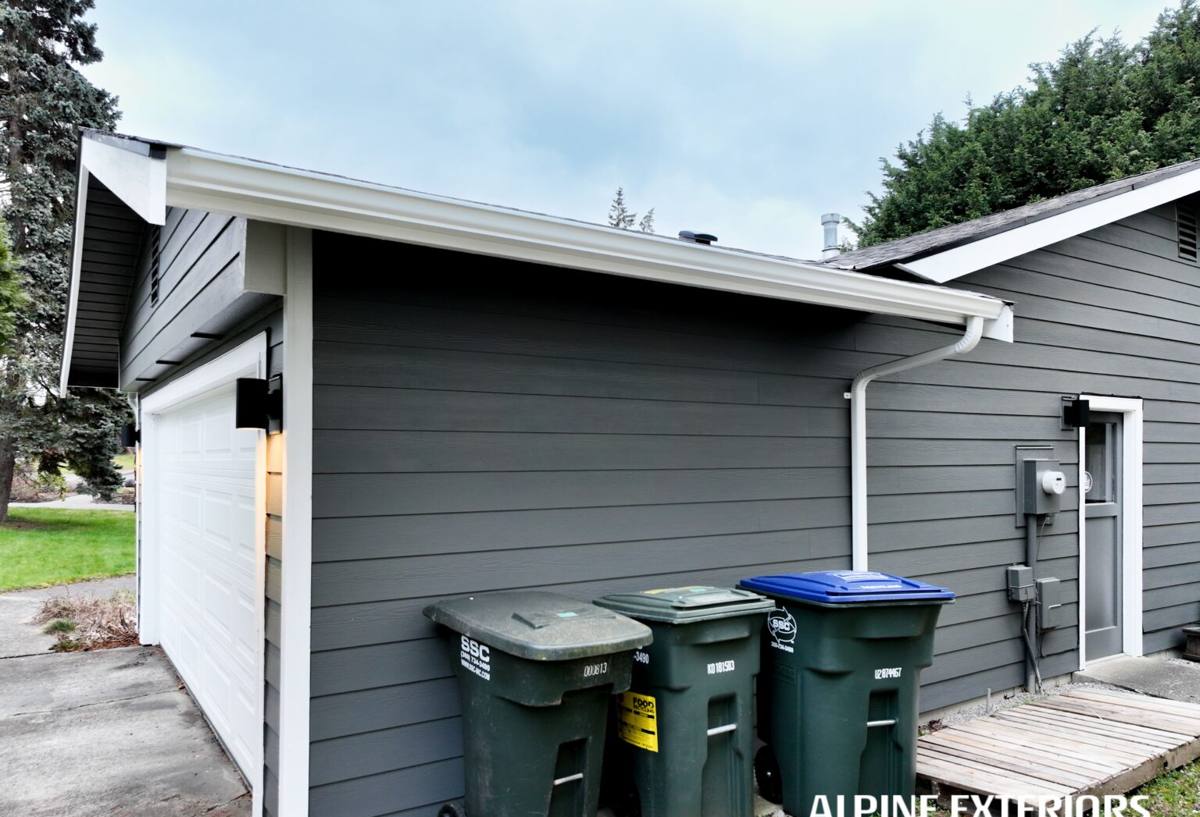
Why This Climate Is Hard on Siding
Salt Air
Airborne salt from the bay settles on exterior surfaces and accelerates corrosion of fasteners, flashing, and any metal trim. On siding materials that aren't dimensionally stable or that rely on paint film alone for protection, salt exposure speeds up cracking, chalking, and edge deterioration — especially on the side of the house facing the water or prevailing wind.
Driving Rain
Whatcom County doesn't just get a lot of rain, it gets a lot of wind-driven rain, which pushes water sideways into laps, seams, and penetrations that would stay dry in a straight-down rain. That's where poor original installation — caulk used instead of proper flashing, tight or missing gaps, fasteners driven wrong — turns into rot years later.
Moss and Constant Dampness
Long stretches of overcast, damp weather keep siding surfaces wet longer than they'd stay wet elsewhere in the state. Moss and algae take hold on north-facing walls, under eaves, and anywhere sun and airflow are limited. Moss holds moisture directly against the siding surface, which is a slow but real contributor to rot in wood-based products and to surface degradation in materials that aren't built to handle sustained dampness.
Signs Your Siding Needs Repair
- Soft or spongy spots when you press on the siding, especially near the bottom courses or below windows
- Visible cracking, splitting, or bubbling paint, particularly on the water-facing side of the house
- Dark staining or streaking that keeps returning even after cleaning
- Persistent moss or algae growth that regrows within a season of removal
- Gaps opening up at seams, corners, or around trim and window flashing
- Visible rust bleeding from fastener heads or metal flashing
- Warping, buckling, or panels that no longer sit flat against the wall
- Musty smell or interior wall staining near an exterior wall — a sign moisture has already gotten past the siding
What a Correct Siding Repair Actually Involves
A lot of "repair" work in this region is really just cosmetic patching — caulk, paint, and a pressure wash — over a problem that's still active underneath. That approach doesn't hold up in this climate. A repair worth doing includes:
- Diagnosis, not just treatment of the visible symptom. If a board is soft, we find out why — flashing failure, a caulked joint that should have been open, a missing kick-out flashing, poor original nailing — before we replace anything.
- Removal of all compromised material. Rot and moisture damage travel further than they look. Cutting back to solid material matters more than minimizing how much gets removed.
- Correcting the underlying water path. If the original installation trapped water instead of shedding it, the repair has to fix that detail — proper flashing, correct lap sequence, drainage gaps where called for — or the same failure comes back.
- Matching materials correctly. Mixing incompatible siding products, or patching fiber cement with a different material, creates new seams and new failure points. We match with the same product line and profile whenever possible.
- Proper fastening and sealant use. Salt-air corrosion means fastener choice matters — we use corrosion-resistant fasteners appropriate to coastal exposure, not whatever was cheapest to grab.
- Finish work that blends in. Color-matched, factory-finished repairs hold up and look right; field-painted patches weather differently than factory finish and often show as a visible patch within a year or two.
Repair vs. Replace: How We Help You Decide
| Factor | Repair usually makes sense | Replacement usually makes sense |
|---|---|---|
| Extent of damage | Isolated areas — one wall, a few boards, one water-intrusion point | Damage spread across multiple elevations |
| Underlying cause | A fixable detail (flashing, caulk, one bad panel run) | Systemic original installation problems |
| Age of siding | Siding is mid-life and otherwise sound | Siding is near or past its expected service life |
| Material | Product still performs well when properly maintained | Product has an inherent moisture or maintenance issue at this location |
| Budget timing | Targeted fix now, plan replacement later | Repair costs approach a meaningful share of replacement cost |
We'll tell you honestly which side of that table your house falls on. There's no reason to sell a full re-side to a homeowner who needs three boards replaced and a flashing detail corrected.
Why We Repair — and Replace — With James Hardie Only
When a repair calls for new siding material, we use James Hardie fiber cement, and only James Hardie. We don't install vinyl, LP SmartSide, primed spruce, cedar, or other fiber cement brands. That's a deliberate standard, not a lack of options.
In a salt-air, high-moisture environment like this one, the material used for a repair matters as much as the workmanship. Fiber cement doesn't rot, doesn't feed moss and algae growth the way wood-based products can, and is non-combustible. James Hardie's HZ5 product line is specifically engineered for climates with more moisture and freeze-thaw cycling, which fits this region better than a generic product spec. The ColorPlus factory finish is baked on under controlled conditions, so a repaired section holds its color and resists fading and chipping far better than a field-painted patch — which matters a lot when the goal is a repair you can't spot from the sidewalk in two years.
We've made the call not to install vinyl or wood-based siding because we've seen how they perform — or don't — under exactly the conditions this area produces: vinyl that warps and gaps at the seams under driving rain, and wood-based products that need a maintenance schedule most homeowners can't realistically keep up with once moss season sets in. Hardie isn't the cheapest material on the market, but for a repair we're putting our name behind, it's the one we trust to actually solve the problem instead of buying a few more years.
Our Repair Process
1. On-Site Inspection
We walk the affected areas, check moisture readings where relevant, and look at flashing, trim, and penetrations — not just the siding panels themselves.
2. Honest Assessment
We tell you what's actually wrong, what caused it, and whether repair or a larger scope makes more sense. If it's a simple fix, we say so.
3. Written Scope and Estimate
You get a clear description of what will be removed, what will be corrected, and what material will be used — no vague "repair siding as needed" line items.
4. The Repair Itself
Removal of compromised material, correction of the underlying water-management detail, installation of matched James Hardie product, and proper fastening and sealing to current best practice for this climate.
5. Final Walkthrough
We review the completed work with you and point out anything worth keeping an eye on going forward.
Why Hiring a Crew That Already Works This Area Matters
Siding repair in a coastal, high-rainfall area isn't the same trade as siding repair in a dry inland climate, even within the same state. A crew that mostly works drier regions can miss the specific things that matter here: how far water travels behind a wall before it shows up as a stain, where moss actually causes structural harm versus cosmetic nuisance, and which flashing details fail first under sustained wind-driven rain off the bay. We work Ferndale and the surrounding Whatcom County communities regularly, including areas near Lummi Nation, so we're diagnosing the same climate patterns on repeat rather than guessing.
That local repetition also means we're not learning on your house. We know what a salt-air-driven fastener failure looks like at year eight versus year fifteen, and we know which original-construction shortcuts in this area tend to cause callbacks. That's the kind of judgment that keeps a repair from becoming a repeat repair.
After the Repair: Keeping It From Happening Again
- Rinse siding periodically, especially north-facing and shaded walls where moss tends to return first
- Trim back vegetation and tree limbs that keep siding shaded and damp
- Check gutters and downspouts each fall so overflow isn't running down the wall
- Walk the exterior once a year and look specifically at caulk lines, corners, and flashing for early gaps
- Address small issues — a loose piece of trim, a cracked caulk joint — before the next wet season, not after
If you're seeing soft spots, staining, or recurring moss on your siding near Lummi Nation, we're happy to take a look and give you a straight answer on what it actually needs. Reach out for a free, no-pressure estimate using the form below.