 Ferndale Siding
 A Deck Built for Sudden Valley Has to Earn Its Keep
Sudden Valley homes sit in one of the greenest, wettest corners of Whatcom County, and that setting is exactly why a deck here needs to be built differently than one going up in a dry inland climate. The same marine air pattern that keeps Ferndale and the surrounding county green year-round also means long stretches of damp weather, driving rain that comes in sideways off a storm front, and a moss season that can run from October well into spring. A deck that isn't built with that reality in mind doesn't fail dramatically — it fails slowly, one soft board or one rusted fastener at a time, until a homeowner is looking at a rebuild years earlier than they should be.
We've built and repaired decks all over this area, and the patterns repeat: decking that traps moisture against the framing, ledger connections that were never properly flashed, and fasteners that looked fine at installation but corroded within a few wet seasons. None of that is inevitable. It's a matter of choosing the right materials and getting the details right the first time.
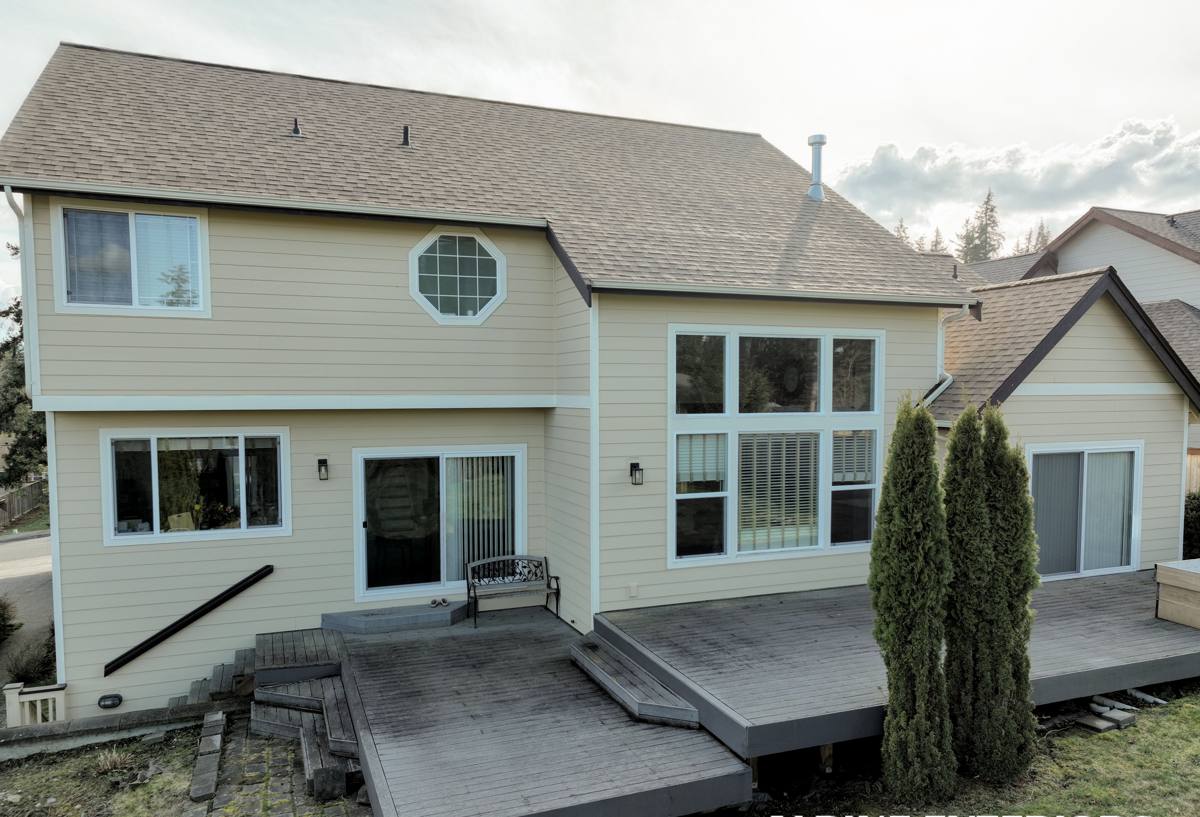
What This Climate Actually Does to a Deck Over Time
It helps to be specific about the failure points, because "the weather is tough here" doesn't tell you what to actually build differently.
- Standing moisture: Whatcom County rarely gets a hard, fast dry-out between storms. Wood that stays damp for days at a time is where rot starts, especially at end grain and fastener holes.
- Moss and algae: Shaded lots, tree cover, and the long wet season give moss a real foothold on horizontal surfaces. Beyond looking bad, a moss mat holds water against the decking surface and turns stairs and low-traffic areas slick.
- Corrosion: The marine-influenced air common to this part of Washington accelerates rust on lower-grade screws, brackets, and joist hangers faster than a homeowner would expect from a few years of exposure.
- UV cycling combined with rain: Wood and some composites expand when wet and contract when they dry, and repeated cycles loosen fasteners and open gaps at seams over time.
None of these are exotic problems. They're the ordinary cost of building outdoors in this part of the state, and they're all manageable with the right material choices and the right hardware.
Choosing a Decking Material That Fits This Climate
There's no single "best" decking material — there's a best material for a given budget, look, and tolerance for upkeep. Here's how the main options actually perform in a wet, moss-prone climate like ours.
| Material | Moisture & Rot Behavior | Moss / Algae Resistance | Upkeep Required | Typical Lifespan |
|---|---|---|---|---|
| Pressure-Treated Wood | Resists rot with proper sealing; end cuts and fastener holes are the weak points | Needs regular cleaning; moss takes hold quickly if neglected | Annual cleaning and re-sealing | 10–15 years with upkeep |
| Cedar | Naturally rot-resistant but softer; still needs sealing in this climate | Moderate resistance; still grows moss in shaded spots | Sealing every 1–2 years | 15–20 years with upkeep |
| Capped Composite | Doesn't rot; can trap surface moisture if boards aren't spaced or ventilated correctly | Better resistance than wood, but a capped surface can still stay damp under debris | Periodic washing, no sealing or staining | 25–30 years |
| PVC / Cellular PVC | Fully moisture-proof; won't absorb water or swell | Best resistance of the group; smooth surface sheds moss more easily | Occasional washing | 25–30+ years |
Wood is still the right call for homeowners who want a natural look and are willing to keep up with sealing on a schedule. Composite and PVC cost more up front but trade that ongoing maintenance for consistent performance in exactly the conditions that give wood decks trouble here — standing moisture and moss. We'll walk through the honest trade-offs for your project rather than push one option, because the right answer depends on your budget and how much upkeep you actually want to do.
The Structural Details That Determine Whether a Deck Lasts
The decking surface is what you see, but the framing underneath is what actually determines whether a deck survives a Whatcom County winter for two decades or needs major repair in five years.
Ledger Flashing
Where a deck attaches to the house, water has to be directed away from the ledger board and the home's siding or sheathing behind it. A ledger without proper flashing is one of the most common sources of hidden rot we find on older decks in this area — the damage happens where you can't see it, against the house itself, and it's often years before it shows.
Joist Protection
Joist tape or an equivalent protective barrier on top of each joist keeps rainwater from sitting directly on cut, exposed wood every time a fastener penetrates it. It's a small material cost that meaningfully extends the life of the framing underneath any decking material.
Fasteners and Hardware
Structural connectors, joist hangers, and screws all need to be rated for exterior, corrosion-resistant use — not just galvanized, but matched to the type of lumber and decking being fastened. Mixing incompatible metals is a quiet cause of accelerated corrosion in a damp climate like this one.
Our Process for a Sudden Valley Deck Project
Site Visit and Design
We start on-site, not over the phone. Lot grade, tree cover, sun exposure, and how close the deck sits to the house all affect drainage and material recommendations, and those things vary a lot from one property to the next even within the same neighborhood.
Permitting
Deck permitting requirements depend on size, height off grade, and the specific jurisdiction, and we handle that process as part of the job rather than leaving a homeowner to sort it out. If your project needs a permit, we pull it and build to the inspected standard — that's not an area to cut corners in a climate where structural details matter this much.
Build and Walkthrough
Framing goes in first with proper flashing and joist protection, then decking, railing, and any stairs. Before we call a job finished, we walk the deck with the homeowner, check every railing and stair for solid attachment, and go over basic care for whatever material was installed.
Keeping a New Deck Ahead of Moss Season
Even the best-built deck benefits from a little seasonal attention in a climate that stays wet as long as ours does. This is the same maintenance rhythm we recommend to every homeowner after a build:
- Sweep debris — leaves, needles, seed pods — off the deck regularly; trapped organic matter is what actually feeds moss growth
- Rinse the surface a few times a year, more often in shaded areas, before moss gets a real foothold
- Check gaps between boards each fall and clear out compacted debris that can hold water against the framing
- Reseal wood decking on the schedule recommended for the product — don't wait until it looks weathered
- Inspect railing posts and stair stringers annually for any give or softness at ground contact points
- Confirm gutters and downspouts near the deck are directing water away rather than onto it
None of this takes much time, and it's far cheaper than dealing with rot or a moss-slick surface that's become a fall hazard.
What Affects the Cost of a Custom Deck
Every project is different, but the same handful of factors drive most of the cost variation we see on deck builds in this area:
| Factor | How It Affects Cost |
|---|---|
| Decking material | Pressure-treated wood costs least up front; composite and PVC cost more but reduce long-term maintenance spending |
| Size and shape | Multi-level decks, curves, and built-in features add labor beyond a simple rectangular footprint |
| Height off grade | Taller decks need more substantial footings, framing, and railing, and may trigger additional permit requirements |
| Site access and grade | Sloped or wooded lots common around Sudden Valley can add site prep and equipment-access costs |
| Railing and stairs | Custom railing systems and multiple stair runs add material and labor beyond a basic deck |
We give straight numbers based on your actual lot and material choice — not a generic per-square-foot figure that doesn't account for site conditions.
Why It Matters That We Already Work in This Area
A deck built for a dry inland climate and a deck built for Whatcom County's wet, moss-prone conditions shouldn't look the same on paper, even if they use the same lumber. A crew that already works around Ferndale and the surrounding communities has already seen which flashing details hold up here, which fastener grades actually resist corrosion through a full wet season, and how local grade and tree cover typically affect drainage on a given lot. That's not something you get from a general framing crew that treats every region the same. It shows up later, in whether the deck is still solid in year fifteen or needs structural repair in year six.
If you're planning a custom deck for your Sudden Valley home, we're happy to walk the site, talk through material options honestly, and give you a straightforward estimate — no pressure, no obligation. Use the form below to get started.