 Ferndale Siding
 Why Blaine's Waterfront Climate Is Hard on Siding
Blaine sits right on the water, and that proximity to Semiahmoo Bay and Drayton Harbor changes what siding has to deal with compared to a home a few miles inland. Salt-laden air moves off the water and settles on exterior surfaces year-round, not just during storms. Combine that with Whatcom County's driving winter rain — often blown sideways by wind off the strait rather than falling straight down — and you get a siding environment that punishes anything prone to trapping moisture, swelling, or corroding.
Then there's the moss and algae season, which in this part of Washington isn't really a season at all — it's most of the year. Shaded north walls, areas under eaves, and anywhere siding stays damp longer than a few hours become breeding ground for green and black growth. Siding that can't shed water fast or that has a paper-based core is going to show that growth sooner and worse than siding engineered for it.
None of this means a home in Blaine needs anything exotic. It means the siding material and the installation details both have to be chosen with this specific combination of salt, wind-driven rain, and persistent dampness in mind — not with a generic "Pacific Northwest" spec that doesn't distinguish a waterfront lot from a dry inland one.
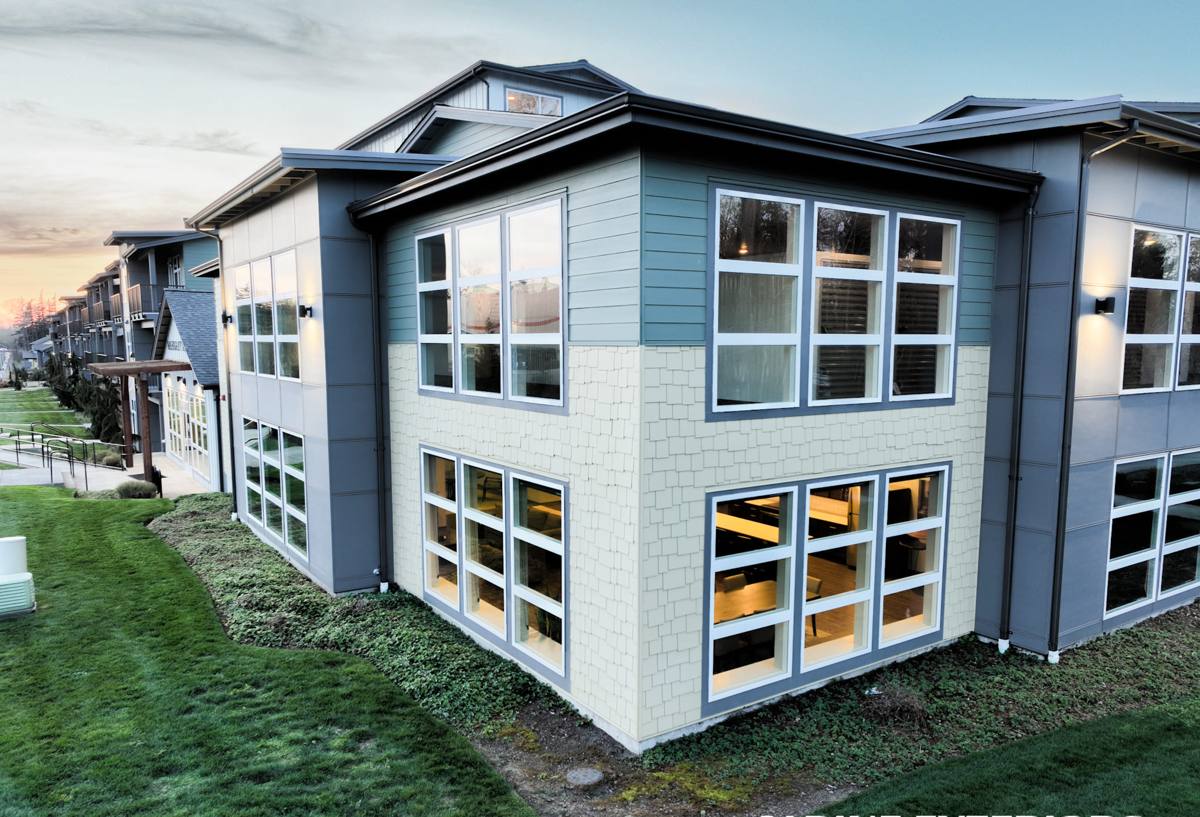
What Salt Air and Driving Rain Do to Different Siding Materials
Not every siding material responds to Blaine's climate the same way. Here's how the common options actually hold up under salt exposure, wind-driven rain, and sustained moss pressure:
| Material | Salt air response | Driving rain / moisture | Moss & algae resistance |
|---|---|---|---|
| Vinyl siding | Doesn't corrode, but can fade, chalk, and become brittle faster near salt air and UV combined | Panels can warp or bow at seams; water gets behind panels with no real drainage plane | Smooth vinyl sheds surface growth okay, but seams and J-channels trap organic debris |
| LP SmartSide (engineered wood) | Wood-based core is vulnerable at any breach in the factory seal | Edge and cut-end swelling is the known failure point if not fully sealed and maintained | Wood fiber surface is more hospitable to moss than fiber cement |
| Cedar | Handles salt reasonably but silvers/degrades faster with airborne salt plus UV | Needs consistent refinishing to keep water out; end grain is a weak point | Natural wood is prime moss and mildew territory without regular treatment |
| James Hardie fiber cement | Non-organic core doesn't corrode or rot from salt exposure | Engineered for wet climates (HZ5 zone); factory-sealed edges resist moisture intrusion | Dense cement composition and ColorPlus finish resist moss/algae far better than wood-based products |
The pattern across every alternative is the same: they can work, but they all depend on ongoing maintenance to stay ahead of moisture. In a spot like Blaine, where the moisture pressure is close to constant, that maintenance window shrinks and the consequences of skipping it show up faster.
Why We Install Only James Hardie in Blaine
We don't install vinyl, LP SmartSide, Cemplank, Allura, primed spruce, or cedar. That's not a marketing line — it's a standard we hold on every job, including waterfront properties in Blaine where the climate has the least tolerance for a material that underperforms. James Hardie fiber cement is non-combustible, dimensionally stable, and manufactured specifically for regional moisture conditions through its HZ product line. When we tell a Blaine homeowner what their siding needs to survive here, we're recommending the same product we're willing to put our own labor and warranty behind.
That said, we're not going to pretend other materials are worthless. Vinyl is inexpensive and low-maintenance in mild climates. Cedar looks great and plenty of people love the natural finish. LP SmartSide is a legitimate engineered wood product with real fans. Our objection isn't that these products are bad — it's that in a salt-air, high-moisture environment like Blaine's, they demand a level of ongoing upkeep and carry a failure risk at seams and cut ends that we're not willing to install and stand behind. Hardie's fiber cement composition sidesteps that specific weakness, which is exactly the weakness this climate exploits.
The James Hardie Product Lines That Fit Blaine Homes
James Hardie builds its siding to different regional specifications, and Blaine falls solidly into the HZ5 climate zone — engineered for the freeze-thaw cycles, sustained moisture, and coastal exposure common to the Pacific Northwest. A few product options come up most often on Blaine projects:
- HardiePlank lap siding — the standard horizontal lap look, available in several exposure widths and textures (smooth, cedarmill), and the most common choice for full re-sides.
- HardiePanel vertical siding — often used for board-and-batten accents, gable ends, or a modern mixed-material look paired with lap siding.
- HardieTrim — matched trim boards for corners, window and door surrounds, and fascia, so the whole exterior envelope resists moisture the same way, not just the field siding.
- ColorPlus Technology finish — a factory-applied, baked-on finish that resists fading and chipping far better than field-applied paint, which matters on a home getting constant salt and UV exposure with no wind break.
The specific line and profile we recommend depends on the home's exposure — a wall facing open water toward the bay gets treated differently in our detailing than a sheltered wall on the lee side of the house, even though both use the same Hardie product.
What a Correct Installation Involves
James Hardie siding performs the way it's rated to perform only when it's installed to spec. A large share of the "fiber cement failures" people hear about trace back to installation shortcuts, not the material itself. In a climate like Blaine's, those shortcuts show up faster because there's less margin for error. A correct install includes:
- Proper water-resistive barrier and a true drainage plane behind the siding, not just house wrap stapled flat against the sheathing
- Correct nailing pattern and fastener type — Hardie specifies fastener spacing and embedment, and getting it wrong affects both weather resistance and warranty coverage
- Minimum clearances at grade, roof lines, and decks so siding isn't sitting in standing water or constant splash-back
- Sealed and primed cut ends on every field cut, since factory-sealed edges are only protected until the installer cuts the board
- Correctly flashed and caulked penetrations — windows, doors, hose bibs, vents — since these are the most common entry points for wind-driven rain
- Proper joint treatment at butt seams and panel edges, following Hardie's specified gaps and sealants rather than closing them up tight
Any one of these done wrong can undercut an otherwise good siding product. That's why "we install James Hardie" and "we install James Hardie correctly for this climate" aren't the same claim, and why the installer matters as much as the material.
Our Process From Estimate to Finished Job
When we look at a Blaine property, we start with an exterior walkthrough that pays specific attention to sides of the house exposed to prevailing wind and water, current moisture damage at trim and window returns, and how the existing siding (whatever it is) has held up so far — that tells us a lot about what the house actually needs. From there:
- We assess the sheathing and water-resistive barrier condition once old siding comes off, since Hardie siding is only as good as what's behind it
- We recommend the product line, exposure width, and finish based on the home's style and specific water/wind exposure
- We detail every penetration, corner, and transition according to Hardie's installation instructions for the HZ5 zone
- We do a final walk-through covering caulking, paint touch-up on cut edges, and clean site cleanup
We work in Blaine regularly, which means we already know which parts of town see the harshest wind-driven rain off the water and which walls tend to hold moss longest through the wet months. That local pattern recognition shapes how we detail flashing and drainage before problems ever show up — it's not something a crew coming from outside the area picks up on a single job.
Moss, Algae, and Long-Term Maintenance
Even with the right material and a correct install, Blaine's wet season means moss and algae pressure never fully goes away. The difference with properly installed Hardie siding is that maintenance stays cosmetic instead of structural. A homeowner can expect to:
- Rinse down north-facing and shaded walls periodically to keep organic growth from building up
- Watch for caulking that's shrunk or cracked at trim joints and penetrations, and have it renewed before it becomes a leak path
- Keep gutters and downspouts clear so overflow doesn't run down the siding face repeatedly in the same spot
- Trim back vegetation and landscaping that keeps a wall shaded and damp longer than it needs to be
This is routine upkeep, not repair. That's the practical payoff of choosing a material built for this climate and installing it to spec — the maintenance schedule stays manageable instead of turning into a recurring source of moisture damage.
What Affects Cost on a Blaine Job
Every re-side is priced around the specifics of the house, but a few factors consistently move the number on Blaine properties:
| Factor | Why it matters here |
|---|---|
| Sheathing condition under old siding | Waterfront exposure means a higher chance of hidden moisture damage that needs repair before new siding goes on |
| Wall exposure to wind and water | Sides facing open water often get extra flashing and drainage detailing, which adds labor |
| Product line and profile chosen | Lap width, panel vs. plank, and ColorPlus color selection all affect material cost |
| Trim and detail work | Homes with more corners, window trim, and architectural detail take longer to flash and finish correctly |
| Access and site conditions | Waterfront lots with tight access or steep grades can add setup and staging time |
We give straight, itemized estimates rather than a single vague number, so a homeowner can see what's driving the cost rather than just a bottom line.
Get an Estimate for Your Blaine Home
If your siding is showing moss buildup that won't stay gone, cracking or swelling at seams, or you're just planning ahead for a home this close to the water, we're happy to take a look. The estimate is free, there's no pressure to commit, and you'll get a straight answer about what your home's specific exposure actually calls for.