 Ferndale Siding
 A deck near Blaine takes a different beating than one twenty miles inland. This stretch of Whatcom County sits right up against the Strait of Georgia, and that proximity to salt water shapes everything about how a deck ages here — the fasteners, the framing, the finish, all of it. If you're looking at soft boards, rusted hardware, or a deck that just doesn't feel solid underfoot anymore, you're not imagining things. You're seeing what salt air, driving rain, and a long moss season do to wood and connectors over time.
We're a Ferndale-based crew, and Blaine is part of our regular service area — not a stretch job we take once and never see again. That matters more than most homeowners realize when it comes to picking a contractor for a project like this.
Why Blaine Decks Wear Out Faster Than the Manufacturer's Warranty Suggests
Most decking and hardware warranties are written assuming a fairly generic climate. Blaine's environment isn't generic. Being this close to saltwater puts a fine mist of airborne salt on every exterior surface, which accelerates corrosion on anything metal — nails, screws, joist hangers, post bases. Combine that with Whatcom County's long wet season, and you get a two-part problem: moisture that wants to sit in end grain and connection points, plus a chemical environment that eats through standard fasteners faster than the same hardware would fail in, say, Spokane.
Moss is the third piece. Shaded decks, north-facing decks, and decks under mature trees near Blaine's residential lots collect moss and algae almost year-round. Beyond the slip hazard, moss holds moisture against the deck surface constantly, which is exactly the condition that rots boards from the top down and keeps ledger boards and framing damp long after a storm has passed.
What This Looks Like in Practice
- Fasteners that show rust or staining well before the wood itself looks obviously bad
- Soft spots near the house where the deck attaches (the ledger board area)
- Persistent green or black growth on shaded sections that pressure washing only knocks back temporarily
- Railings or stair stringers that feel loose even though the boards look intact
- Gaps between boards that have closed up or warped unevenly from repeated wet-dry cycling
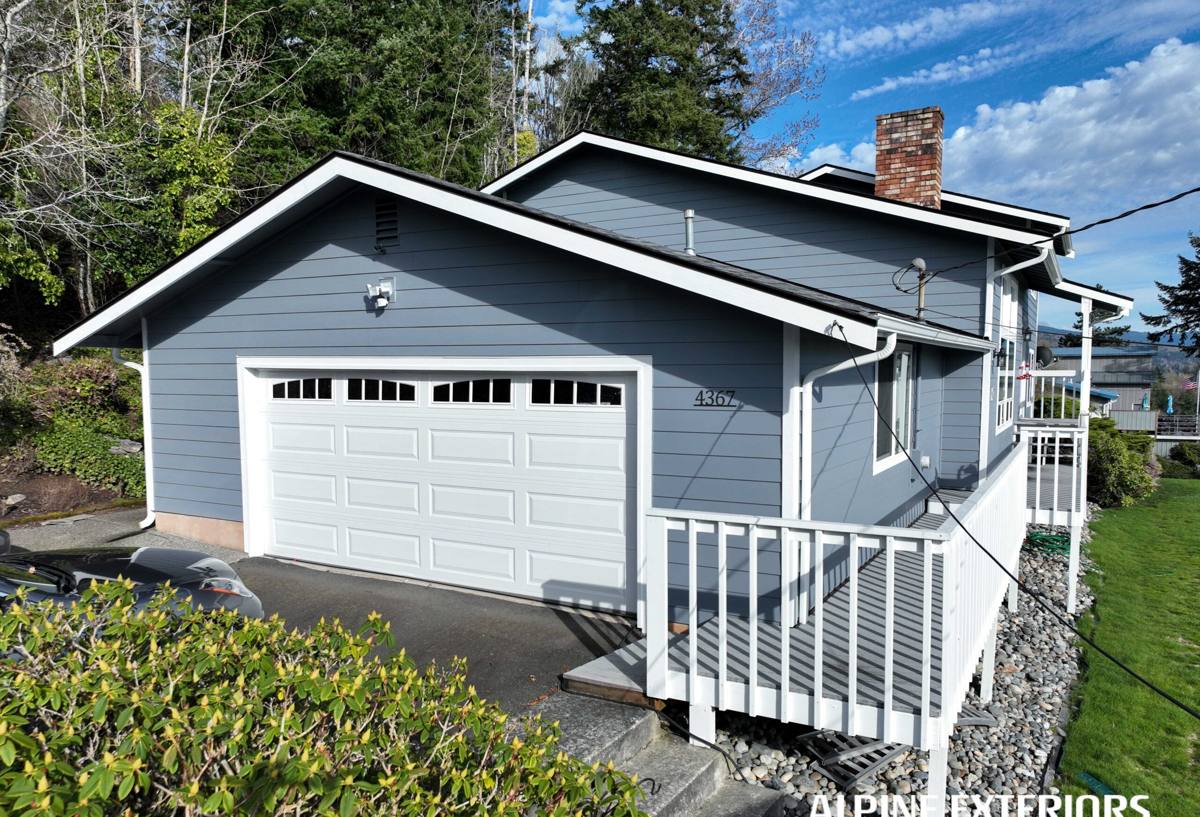
Repair or Full Replacement? How We Actually Decide
Not every tired-looking deck needs to come out entirely. We look at three things before recommending replacement: the condition of the framing and ledger connection, the age and type of the original build, and how much of the visible damage is cosmetic versus structural.
A deck with solid framing but worn or moss-stained surface boards might only need decking and railing replaced, with the substructure reused after inspection. A deck with rot at the ledger, undersized or corroded post connections, or framing that predates current code requirements for guardrails and stair geometry is usually a full replacement — patching those issues piecemeal tends to cost more over time than doing it right once.
| Condition Found | Repair Often Works | Replacement Usually Needed |
|---|---|---|
| Surface board wear, graying, minor splintering | Yes | No |
| Rust staining on visible fasteners only | Yes | No |
| Soft or spongy boards near the house | Sometimes | Often |
| Rot or corrosion at the ledger board | No | Yes |
| Undersized posts or missing structural connectors | No | Yes |
| Guardrail spacing or stair rise out of current code | No | Yes |
What a Correct Deck Replacement Involves
A deck replacement is more than pulling old boards and screwing down new ones. Done right, it starts below the surface.
Framing and Ledger Connection
The ledger board — where the deck attaches to the house — is the single most common failure point on decks in wet climates, and it's also the hardest to inspect from the surface. We check flashing at this connection carefully, because a ledger that's leaking water into the house rim joist is a much bigger problem than a worn deck board. Correct flashing detail here is non-negotiable in an area that gets this much sustained rain.
Fasteners and Hardware
Given the salt exposure in Blaine, we don't use standard hot-dip galvanized hardware as a default here — in a coastal environment it corrodes faster than the deck boards it's holding up. Stainless steel fasteners and structural connectors cost more up front, but for a project this close to saltwater, that upfront cost is what keeps the hardware from being the first thing to fail again in five or six years.
Decking Material
Homeowners in Blaine generally land on one of two paths: quality pressure-treated or cedar lumber, or composite decking. Each has real trade-offs worth understanding rather than picking based on price alone.
| Factor | Wood (Cedar/Treated) | Composite |
|---|---|---|
| Upfront cost | Lower | Higher |
| Maintenance | Periodic sealing/staining, more with moss exposure | Occasional cleaning, no sealing |
| Moss/algae resistance | Lower — porous surface holds growth | Higher, though shaded areas still need cleaning |
| Look and feel | Natural grain, warms and softens with age | Consistent color, doesn't take a natural patina |
| Long-term cost | Lower material cost, higher labor cost over time | Higher material cost, lower labor cost over time |
Neither is the "wrong" choice. It depends on how much upkeep a homeowner wants to do and how the deck sits relative to shade and moisture exposure. We'll walk through the actual site conditions with you rather than push one material as a blanket recommendation.
Guardrails, Stairs, and Code — Why This Matters on a Replacement
Older decks in this area were often built to standards that have since changed. A full replacement is the point where we bring guardrail height, baluster spacing, and stair rise/run into line with current code. This isn't paperwork for its own sake — it's the difference between a railing that actually stops a fall and one that just looks like a railing. We handle the permitting and inspection process as part of the job so this isn't something you have to chase down separately.
Our Process, Start to Finish
- On-site assessment. We look at the framing, ledger connection, and existing hardware condition, not just the surface boards, and give you a straight read on repair versus replacement.
- Written scope and estimate. You'll know what's being removed, what's being rebuilt, and what materials are involved before any work starts.
- Permitting. For most deck replacements in Whatcom County, a permit is required — we handle that submission and the associated inspections.
- Demo and framing. Old decking, and if needed, old framing, comes out. New ledger flashing and structural connections go in first, before a single deck board is placed.
- Decking, railing, and stairs. Installed per manufacturer spec if composite, or with proper spacing and fastening if wood.
- Final walkthrough and inspection. We review the finished deck with you and coordinate the final building inspection.
Why a Local Ferndale Crew Matters for a Blaine Job
A crew that only occasionally works this far north treats Blaine's salt exposure and moss season as an afterthought — same materials, same fastener specs they'd use anywhere else in the state. We work this corridor regularly, so the coastal-grade hardware, the flashing detail at the ledger, and the material trade-offs above aren't things we're relearning on your project. They're just how we build decks up here.
Being local also means we're not disappearing after the final payment clears. If a question comes up two years down the road about how a section is holding up, you're calling a crew that's still working in the neighborhood, not chasing down a company that did one job in Blaine and moved on.
Before You Call Anyone: A Quick Checklist
- Note where the deck feels soft or bouncy, and whether that's near the house or out at the edges
- Check for rust staining around visible screws or bolts
- Look underneath if you can access it — daylight through gaps at the ledger, or visible water staining on the rim joist, is worth mentioning to whoever assesses it
- Note any shaded or north-facing sections that stay damp or mossy longer than the rest of the deck
- Think about how the deck is actually used — dining, grilling, hot tub weight load — since that affects framing requirements on a rebuild
If your deck is showing its age, we're happy to take a look and give you a straight, no-pressure assessment of what it actually needs — repair, partial rebuild, or full replacement. Use the form below to request a free estimate, and we'll get back to you to schedule a time to come out.