 Ferndale Siding
 Decks Near Lummi Nation Take a Different Kind of Beating
Homes around Lummi Nation sit close to the water, and that changes what a deck has to survive. You're not just dealing with Pacific Northwest rain here — you're dealing with salt-laden air coming off Bellingham Bay and the Strait of Georgia, near-constant humidity, and long stretches of low winter sun that never quite dry things out. That combination is harder on wood, fasteners, and hardware than what a deck fifteen miles inland has to deal with.
Salt air accelerates corrosion in anything metal — nails, screws, joist hangers, post bases. Once those start to go, the deck's structure is compromised even if the decking boards on top still look fine. Add in driving rain that gets pushed sideways by wind off the water, and you get moisture intrusion at ledger boards, stair stringers, and railing posts that a drier inland deck would rarely see. Then there's moss season, which around here isn't really a season at all — it's most of the year. Moss holds moisture against wood and finishes far longer than a dry surface would, and it turns decking into a slip hazard on top of a rot hazard.
We work on decks throughout Whatcom County, but the ones near Lummi Nation and the surrounding waterfront areas get inspected and repaired with that salt-air, high-moisture reality specifically in mind — not treated like a generic inland deck job.
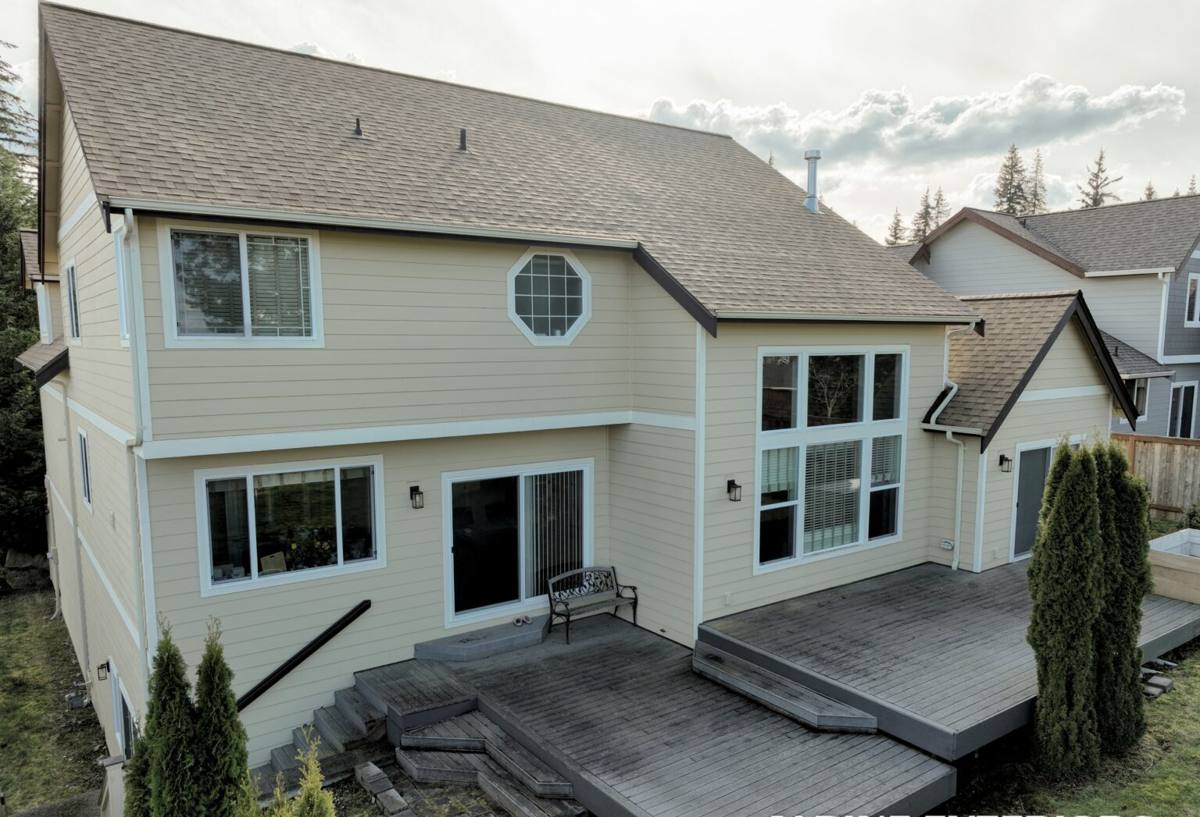
Signs a Lummi Nation Deck Needs Repair
Most deck failures don't happen all at once. They start small and get ignored because the deck still "feels fine" to walk on. Here's what we tell homeowners in this area to watch for:
- Soft or spongy spots underfoot, especially near the house or at stair landings
- Rust streaks running down from screws, nails, or metal connectors
- Gaps opening up where the deck meets the house (a sign the ledger board is pulling away)
- Railing posts that wiggle or flex when you lean on them
- Persistent green or black moss growth that doesn't fully dry out between rains
- Boards that have cupped, split, or feel noticeably lighter/spongier than the boards around them
- Visible daylight or gaps at flashing where the deck ledger attaches to the house
Any one of these on its own might just mean a spot repair. Several at once, especially combined with a deck that's more than 12-15 years old, usually means it's worth a full structural look before we talk about what to fix.
What a Correct Deck Repair Actually Involves
It Starts Below the Boards, Not On Top of Them
A lot of deck "repairs" are really just cosmetic — replace the obviously bad boards, call it done. That's a mistake on a deck exposed to salt air and heavy rain, because the framing underneath is usually where the real damage is happening. We check ledger board attachment and flashing first, since that's the single most common point of structural failure on older decks in wet coastal climates. If water has been getting behind the ledger for years, no amount of new decking on top fixes the actual problem.
Fasteners and Hardware Matter More Here
Standard galvanized fasteners corrode faster in salt air than most homeowners expect. When we replace hardware on a deck near Lummi Nation, we're specifying stainless steel or coated fasteners rated for coastal/marine exposure, not whatever's cheapest at the hardware store. It costs a little more up front and saves you from redoing the same repair in five years.
Structural Checks We Don't Skip
A proper repair includes checking post bases for rot at ground contact, joist hangers for rust-through, beam and joist spans for sagging, and stair stringers for cracking or soft spots. We also check the grade and drainage around the deck footings — standing water at the base of a post is a slow-motion structural problem in this climate.
Repair or Replace? What Actually Drives That Decision
Homeowners near the water often ask whether it's worth repairing an older deck at all. The honest answer depends on where the damage is, not just how much of it there is.
| Factor | Usually Repairable | Usually Needs Replacement |
|---|---|---|
| Structural framing (joists, beams) | Isolated rot at one or two members | Widespread rot or rust across the frame |
| Ledger board attachment | Flashing failure caught early | Long-term water intrusion into the rim joist/wall |
| Decking boards | Scattered cupped or split boards | Most boards spongy or failing at once |
| Posts and footings | Surface rot above grade | Rot at or below grade, undersized footings |
| Age of the deck | Under ~15 years, built to code | 20+ years, outdated construction methods |
| Cost to repair vs. rebuild | Repair under roughly 40% of rebuild cost | Repair approaching rebuild cost |
We'll always tell you honestly if a repair is a band-aid on a deck that's structurally past its useful life. There's no upside to us patching something that's going to need a full rebuild in two years anyway — that just costs you twice.
Decking Material Choices for This Climate
Wood Decking
Pressure-treated wood and cedar both work here, but both need real maintenance in a salt-air, high-moisture environment — annual or biennial cleaning, moss treatment, and resealing. Skip that maintenance for a few years and a wood deck near the water ages faster than one fifteen miles inland. We're honest with clients about this trade-off: wood costs less up front but asks more of you over time.
Composite Decking
Composite boards resist moisture absorption and don't rot, which is a real advantage in a moss-heavy, high-rain area. The trade-off is that composite still needs periodic cleaning to keep moss and mildew from staining the surface, and not all composite products handle ground-level humidity or poor airflow underneath equally well. We install composite when a client wants lower long-term maintenance, but we're upfront that "low maintenance" doesn't mean "no maintenance" here.
Framing Material
Regardless of what decking goes on top, we treat the framing as the part that has to last longest and see the least attention. Pressure-treated framing lumber, properly flashed and fastened with corrosion-resistant hardware, is the baseline we won't compromise on for a repair near the water.
Our Deck Repair Process
- Inspection — We check the deck from the framing up: posts, footings, ledger, joists, hardware, and surface boards, and we tell you plainly what we find.
- Honest scope — You get a written explanation of what needs repair now, what's worth watching, and what doesn't need touching yet. No upsell to a full rebuild if a rebuild isn't warranted.
- Structural repair first — Framing, ledger flashing, and hardware get addressed before any cosmetic work, since that's what keeps the deck safe and dry over the long run.
- Surface repair — Damaged decking, railings, and stair components get replaced or repaired to match the rest of the deck as closely as possible.
- Cleanup and walkthrough — We walk the finished repair with you and point out anything you should keep an eye on going forward.
Maintenance That Actually Extends the Life of a Coastal Deck
Repair work holds up a lot longer when it's paired with basic upkeep suited to this climate. For decks in the Lummi Nation area, that means:
- Cleaning moss and organic debris off the surface and between boards at least once or twice a year
- Keeping gutters and downspouts clear so runoff isn't dumping extra water onto or near the deck
- Checking fasteners and hardware for rust or corrosion annually, especially near the water side of the house
- Resealing or restaining wood decking on the schedule the product actually needs, not just when it looks bad
- Making sure the ledger flashing and any deck-to-house junctions stay sealed and haven't opened up after a hard winter
Why It Matters to Hire a Crew That Already Works This Area
A deck repair crew that mostly works drier, inland properties can miss things that are routine for us near Lummi Nation — the level of corrosion-resistant hardware actually needed, how much moss buildup is normal here versus a sign of a drainage problem, or how aggressively driving rain off the water finds its way behind flashing that would hold up fine elsewhere in Whatcom County. We've done enough of this work along the water to know what fails first in this environment and to build the repair around that, not around a generic checklist.
We're also familiar with the practical side of working in and around the Lummi Nation community — showing up when we say we will, respecting the property and the neighborhood, and communicating clearly about scope and timeline before work starts, not after.
Get a Straightforward Deck Assessment
If your deck near Lummi Nation is showing soft spots, rust, or moss that won't quit, it's worth having someone look at it before those small problems become structural ones. We offer free, no-pressure estimates — we'll tell you honestly what needs repair, what can wait, and what a fix actually involves. Fill out the form below to get started.